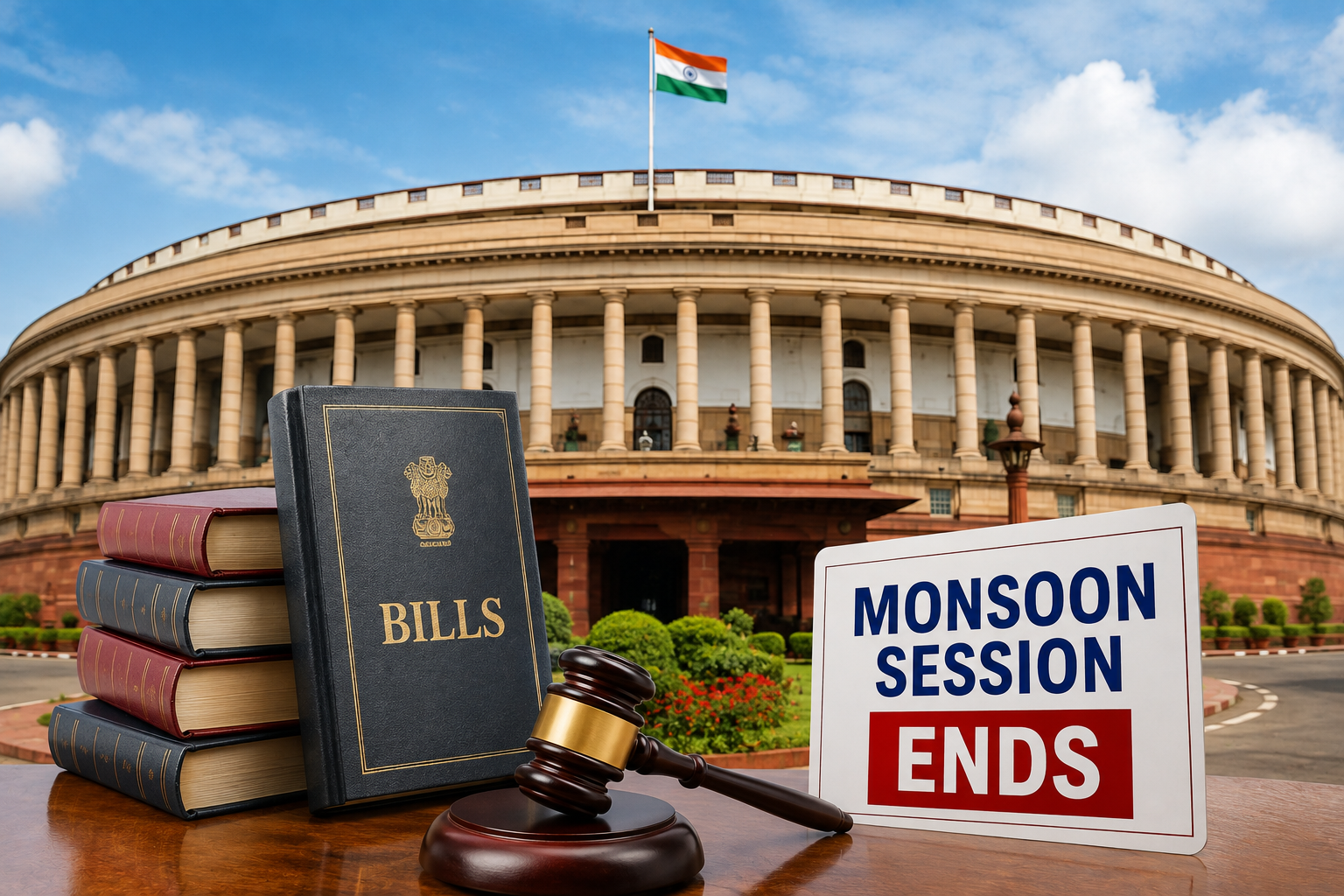
19-Sitting Session Concludes With Legislative Push on Examinations, MSMEs, Taxation, Mining and National Honour; NEET-UG Row Remains Major Political Flashpoint
The Monsoon Session of Parliament concluded on Thursday, August 13, 2026, with both the Lok Sabha and Rajya Sabha being adjourned sine die after a session marked by legislative activity as well as repeated disruptions.
The session, which began on July 20, was scheduled for 19 sittings. During the period, the government introduced 12 Bills, of which 11 were passed by both Houses, while the Indian Statistical Institute Bill, 2026 remained pending.
The session witnessed heated exchanges between the government and Opposition, with the NEET-UG controversy, alleged police action against protesters and other political issues dominating several proceedings.
Lok Sabha Concludes With Vande Mataram
The final sitting of the Lok Sabha began with the playing of Vande Mataram.
Prime Minister Narendra Modi, Congress MP Rahul Gandhi and other members were present in the House during the National Song.
Six stanzas of Vande Mataram were played before Lok Sabha Speaker Om Birla adjourned the House sine die, formally bringing the Lower House's proceedings to an end.
The conclusion of the session also came shortly after Parliament passed legislation providing legal protection to the National Song through amendments to the Prevention of Insults to National Honour Act.
Rajya Sabha Also Adjourned Sine Die
The Rajya Sabha concluded its proceedings later on Thursday.
The Upper House took up the Mines and Minerals (Development and Regulation) Amendment Bill, 2026, which was passed by voice vote.
The House departed from its regular pre-lunch schedule on the final day and did not take up the usual Question Hour and Zero Hour.
Chairman CP Radhakrishnan subsequently highlighted the functioning of the House during the session before adjourning the Rajya Sabha sine die.
Session Began Amid NEET-UG Protests
The Monsoon Session opened against the backdrop of protests over alleged irregularities in the NEET-UG examination.
Opposition parties demanded a detailed discussion on the issue and sought accountability from the government.
The controversy remained one of the most prominent political issues throughout the session, with Opposition members repeatedly raising concerns over examination integrity and the impact of alleged irregularities on students.
Opposition Demanded Action Over Examination Row
Opposition parties sought accountability from the government and demanded action over alleged irregularities connected with the examination.
The issue also spilled beyond Parliament, with protests organised by political parties and student groups.
The government maintained that it was prepared to discuss the matter but opposed attempts to impose conditions that could prevent Parliament from functioning.
The disagreement contributed to repeated disruptions during the session.
Protests Outside Parliament Added to Political Tensions
The political confrontation was not restricted to proceedings inside Parliament.
Opposition parties and student groups organised protests, including the July 20 ‘Sansad Chalo’ march, while demands were also raised over alleged police action against protesters at Jantar Mantar.
The Opposition sought a statement from Union Home Minister Amit Shah regarding the alleged police action.
These developments contributed to the charged political atmosphere surrounding the session.
Government Introduces 12 Bills, 11 Become Law-Making Measures
Despite the disruptions, the government progressed with its legislative agenda.
A total of 12 Bills were introduced, with 11 subsequently cleared by both Houses.
The legislation covered a wide range of subjects, including:
- Public examination reforms
- National honour
- Birth and death registration
- Supreme Court strength
- MSMEs
- Taxation
- Banking records
- Tribunals
- State nomenclature
- Cooperative development
- Mining and minerals
The breadth of the legislative agenda made the session significant from a policy perspective.
Public Examinations Amendment Bill Takes Centre Stage
One of the most important pieces of legislation passed during the session was the Public Examinations (Prevention of Unfair Means) Amendment Bill, 2026.
The legislation was introduced against the backdrop of the NEET-UG controversy and seeks to strengthen the framework for dealing with unfair practices in public examinations.
The Bill received considerable attention in both Houses, with debates extending over several hours.
The legislation is aimed at creating stronger deterrence against examination-related malpractice and organised attempts to undermine the integrity of competitive examinations.
Focus on Stronger Action Against Examination Fraud
The amendments seek to strengthen penalties and enforcement mechanisms related to unfair means in public examinations.
The move comes at a time when examination security has become a major public concern, particularly because competitive examinations determine access to higher education and government employment opportunities.
The legislation reflects the government's attempt to strengthen institutional safeguards and impose greater accountability for organised examination-related wrongdoing.
Vande Mataram Amendment Bill Passed
Parliament also passed the Prevention of Insults to National Honour (Amendment) Bill, 2026.
The legislation provides legal protection to the National Song, Vande Mataram, through amendments to the existing legal framework dealing with national symbols.
The legislation became particularly prominent during the final sitting of the Lok Sabha, when Vande Mataram was played before the House was adjourned.
The measure has both legal and symbolic significance and was among the prominent Bills cleared during the session.
MSME Amendment Bill Passed
The Micro, Small and Medium Enterprises Development (Amendment) Bill, 2026 was another significant piece of economic legislation passed during the session.
MSMEs are an important component of India's economy and play a major role in employment, manufacturing, exports and regional economic activity.
The amendments focus on improving aspects of the MSME framework, including mechanisms dealing with delayed payments and the functioning of facilitation institutions.
Delayed payments have historically been a major working-capital challenge for smaller businesses, making the issue particularly important for the sector.
Taxation and Other Laws Amendment Bill Cleared
Parliament also passed the Taxation and Other Laws (Amendment) Bill, 2026.
Tax-related legislation can have implications for businesses, taxpayers and the government's revenue administration.
The passage of the Bill forms part of the broader legislative effort to modify and update provisions across India's taxation framework.
Mining Legislation Passed on Final Day
The Mines and Minerals (Development and Regulation) Amendment Bill, 2026 was among the final pieces of legislation cleared during the session.
The Bill was taken up by the Rajya Sabha on Thursday and passed by voice vote.
The mining sector remains strategically important for India's industrial economy because mineral availability affects industries including:
- Steel
- Cement
- Infrastructure
- Construction
- Power
- Manufacturing
- Metals
Changes to the mining framework can therefore have implications extending beyond the mining industry itself.
Supreme Court Judge Strength Increased
Parliament also passed the Supreme Court (Number of Judges) Amendment Bill, 2026.
The legislation addresses the sanctioned strength of judges in the country's highest court.
Increasing judicial capacity is intended to help the Supreme Court manage its workload and strengthen its ability to deal with pending cases.
The measure forms part of the broader effort to improve judicial capacity and efficiency.
Registration of Births and Deaths Amendment Bill
Another Bill passed during the session was the Registration of Births and Deaths (Amendment) Bill, 2026.
The legislation seeks to modify the legal framework governing the registration of births and deaths.
Accurate civil registration is important for government records, public administration and delivery of welfare and other public services.
Bankers' Books Evidence Bill Passed
Parliament also cleared the Bankers' Books Evidence Bill, 2026.
The legislation deals with the legal treatment and evidentiary value of banking records.
As India's financial system becomes increasingly digital, the legal framework surrounding financial records and documentation remains an important area of regulation.
Tribunals Reforms Bill Among Measures Cleared
The Tribunals Reforms Bill, 2026 was also passed during the session.
Tribunals play an important role in resolving specialised disputes across areas such as taxation, corporate matters and other regulatory issues.
Reforms in this area can have implications for the speed and efficiency of dispute resolution.
Kerala Name Change Bill Passed
Parliament also passed the Kerala (Alteration of Name) Bill, 2026.
The legislation deals with the formal alteration of the state's name within the relevant legal framework.
Such measures require parliamentary approval because the official names of states are governed by constitutional and statutory provisions.
Cooperative Development Legislation Cleared
The National Co-operative Development Corporation (Amendment) Bill, 2026 was among the other measures passed by both Houses.
The legislation relates to the functioning and development framework surrounding cooperative institutions.
Cooperatives remain significant in India's rural economy, agriculture, credit, dairy and other sectors.
Indian Statistical Institute Bill Remains Pending
While 11 Bills were passed by both Houses, the Indian Statistical Institute Bill, 2026 was not cleared during the session.
The pending legislation will therefore have to await consideration in a future parliamentary session.
Its status highlights the difference between the government's proposed legislative agenda and the measures that ultimately receive parliamentary approval.
Opposition and Government Remain Divided
Repeated disruptions during the Monsoon Session reflected continuing differences between the government and Opposition.
The Opposition sought discussions on issues including NEET-UG irregularities and alleged police action against protesters.
The government, meanwhile, maintained that legislative and parliamentary business should proceed without preconditions that could prevent the functioning of the Houses.
The disagreement resulted in several interruptions and adjournments.
Parliamentary Productivity Remains a Key Question
The session once again raised questions about the balance between legislative productivity and parliamentary debate.
While the passage of 11 Bills represents substantial legislative output, repeated disruptions reduced the uninterrupted time available for discussions.
For Parliament, the challenge remains to ensure that important legislation receives adequate scrutiny while also allowing Opposition parties to raise matters of public concern.
Major Bills Passed During the Session
| Bill | Broad area |
|---|---|
| Public Examinations (Prevention of Unfair Means) Amendment Bill, 2026 | Examination integrity |
| Prevention of Insults to National Honour (Amendment) Bill, 2026 | National symbols |
| Registration of Births and Deaths (Amendment) Bill, 2026 | Civil registration |
| Supreme Court (Number of Judges) Amendment Bill, 2026 | Judicial capacity |
| MSME Development (Amendment) Bill, 2026 | Small businesses |
| Taxation and Other Laws (Amendment) Bill, 2026 | Taxation |
| Bankers' Books Evidence Bill, 2026 | Banking records |
| Tribunals Reforms Bill, 2026 | Dispute resolution |
| Kerala (Alteration of Name) Bill, 2026 | State administration |
| NCDC (Amendment) Bill, 2026 | Cooperatives |
| Mines and Minerals (Development and Regulation) Amendment Bill, 2026 | Mining |
Economic Significance of the Legislative Agenda
Several Bills passed during the session have implications for India's economic environment.
The MSME legislation is relevant to small businesses and their working-capital challenges, while mining reforms could affect the availability and development of mineral resources.
Taxation-related changes may influence businesses and government revenue administration, while banking and tribunal reforms could affect financial-sector processes and dispute resolution.
The combined impact will depend largely on the implementation of the legislation and subsequent rules.
Session Ends With Legislative Achievements and Political Friction
The Monsoon Session ended with a clear contrast between legislative progress and political confrontation.
The government succeeded in passing 11 Bills through both Houses, covering areas ranging from examination reforms and national honour to MSMEs, taxation and mining.
At the same time, repeated disruptions over the NEET-UG controversy and other Opposition demands prevented the session from becoming a completely smooth legislative exercise.
The conclusion of the session now shifts attention towards implementation of the legislation already passed and the political issues that remain unresolved.
Key Takeaways
- Monsoon Session: July 20 to August 13, 2026
- Scheduled sittings: 19
- Bills introduced: 12
- Bills passed by both Houses: 11
- Pending Bill: Indian Statistical Institute Bill, 2026
- Major political issue: NEET-UG controversy
- Key economic legislation: MSME, taxation and mining-related Bills
- Final-day legislation: Mines and Minerals (Development and Regulation) Amendment Bill, 2026
- Lok Sabha: Adjourned sine die after Vande Mataram was played
- Rajya Sabha: Adjourned sine die after passing the mining amendment Bill
Conclusion
The Monsoon Session of Parliament concluded on August 13 after nearly four weeks of legislative and political activity. Although repeated disruptions over the NEET-UG controversy and other issues affected proceedings, the government succeeded in securing passage of 11 Bills through both Houses.
The legislation covers several important areas of public policy, including examination integrity, MSMEs, taxation, banking, judicial administration, cooperatives and mining.
The session also witnessed the passage of the amendment relating to Vande Mataram, giving the National Song additional statutory protection, while the final sitting itself began with the playing of the song.
With Parliament now adjourned sine die, attention will shift towards the implementation of the newly passed laws and the issues that remain pending for the next session. The political debate over examination reforms, parliamentary functioning and government accountability is also likely to continue beyond the Monsoon Session.