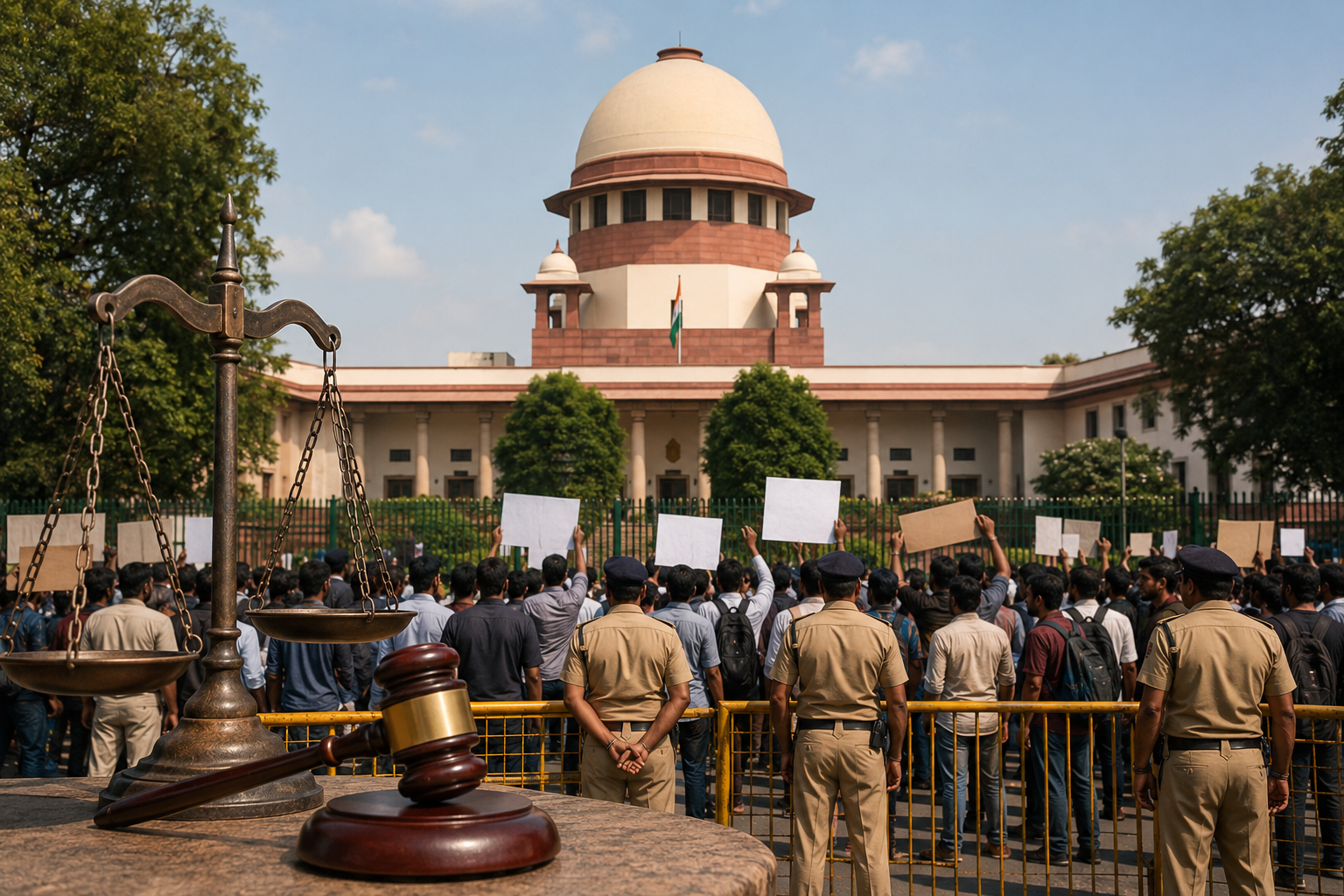
Bench to examine concerns over public access, movement and disruption of essential services during demonstrations
The Supreme Court on Wednesday agreed to hear a plea raising concerns over the disruption of essential services and public movement during protests. The matter brings into focus the difficult balance between the constitutional right to peaceful protest and the need to ensure that essential public services and ordinary civic life are not adversely affected.
A bench comprising Chief Justice Surya Kant and Justices Joymalya Bagchi and V Mohana was told by the counsel for the petitioner that protests can lead to disruption of essential services, while movement into and out of affected areas can also be severely restricted. The Court has directed that the plea be considered alongside another pending matter concerning the suitability of Jantar Mantar in Delhi as a venue for protests.
Petition Raises Concern Over Disruption of Essential Services
During the hearing, the petitioner's counsel submitted that when protests take place, it can become difficult to distinguish between demonstrators and members of the general public. According to the submission, this creates practical challenges for authorities trying to maintain the movement of people and essential services.
The counsel highlighted concerns relating to ingress and egress, referring to the movement of people and vehicles into and out of affected areas. The issue, the petitioner argued, is not limited to a particular location and is increasingly being witnessed across the country.
The bench acknowledged the concern but also raised the question of how a judicial direction could practically address the problem while accounting for the different circumstances surrounding protests.
Supreme Court Links Plea With Jantar Mantar Case
The Court has tagged the fresh plea with a separate pending petition concerning protests at Jantar Mantar in New Delhi.
The earlier petition argues that Jantar Mantar may no longer be an appropriate location for large demonstrations because protests in the area can inconvenience residents and interfere with essential goods and medical services. The Supreme Court had agreed on August 3 to examine the issue and sought consideration of an alternative arrangement for demonstrations.
The linkage of the two matters indicates that the Court may examine the broader question of how designated protest venues should function in densely populated urban areas while protecting public access and essential services.
Balancing Right to Protest With Public Convenience
The proceedings also raise a wider constitutional and administrative question: how can authorities protect the right to peaceful protest while preventing demonstrations from causing disproportionate disruption to the wider public?
Peaceful protest is an important part of democratic participation. At the same time, large gatherings in busy urban areas can create challenges for traffic movement, emergency access, healthcare services, public transport and the daily activities of residents.
The Supreme Court has recently been dealing with several matters concerning protests at Jantar Mantar. In July, a bench headed by CJI Surya Kant observed that peaceful and lawful protest is constitutionally protected, while also considering allegations concerning police action against protesters.
Why the Issue Matters Beyond Delhi
Although the Jantar Mantar dispute is centred on Delhi, the latest plea raises a broader national concern. Major protests can occur around government offices, highways, transport hubs, hospitals and commercial areas, potentially affecting people who are not participating in the demonstrations.
The petitioner has specifically argued that the problem of disruption of essential services during protests is arising across the country. This could make any eventual judicial observations relevant to state authorities and local administrations dealing with large public gatherings.
The challenge for authorities is to establish arrangements that allow demonstrations to take place without unnecessarily restricting access to hospitals, emergency services, public transport and other critical infrastructure.
Search for Suitable Protest Venues
The Jantar Mantar proceedings have also revived discussion over whether Delhi requires a larger or differently located venue for demonstrations.
A petition examined by the Court has sought an alternative location, arguing that the present site creates difficulties for local residents and affects essential services. The question is particularly significant for Delhi because of the concentration of government offices, residential areas, commercial establishments and important public infrastructure in central parts of the city.
A suitable protest venue could potentially provide dedicated space for demonstrations while reducing the impact on surrounding neighbourhoods and essential public activity. However, determining such a location would also require consideration of accessibility, security, crowd management and the practical ability of citizens to reach the venue.
Administrative Challenge for Authorities
The latest proceedings could place greater focus on the responsibility of authorities to plan for large demonstrations.
Effective crowd management may require advance coordination between police, civic authorities, healthcare services and transport agencies. Authorities may also need contingency arrangements to ensure that emergency vehicles and essential services continue to operate even when large gatherings take place.
At the same time, restrictions on demonstrations would need to be carefully structured so that measures intended to protect public convenience do not unnecessarily interfere with lawful and peaceful expression.
What the Supreme Court May Examine
The Court's consideration of the matter could eventually address several practical questions, including how authorities should protect essential services during protests, whether designated venues require changes and what safeguards can be used to maintain public access.
The Court has not, at this stage, issued a final ruling on the broader issue. The decision to hear the plea and tag it with the Jantar Mantar matter means that the legal questions will now be considered in the context of the pending proceedings.
The outcome could have implications for how large demonstrations are managed in major cities, particularly where protest sites are located close to residential neighbourhoods, hospitals, government establishments and major transport routes.
Market Outlook
While the matter is primarily constitutional and administrative in nature, its broader significance lies in the functioning of essential public infrastructure and urban services. Any future directions on protest management could influence how authorities plan public gatherings, traffic management and access to critical services.
For businesses and the wider economy, uninterrupted movement of people, goods and essential services remains important. The Supreme Court's eventual observations could therefore be relevant not only to the rights of protesters and residents but also to the smooth functioning of commercial and public activity in major urban centres.