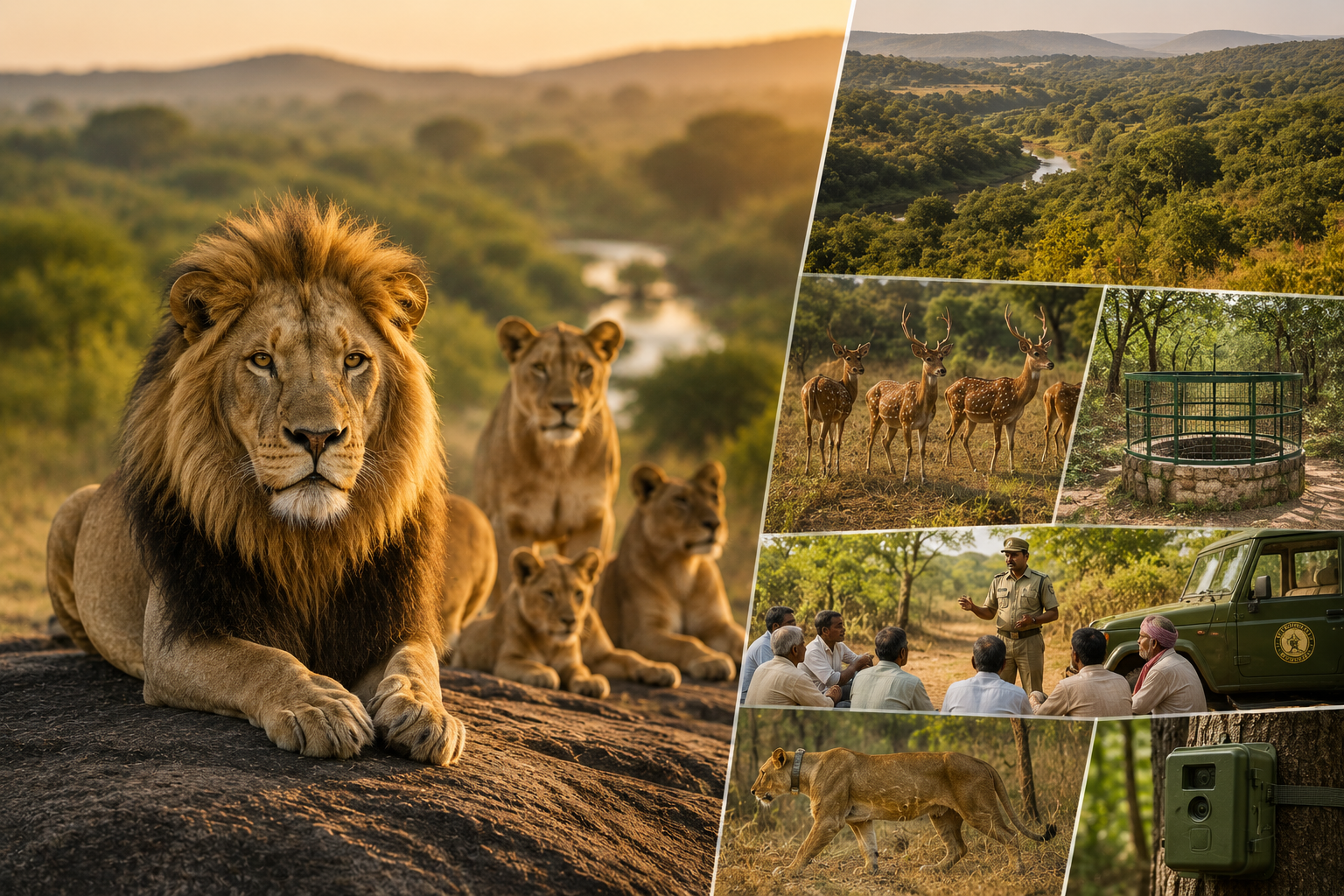
A 70% population increase in a decade highlights the impact of habitat protection, prey restoration, scientific monitoring and community-led conservation across Gujarat
India's Asiatic lion population has reached 891 in 2025, marking a remarkable recovery for a species that was once pushed to the brink of extinction.
The population has risen from 523 in 2015 to 891 in 2025, representing an increase of more than 70% in a decade. Compared with the 674 lions recorded in 2020, the latest estimate represents a further 32% increase.
The 16th Asiatic Lion Population Estimation, conducted in May 2025, recorded the animals across the Greater Gir landscape in Gujarat.
The recovery is the result of decades of conservation measures involving strict legal protection, habitat management, improvement in the natural prey base, scientific monitoring and increasing participation from communities living alongside the lion landscape.
Asiatic Lion Population Has More Than Recovered From Its Historic Low
The Asiatic lion's recovery is particularly significant because the species faced an extremely precarious situation in the early 20th century.
Only around 40-60 lions were estimated to remain in and around Gir during that period.
Unregulated hunting, habitat degradation and the depletion of natural prey had severely reduced the population.
The establishment of the Gir Wildlife Sanctuary in 1965 created a formal institutional framework for protecting the remaining population.
Over subsequent decades, conservation authorities expanded protected habitats and strengthened measures to control hunting, improve prey availability and reduce human-wildlife conflict.
The result has been a long-term recovery in both population and geographical range.
2015-2025: A Decade of Strong Population Growth
The population trajectory illustrates the scale of the recovery.
| Year | Estimated Asiatic Lion Population |
|---|---|
| 2015 | 523 |
| 2020 | 674 |
| 2025 | 891 |
The increase from 523 to 891 means the population has added 368 lions in ten years.
The growth between 2020 and 2025 has also been substantial, demonstrating that the recovery has continued even after the population crossed earlier milestones.
This sustained growth makes habitat management increasingly important because a larger population places greater demands on food, water and territory.
Greater Gir Landscape Becomes the Core of Conservation
The Greater Gir landscape has evolved into the principal stronghold of the Asiatic lion.
Instead of limiting conservation efforts to the core protected forest, authorities have increasingly adopted a landscape-level approach.
This recognises that lions naturally move across forests, agricultural land, grasslands and other surrounding habitats.
The approach therefore focuses on managing the broader ecosystem in which lions and people coexist.
Lion Range Expands to Nearly 35,000 Sq Km
The geographical range of the Asiatic lion has expanded dramatically.
The estimated range increased from approximately 30,000 sq km in 2020 to nearly 35,000 sq km, spread across 11 districts.
The contrast with 1990 is even more significant, when the lion range was estimated at only around 6,600 sq km.
The expansion means that conservation planning increasingly has to account for wildlife movement outside traditional protected areas.
Natural Return to Barda Marks a Major Milestone
The return of Asiatic lions to Barda Wildlife Sanctuary is among the clearest examples of natural range expansion.
The species had disappeared from the area during the 19th century.
Lions naturally returned to Barda in 2023, and by 2025 the sanctuary had recorded 17 lions.
The development demonstrates that suitable habitat and prey availability can allow the species to recolonise areas that formed part of its historical range.
Barda could consequently become increasingly important in managing the growing lion population.
Why Multiple Lion Habitats Matter
A single concentrated population can expose a species to systemic risks.
A disease outbreak, environmental event or sudden decline in prey could affect a large proportion of the population if animals are concentrated in one location.
Multiple viable habitats provide an additional layer of resilience.
Dispersed populations can also reduce pressure on individual ecosystems.
For the Asiatic lion, therefore, the expansion from Gir into surrounding landscapes is not simply about increasing geographical territory. It is also a strategy for improving the long-term resilience of the species.
Natural Prey Now Accounts for 74% of the Diet
One of the most important conservation gains has been the recovery of the lion's natural prey base.
According to the government, wild prey including spotted deer, sambar, nilgai and wild pig now account for approximately 74% of the lions' diet.
In 1974, wild prey accounted for only around 26%.
The shift is significant for several reasons.
A stronger natural prey base supports healthier wildlife populations, reduces dependence on livestock and strengthens the ecological balance of the landscape.
Prey Recovery Reduces Pressure on Communities
When natural prey is insufficient, predators can increasingly come into contact with livestock.
This creates economic losses for farmers and pastoral communities and can increase negative perceptions towards wildlife.
Restoring populations of deer, nilgai, wild pig and other prey therefore has benefits beyond the lions themselves.
It can reduce the frequency with which lions depend on livestock and potentially lower the intensity of human-wildlife conflict.
Community Participation Is Central to Long-Term Success
The recovery of the Asiatic lion cannot be attributed to protected forests alone.
The Greater Gir landscape includes villages, agricultural areas and livestock-owning communities.
Lions frequently move through landscapes where people live and work.
Consequently, conservation authorities have increasingly focused on building mechanisms that allow communities and wildlife to coexist.
More Than 55,000 Open Wells Secured
One example is the effort to secure more than 55,000 open wells across the landscape.
Unprotected wells can become deadly traps for wildlife moving through agricultural areas.
Securing these structures reduces accidental mortality and allows animals to move more safely through human-dominated landscapes.
The initiative demonstrates how relatively simple interventions can have a significant impact when implemented at scale.
Compensation Helps Maintain Local Support
Livestock attacks can impose significant financial costs on rural households.
Compensation for livestock losses can help reduce the economic burden and improve community acceptance of wildlife conservation.
Such programmes are particularly important when a protected species expands beyond the boundaries of traditional reserves.
The objective is to ensure that communities living alongside lions do not bear a disproportionate cost for conserving a national ecological asset.
Communication Helps Reduce Human-Wildlife Conflict
Initiatives such as Gir Samvad Setu are aimed at improving communication between communities and conservation authorities.
Effective communication can help authorities respond quickly when lions enter populated areas.
It can also allow residents to receive information about wildlife movement and safety measures.
The broader objective is to create a system where conflict can be addressed before it becomes a serious threat to either people or animals.
Project Lion Broadens the Conservation Framework
The launch of Project Lion in 2020 marked another important step in the conservation strategy.
The project covers approximately 60,000 sq km of Saurashtra and focuses on multiple dimensions of lion conservation.
Its priorities include:
-
Habitat improvement
-
Population monitoring
-
Disease surveillance
-
Scientific research
-
Technology-based tracking
-
Community participation
-
Conflict management
The programme reflects the changing nature of lion conservation as the population and its geographical range expand.
Technology Is Becoming Increasingly Important
Modern conservation increasingly depends on technology.
Scientific tracking can help authorities understand:
-
Where individual lions move
-
Which habitats they prefer
-
How far they travel
-
Where conflict is concentrated
-
How populations are distributed
Such information can help forest officials deploy resources more efficiently.
Technology can also assist in identifying vulnerable animals and responding to unusual movement patterns.
Disease Management Will Become More Critical
Disease is an important risk for any growing wildlife population.
As the number of lions increases, maintaining veterinary surveillance becomes increasingly important.
Monitoring animal health, identifying symptoms early and maintaining emergency response capabilities can help reduce the risk of large-scale outbreaks.
The wider movement of lions between habitats also makes coordinated disease monitoring more important.
Habitat Connectivity Is the Next Big Challenge
The expansion of the lion population has increased the importance of maintaining connectivity between habitats.
A landscape divided by roads, settlements, industrial development or other infrastructure can restrict wildlife movement.
Maintaining corridors allows lions to move between suitable habitats while reducing the risk of isolated populations.
Future conservation planning will therefore need to consider wildlife movement at the regional level.
Infrastructure Development Must Account for Wildlife Movement
Saurashtra is also an economically active region.
Roads, railways, power infrastructure, industrial projects and urban expansion can alter landscapes.
The challenge is to balance economic development with ecological requirements.
Environmental planning that identifies wildlife corridors and sensitive habitats before infrastructure is constructed can reduce future conflict.
Conservation and Tourism Are Closely Linked
The Asiatic lion has become one of Gujarat's most important wildlife tourism attractions.
Visitors travelling to the Gir region support a broad local economic ecosystem.
This includes:
-
Hotels
-
Resorts
-
Restaurants
-
Safari operators
-
Local guides
-
Transport providers
-
Handicraft businesses
-
Other tourism services
The growth of the lion population can therefore create economic opportunities alongside ecological benefits.
Eco-Tourism Can Create Local Incentives
Responsible wildlife tourism can provide communities with a direct economic incentive to protect wildlife.
If local residents benefit from tourism activity, conservation can become more closely aligned with economic development.
However, tourism must remain controlled.
Excessive vehicle movement, construction or visitor pressure can negatively affect wildlife habitats.
A sustainable tourism model will therefore be important as lion-related tourism expands.
The Economic Value of a Healthy Ecosystem
The lion is an apex predator and plays an important role within its ecosystem.
Protecting lions requires protection of forests, grasslands, water sources and prey species.
Consequently, investment in lion conservation can have broader ecological benefits.
A healthy ecosystem can support biodiversity, groundwater systems, vegetation and local livelihoods.
The conservation programme therefore has significance beyond the protection of a single species.
Why the Asiatic Lion Is Different From Other Big Cats
The Asiatic lion has a much more restricted natural range than many African lion populations.
India therefore carries a particularly important responsibility for its global survival.
The successful recovery in Gujarat demonstrates that a species with a highly restricted population can recover when habitat protection, prey management and human participation are sustained over decades.
Genetic Diversity Remains an Important Consideration
Population size is not the only measure of conservation success.
Maintaining genetic diversity is also important for the long-term health of a species.
A population that originates from a relatively small historical base can face genetic risks even after its numbers increase.
Scientific research and careful population management will therefore remain important as the Asiatic lion population grows.
Population Growth Changes the Conservation Equation
When the population was close to extinction, the primary objective was simply survival.
Today, with 891 lions recorded, the conservation challenge is different.
Authorities must increasingly balance:
-
Population growth
-
Habitat capacity
-
Prey availability
-
Disease risk
-
Genetic health
-
Community interests
-
Infrastructure development
-
Tourism
The next stage of conservation will therefore require more sophisticated landscape management.
Barda Could Reduce Pressure on the Gir Landscape
The emergence of Barda as a second lion habitat could become increasingly valuable.
A functioning secondary population can reduce the concentration of lions in the core Gir landscape.
Over time, additional suitable habitats could further distribute the population.
This would potentially create a more resilient conservation network.
The Role of Local Communities Could Become Even Larger
As the lion population expands, the number of communities interacting with wildlife may also increase.
This makes local participation increasingly important.
Future conservation strategies could focus on:
-
Faster compensation
-
Livestock protection
-
Community awareness
-
Wildlife response teams
-
Local employment
-
Eco-tourism participation
-
Conservation education
The objective should be to ensure that communities see the lion as an economic and ecological asset rather than a source of unavoidable losses.
Lessons for Other Wildlife Conservation Programmes
India's Asiatic lion recovery offers broader lessons for wildlife conservation.
The experience shows that successful conservation requires more than establishing a protected area.
It requires a combination of:
Protection + Habitat + Prey + Science + Community Participation
A similar framework could be relevant to other endangered species whose habitats overlap with human settlements.
Conservation Is Becoming a Landscape-Level Exercise
Modern wildlife conservation increasingly recognises that animals do not follow administrative boundaries.
Lions move across forests, farms and villages.
Conservation planning must therefore extend beyond protected-area boundaries.
The Greater Gir approach demonstrates how landscape-level conservation can integrate wildlife habitats with human-dominated areas.
Future Priorities for India's Asiatic Lions
The next decade could focus on strengthening the gains already achieved.
Key priorities include:
Protecting Existing Habitat
Preventing fragmentation of existing lion landscapes will remain fundamental.
Expanding Suitable Habitat
Additional areas could provide space for future population growth.
Strengthening Corridors
Connectivity between habitats can allow natural movement.
Maintaining Prey Populations
A strong prey base will reduce dependence on livestock.
Disease Surveillance
Early detection can protect the wider population.
Community Support
Compensation and participation will remain essential.
Responsible Tourism
Tourism must generate benefits without damaging habitats.
Scientific Monitoring
Regular population estimates and technology-based tracking will support evidence-based decisions.
What Could Threaten Future Progress?
The recovery story does not eliminate risks.
Potential challenges include:
-
Disease outbreaks
-
Habitat fragmentation
-
Road and rail accidents
-
Declining prey availability
-
Human-wildlife conflict
-
Unplanned tourism
-
Climate-related changes
-
Water stress
-
Infrastructure expansion
-
Genetic vulnerability
Managing these risks will determine whether the current population growth can be sustained.
A New Phase of Lion Conservation
The rise to 891 lions represents an important milestone, but it should also be viewed as the beginning of a new phase.
The conservation challenge is shifting from saving a species from extinction to managing a growing population across an expanding human-dominated landscape.
This requires greater scientific capacity, stronger community institutions and long-term planning.
The success of Gir provides a strong foundation, but the next stage will demand continued investment and careful management.
Market Outlook
India's Asiatic lion recovery is a significant conservation success, with the population rising from 523 in 2015 to 891 in 2025 and its landscape expanding substantially over the same period.
The strongest positive signal is that the recovery is being supported by several factors simultaneously. The natural prey base has improved, lion habitats have expanded, Barda has emerged as an additional habitat, and community-focused initiatives are helping reduce human-wildlife conflict.
The shift towards a diet comprising around 74% wild prey, compared with 26% in 1974, is particularly important because it reflects broader ecological improvement and can reduce dependence on livestock.
However, the next stage will be more complex. With nearly 900 lions, habitat connectivity, disease surveillance, genetic health, prey availability and coexistence with communities will become increasingly important.
The expansion of the lion range also means that infrastructure and regional development planning will need to incorporate wildlife corridors and sensitive habitats more carefully.
The long-term outlook remains positive if conservation authorities continue combining strict protection, scientific monitoring, habitat expansion, prey management and community participation.
The Asiatic lion's journey from near-extinction to 891 animals is therefore not just a population-recovery story. It is an example of how sustained conservation over decades can restore an endangered species while creating a broader framework for coexistence between wildlife, communities and economic development.