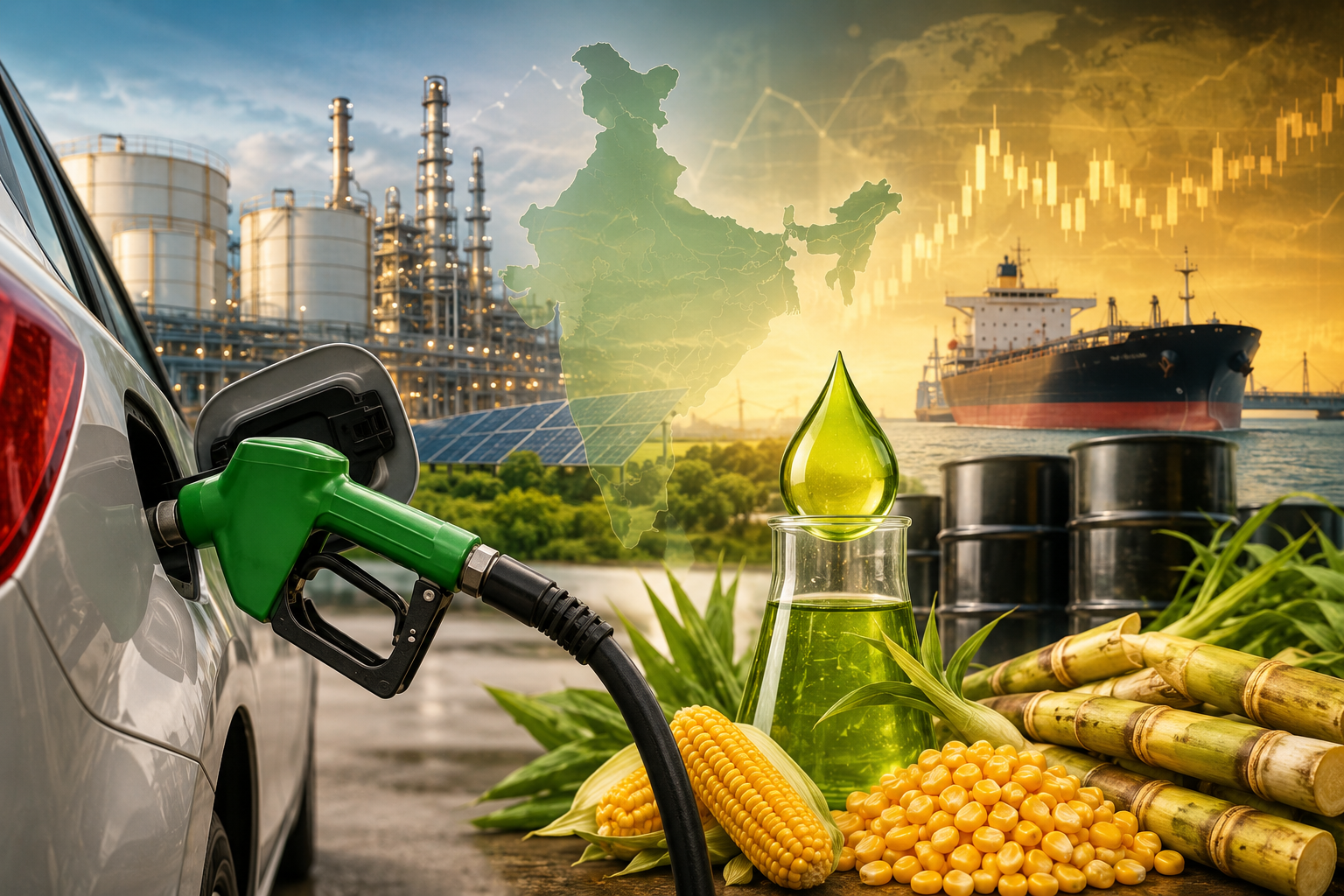
Centre Says E20 Is Meant to Strengthen Energy Security, Protect Consumers from Global Oil Price Shocks and Boost Farmers' Income Rather Than Reduce Fuel Prices Immediately
India's nationwide rollout of 20% ethanol-blended petrol (E20) marks one of the country's biggest energy transition milestones, but it has also raised a common question among consumers: If every litre of petrol now contains 20% ethanol, why hasn't petrol become cheaper?
The Ministry of Petroleum and Natural Gas (MoPNG) has now addressed the issue through a detailed Frequently Asked Questions (FAQ) document, explaining that the objective of the Ethanol Blended Petrol (EBP) Programme is not to make petrol cheaper on a day-to-day basis, but to reduce India's dependence on imported crude oil, stabilise fuel prices over the long term, strengthen energy security and improve farmers' incomes.
According to the ministry, the economics of ethanol blending are often misunderstood. While ethanol replaces a portion of imported petrol, its procurement price, transportation and storage costs mean that E20 fuel is not necessarily cheaper to produce under current global oil prices. Instead, its biggest advantage lies in insulating the Indian economy from international crude oil volatility.
India Achieves a Major Energy Milestone
The nationwide availability of E20 petrol represents a significant achievement in India's clean energy roadmap.
The Ethanol Blended Petrol Programme has evolved steadily over the past decade, with blending levels rising from single digits to 20%, helping India become one of the world's fastest-growing biofuel markets.
The programme supports multiple national objectives, including:
-
Reducing dependence on imported crude oil.
-
Enhancing energy security.
-
Supporting India's climate commitments.
-
Creating additional income opportunities for farmers.
-
Promoting domestic biofuel production.
-
Lowering foreign exchange outflows.
The rollout also aligns with India's long-term goal of increasing the use of renewable fuels while reducing exposure to geopolitical disruptions in global energy markets.
The Biggest Misconception: Ethanol Is Not Always Cheaper Than Petrol
Many consumers assume that because ethanol is blended with petrol, fuel should automatically become cheaper.
However, the Ministry clarified that the reality is more complex.
The government purchases ethanol from domestic producers at remunerative prices to ensure fair compensation for farmers and ethanol manufacturers.
At present:
-
Maize-based ethanol is procured at around ₹71.86 per litre.
-
Additional costs include GST, transportation, storage, depot handling and logistics.
-
These factors increase the effective cost of ethanol supplied to oil marketing companies.
When international crude oil prices remain around US$70 per barrel, the overall cost of producing E20 petrol can actually exceed that of conventional petrol.
Therefore, blending ethanol does not necessarily translate into lower retail fuel prices.
Why the Government Pays Higher Prices for Ethanol
The government intentionally purchases ethanol at remunerative prices as part of its broader agricultural and energy policy.
This policy serves multiple purposes:
-
Providing stable income for farmers.
-
Encouraging domestic ethanol production.
-
Reducing dependence on imported fossil fuels.
-
Promoting investment in ethanol manufacturing capacity.
-
Supporting rural employment.
Instead of treating ethanol purely as a cheaper substitute for petrol, the government views it as a strategic domestic energy resource that strengthens India's economic resilience.
The Economics Change When Crude Oil Prices Rise
While E20 may not be cheaper under current crude oil prices, the Ministry noted that the equation changes significantly during periods of elevated oil prices.
If Brent crude rises to around US$120–130 per barrel, ethanol becomes comparatively more economical than imported petrol.
In such situations:
-
Petrol production costs increase sharply.
-
Ethanol procurement costs remain relatively stable.
-
Blended fuel helps reduce the impact of expensive crude imports.
-
Consumers benefit from more stable retail fuel prices.
This makes ethanol blending an important tool for protecting India's economy during global energy crises.
E20 Is Designed for Price Stability, Not Discounted Fuel
The Ministry emphasised that consumers should view E20 as a mechanism for price stability rather than price reduction.
Nearly 20% of every litre of petrol sold in India now consists of ethanol produced within the country.
Unlike crude oil, whose price changes daily due to global events, ethanol is purchased under an administered pricing mechanism.
Its price is largely insulated from:
-
Brent crude fluctuations.
-
Geopolitical conflicts.
-
Shipping disruptions.
-
Currency volatility.
-
International commodity speculation.
This stable pricing helps reduce India's vulnerability to external shocks.
Reducing India's Crude Oil Dependence
India imports the majority of its crude oil requirements, making the economy highly sensitive to global oil prices.
Every litre of ethanol blended into petrol reduces the amount of imported crude required.
According to the Ministry, the Ethanol Blended Petrol Programme has so far:
-
Saved more than ₹1.97 lakh crore in foreign exchange.
-
Replaced approximately 316 lakh metric tonnes of crude oil imports.
-
Reduced nearly 952 lakh metric tonnes of carbon dioxide emissions.
-
Generated over ₹1.66 lakh crore in payments to Indian farmers.
These achievements demonstrate that the programme delivers economic benefits extending far beyond retail fuel pricing.
Strengthening Farmers' Income
One of the programme's most important objectives is improving rural prosperity.
Ethanol production creates additional demand for agricultural commodities such as:
-
Sugarcane.
-
Maize.
-
Damaged food grains.
-
Surplus rice.
-
Other approved feedstocks.
By ensuring long-term procurement at assured prices, the government provides farmers with greater income stability while encouraging diversification into biofuel crops.
The programme has become an important link between India's agricultural economy and its clean energy transition.
Protecting Consumers During Global Crude Oil Volatility
The Ministry argues that ethanol blending has already helped cushion Indian consumers from major global fuel price shocks.
It compared petrol price increases between June 2022 and June 2026:
| Country | Petrol Price Increase |
|---|---|
| India (Delhi) | 5.58% |
| Pakistan | 39.77% |
| Sri Lanka | 36.66% |
| Nepal | 20.35% |
| Bangladesh | 42.69% |
Similarly, diesel prices in India increased far less than those in neighbouring countries during the same period.
According to the government, ethanol blending has been one of several factors helping moderate domestic fuel inflation.
Recent West Asia Crisis Demonstrated the Benefits
The Ministry also cited fuel price trends during the recent geopolitical tensions in West Asia.
Between March and June 2026:
| Country | Petrol Price Increase |
|---|---|
| India (Delhi) | 7.76% |
| Pakistan | 50.39% |
| Sri Lanka | 44.96% |
| Nepal | 37.88% |
| Bangladesh | 25.88% |
The relatively modest increase in India reflects the country's diversified fuel sourcing strategy, which includes ethanol blending.
Environmental Gains Add Long-Term Value
Beyond economics, E20 contributes significantly to India's climate objectives.
Key environmental benefits include:
-
Lower greenhouse gas emissions.
-
Reduced dependence on fossil fuels.
-
Improved air quality.
-
Greater use of renewable energy.
-
Support for India's net-zero ambitions.
The Ministry estimates that the programme has already reduced approximately 952 lakh metric tonnes of carbon dioxide emissions, making it one of India's largest clean fuel initiatives.
Government Rejects Concerns Over Engine Compatibility
The FAQ also follows recent concerns regarding E20's impact on vehicle performance.
The government, along with leading automobile manufacturers, has clarified that extensive laboratory testing and real-world validation have found no evidence that E20 damages engines or causes abnormal wear in vehicles specifically designed or certified for E20 fuel.
Manufacturers continue to advise consumers to use E20 only in compatible vehicles.
Challenges in Scaling the Ethanol Ecosystem
Despite its success, India's ethanol programme still faces several long-term challenges:
-
Expanding ethanol production capacity.
-
Ensuring sustainable feedstock availability.
-
Managing water usage in crop cultivation.
-
Balancing food security with biofuel production.
-
Strengthening transportation and storage infrastructure.
-
Supporting the transition to higher blending levels.
Addressing these issues will be essential as India seeks to deepen its biofuel programme over the coming decade.
What E20 Means for Consumers
For consumers, E20 offers several long-term advantages even if pump prices remain broadly unchanged.
These include:
-
Reduced exposure to international oil price shocks.
-
Improved national energy security.
-
Lower dependence on imported crude.
-
Support for Indian farmers.
-
Reduced carbon emissions.
-
Greater fuel supply resilience.
Rather than providing immediate price discounts, E20 acts as an insurance mechanism against future volatility in global energy markets.