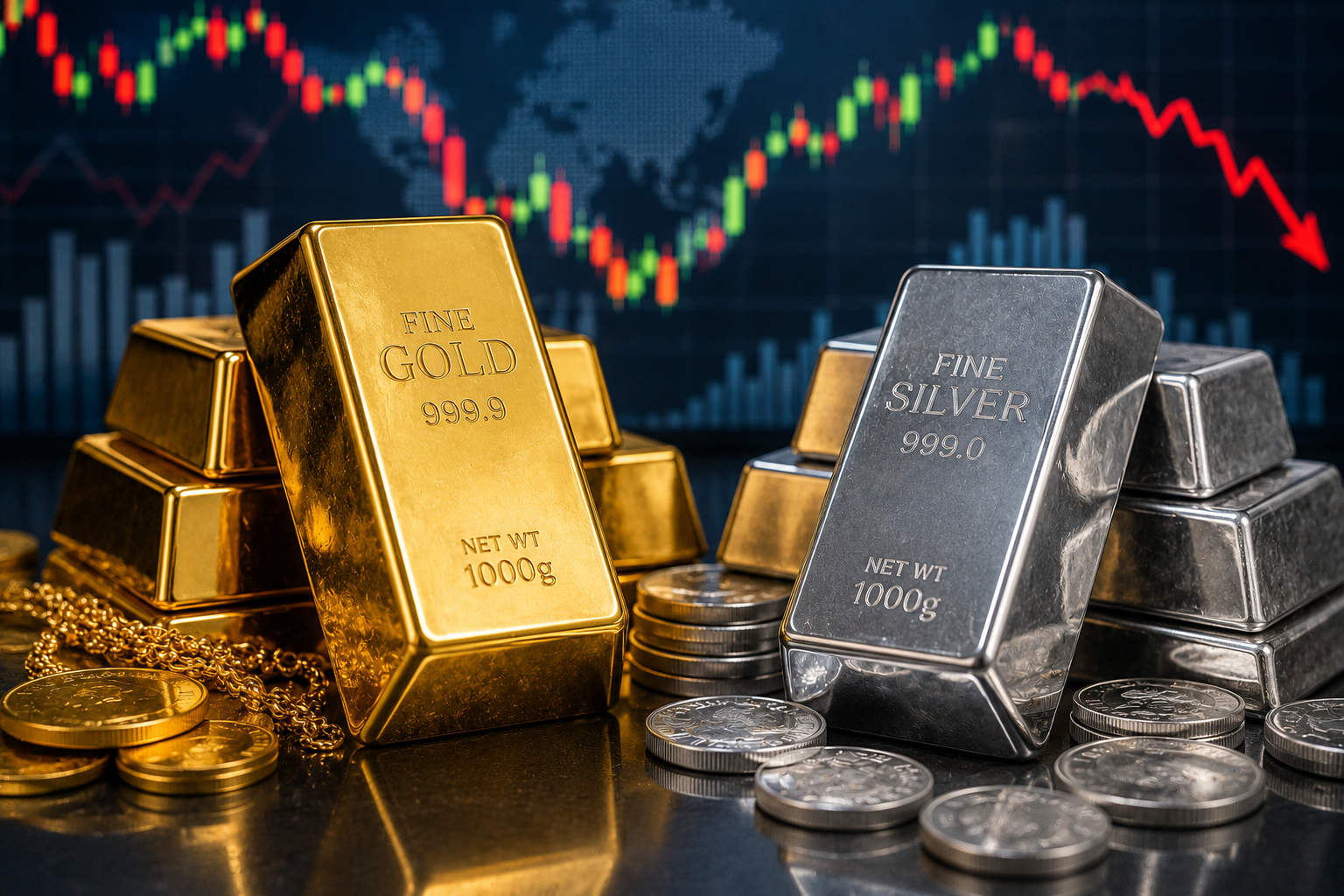
Domestic bullion prices decline amid weaker global cues, firm US dollar and cautious investor sentiment; experts remain optimistic on long-term outlook despite near-term volatility
India's bullion market witnessed a broad-based correction on Monday, with gold and silver prices retreating sharply as a strengthening US dollar and subdued global sentiment prompted investors to trim their positions in precious metals. Gold prices declined by ₹150 per 10 grams, while silver registered a steep fall of ₹5,000 per kilogram, ending its four-session rally.
According to bullion dealers, the decline was largely driven by profit booking after the recent surge in precious metal prices and renewed strength in the US dollar, which reduced the appeal of non-yielding assets like gold. Market participants also remained cautious ahead of key US economic data releases and fresh signals from the US Federal Reserve regarding the future trajectory of interest rates.
Although the correction weighed on investor sentiment in the short term, analysts believe the long-term fundamentals for gold and silver remain intact, supported by central bank purchases, geopolitical uncertainties and persistent demand for safe-haven assets.
Gold Prices Retreat from Recent Highs
Gold of 99.9% purity declined by ₹150 to ₹1,50,650 per 10 grams in the national capital on Monday.
The precious metal had settled at ₹1,50,800 per 10 grams in the previous trading session.
Despite the modest decline, gold continues to trade near historically elevated levels after witnessing a strong rally over recent months, driven by geopolitical tensions, central bank buying and expectations of monetary easing across major economies.
Jewellers reported that retail demand remained relatively subdued as buyers waited for prices to stabilize before making fresh purchases.
Silver Records Sharpest Decline
Silver witnessed a much steeper correction compared to gold.
The metal fell by ₹5,000 to ₹2,40,000 per kilogram (inclusive of all taxes), down from ₹2,45,000 per kilogram recorded on Friday.
The correction brought an end to silver's four-day winning streak.
Unlike gold, silver is influenced by both investment demand and industrial consumption, making it more volatile during periods of changing market sentiment.
Analysts noted that profit booking in international commodity markets accelerated the decline in domestic silver prices.
US Dollar Strength Pressures Bullion Prices
A stronger US dollar emerged as the primary reason behind the weakness in precious metals.
Gold and silver are internationally priced in US dollars. As the dollar appreciates:
- Precious metals become more expensive for overseas buyers.
- International demand tends to weaken.
- Investors shift towards dollar-denominated assets.
- Safe-haven buying slows temporarily.
The recent appreciation of the US dollar followed resilient economic indicators from the United States, which have reduced expectations of aggressive interest rate cuts in the near term.
Global Bullion Market Remains Under Pressure
International precious metal markets also traded lower as investors evaluated several macroeconomic developments, including:
- US inflation outlook
- Federal Reserve policy expectations
- Treasury bond yields
- Currency movements
- Global economic growth
- Geopolitical developments
Higher bond yields and a stronger dollar reduced investor interest in gold, which does not generate regular income unlike fixed-income assets.
The weakness in global markets was reflected in domestic bullion prices.
Profit Booking After a Strong Rally
Market experts believe Monday's decline largely represents healthy profit booking rather than a reversal of the long-term bullish trend.
Gold and silver have delivered impressive gains during the past several months due to:
- Rising geopolitical tensions
- Global economic uncertainty
- Increased central bank purchases
- Inflation concerns
- Expectations of lower global interest rates
Following such a sharp rally, traders often book profits to lock in gains, resulting in temporary corrections.
Analysts believe such movements are a normal part of commodity market cycles.
Investors Await Fresh US Economic Signals
Bullion traders are closely monitoring upcoming US economic data, which could influence the Federal Reserve's next policy decisions.
Important indicators include:
- Consumer Price Index (CPI)
- Employment data
- Retail sales
- Manufacturing PMI
- GDP growth
- Consumer confidence
Any indication of slowing inflation or weaker economic growth could revive expectations of interest rate cuts, potentially supporting gold prices.
Conversely, stronger-than-expected economic data may continue to strengthen the US dollar and limit upside in bullion.
Central Banks Continue to Accumulate Gold
Despite short-term volatility, central banks around the world remain significant buyers of gold.
Many monetary authorities have been increasing their gold reserves to:
- Diversify foreign exchange reserves.
- Reduce dependence on major reserve currencies.
- Enhance financial stability.
- Strengthen long-term reserve management.
This sustained institutional demand has emerged as one of the strongest structural supports for global gold prices in recent years.
Indian Jewellery Demand Remains Cautious
Domestic jewellery demand has remained relatively cautious due to elevated prices.
However, industry participants expect buying interest to gradually improve during the upcoming festive and wedding season.
Demand will largely depend on:
- Price stability.
- Rural income growth.
- Consumer confidence.
- Inflation trends.
Silver demand is also expected to receive support from expanding industrial applications, particularly in renewable energy, electronics and electric vehicle manufacturing.
Long-Term Outlook Remains Constructive
Commodity analysts continue to maintain a positive long-term outlook for precious metals despite periodic corrections.
Several structural factors continue to support the sector:
- Global geopolitical uncertainty.
- Central bank buying.
- Inflation risks.
- Portfolio diversification demand.
- Currency volatility.
- Potential monetary easing.
These factors are expected to keep investment demand for gold and silver resilient over the medium to long term.
Investment Strategy for Investors
Financial experts advise investors to avoid reacting to short-term price swings and instead focus on strategic portfolio allocation.
Suggested approaches include:
- Gradual accumulation during corrections.
- Diversifying investments between gold and silver.
- Maintaining disciplined long-term exposure.
- Reviewing allocation based on risk tolerance and financial objectives.
Gold continues to be regarded as an effective hedge against inflation and financial market volatility.