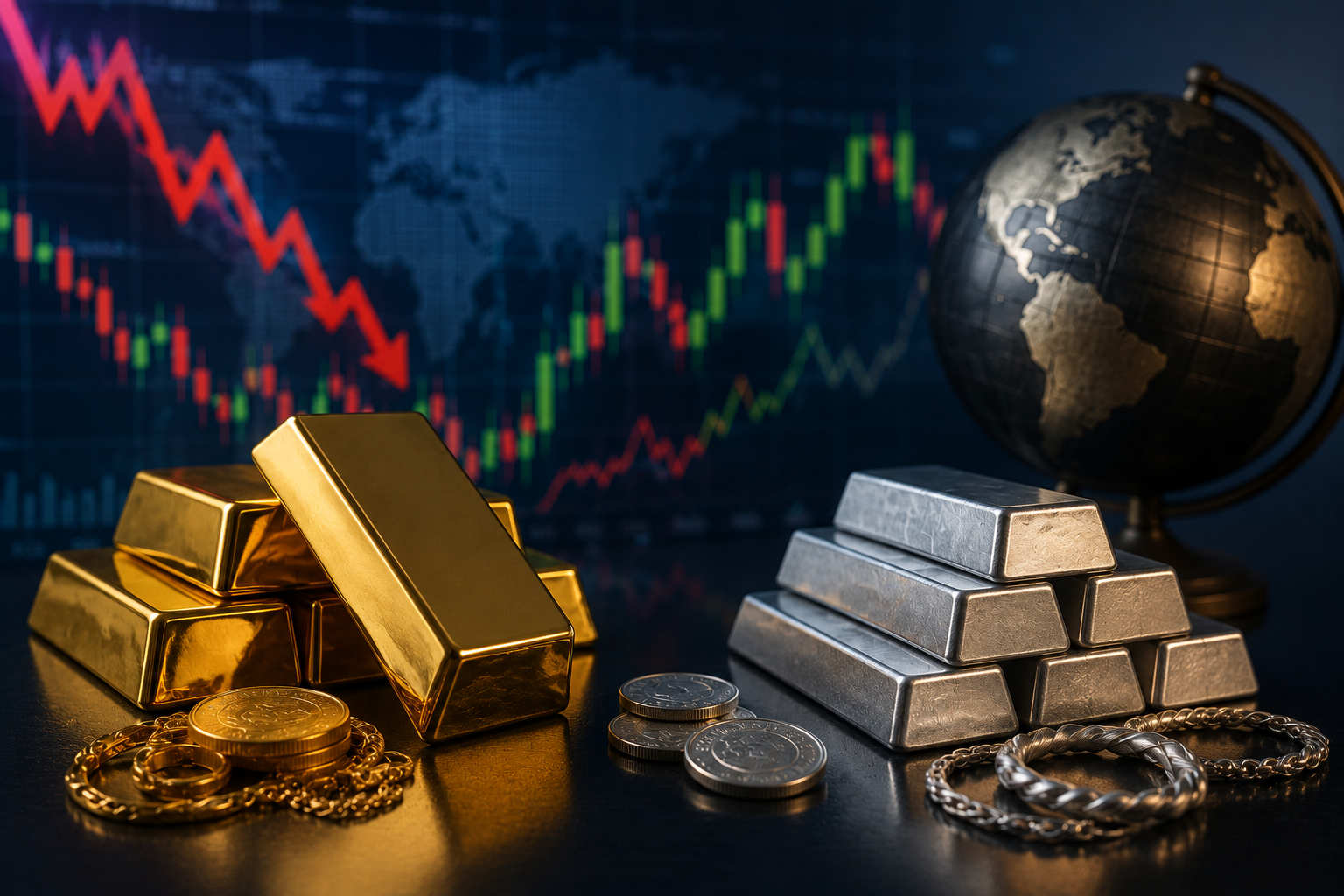
Precious Metals Retreat Amid Profit Booking, Firm US Dollar and Cautious Global Sentiment; Investors Await Fresh Signals from the US Federal Reserve
Bullion Market Begins the Week on a Softer Note
Gold and silver prices started the week on a weaker footing as investors booked profits following recent gains and shifted their focus toward global macroeconomic developments. A stronger US dollar, mixed geopolitical developments and uncertainty surrounding the US Federal Reserve's monetary policy prompted traders to reduce exposure to precious metals.
While gold witnessed only a modest decline, silver experienced a sharp correction after a strong rally in recent sessions, reflecting its higher price volatility and sensitivity to global economic conditions.
Despite the decline, analysts believe the medium-term outlook for bullion remains supported by expectations of easing inflation, continued central bank purchases and persistent geopolitical uncertainty.
Gold Prices Witness Mild Correction
In the domestic bullion market, gold prices eased by ₹150, with 99.9% purity gold trading at ₹1,50,650 per 10 grams.
The decline followed weakness in international bullion markets, where rising strength in the US dollar reduced demand for gold among overseas investors. Since gold is priced globally in US dollars, a stronger greenback generally makes the metal more expensive for buyers using other currencies, limiting international demand.
However, the correction remained relatively limited as safe-haven buying continued to provide underlying support.
Silver Falls Sharply After Recent Rally
Silver recorded a much steeper correction, declining ₹5,000 per kilogram to ₹2,40,000 per kg, ending its four-session winning streak.
The sharp decline was primarily driven by profit booking after silver's recent rally, combined with weakness in global commodity markets. Unlike gold, silver has significant industrial applications, making it more sensitive to economic growth expectations and changes in industrial demand.
Market experts noted that silver's higher volatility often results in larger price swings compared to gold during periods of global uncertainty.
US Dollar Strength Pressures Precious Metals
The appreciation of the US dollar remained one of the biggest factors weighing on bullion prices.
A stronger dollar typically reduces the attractiveness of gold and silver because international buyers must pay more in local currency terms. This often leads to reduced demand in overseas markets and encourages investors to shift funds toward dollar-denominated assets.
The Dollar Index has remained firm as investors continue assessing the strength of the US economy and future interest rate decisions by the Federal Reserve.
Federal Reserve Policy Remains the Biggest Driver
Financial markets are closely watching upcoming US inflation figures, employment data and business activity reports for clues about the Federal Reserve's next policy move.
Although expectations of immediate interest rate hikes have moderated, uncertainty remains over the timing and magnitude of potential rate cuts.
Higher interest rates generally increase the opportunity cost of holding non-yielding assets such as gold, while expectations of lower borrowing costs tend to support precious metal prices.
As a result, every major US economic release continues to influence bullion prices worldwide.
Geopolitical Risks Continue to Support Gold
Despite Monday's decline, geopolitical uncertainty continues to provide a strong support base for precious metals.
Ongoing tensions in West Asia, global trade uncertainties and concerns over geopolitical stability have encouraged investors to maintain exposure to safe-haven assets.
Historically, gold performs well during periods of geopolitical instability as investors seek assets capable of preserving value during uncertain times.
This defensive demand is expected to limit any significant downside in bullion prices unless geopolitical conditions improve substantially.
Central Bank Buying Remains a Long-Term Positive
Another structural factor supporting gold prices is continued purchasing by central banks around the world.
Many central banks have increased their gold reserves in recent years as part of reserve diversification strategies aimed at reducing dependence on major reserve currencies.
Strong central bank demand has emerged as one of the most important long-term drivers supporting international gold prices, even during periods of short-term market corrections.
Silver Continues to Benefit from Industrial Demand
Although silver corrected sharply during the session, its long-term demand outlook remains favourable due to expanding industrial consumption.
Silver plays a vital role in several high-growth industries, including:
-
Solar photovoltaic manufacturing
-
Electric vehicles
-
Electronics and semiconductors
-
Battery technologies
-
Medical equipment
-
Renewable energy infrastructure
The global transition toward clean energy and electrification is expected to support structural demand for silver over the coming years.
Factors Investors Should Monitor
Bullion traders are expected to closely track several important developments in the coming weeks:
-
US inflation data
-
Federal Reserve policy commentary
-
US employment reports
-
Dollar Index movements
-
US Treasury bond yields
-
Central bank gold purchases
-
ETF investment flows
-
Geopolitical developments
-
Crude oil price movements
These indicators will likely determine the short-term direction of gold and silver prices.
Investment Perspective
Despite the latest correction, market analysts remain constructive on the long-term outlook for precious metals. Expectations of moderating inflation, potential monetary policy easing by major central banks and persistent geopolitical uncertainty continue to provide a supportive environment for bullion.
Gold remains an important portfolio diversifier and hedge against inflation, currency volatility and global economic uncertainty. Meanwhile, silver offers a unique combination of safe-haven demand and industrial growth potential, making it attractive for investors seeking exposure to both precious metals and the global clean energy transition.
While short-term price fluctuations are likely to continue due to changing interest rate expectations and currency movements, the broader investment case for precious metals remains intact, with investors expected to maintain a balanced allocation as part of diversified long-term portfolios.