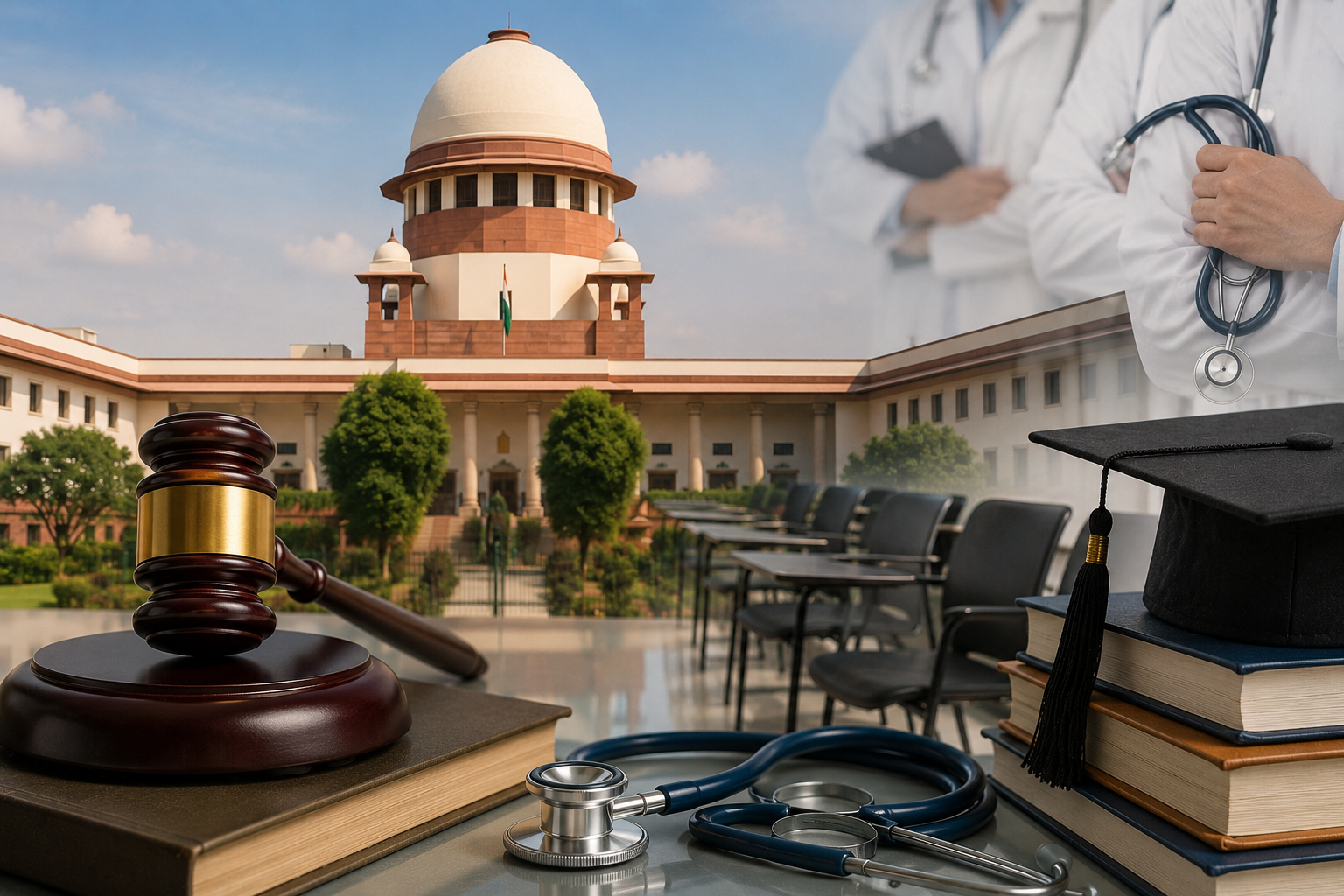
Tamil Nadu Medical Officers Association Moves Apex Court Seeking Protection of In-Service Super-Speciality Seats
The Supreme Court has agreed to hear a petition challenging the proposed surrender of 152 vacant in-service super-speciality medical seats in Tamil Nadu to the All India Quota (AIQ) for the academic year 2025-26. The case has reignited discussions over the balance between national-level medical admissions and the need to strengthen public healthcare systems through specialised training for government doctors.
A bench comprising Justices B V Nagarathna and Joymalya Bagchi issued notices to the Central government, the Tamil Nadu government and other concerned authorities, seeking their responses on the matter. The petition has been filed by the Tamil Nadu Medical Officers Association.
Supreme Court Recognises Importance of Government Doctors
During the hearing, the Supreme Court highlighted the critical role played by government doctors in delivering healthcare services across the country.
The bench observed that when government doctors acquire advanced medical qualifications, the benefits ultimately reach the public healthcare system. Since these doctors continue to serve in government hospitals after completing their higher studies, they contribute significantly to improving healthcare delivery, particularly in rural and underserved regions.
The court also noted that in-service doctors constitute a separate category because they balance professional responsibilities with academic pursuits.
Dispute Over Vacant Super-Speciality Seats
The dispute centres around 152 super-speciality medical seats reserved for in-service government doctors in Tamil Nadu that remained vacant after the second round of counselling.
Out of the total super-speciality seats available in the state for the 2025-26 academic session, a substantial portion had been reserved for serving government doctors. However, a large number of these seats remained unfilled after the counselling process, prompting authorities to consider transferring them to the All India Quota.
The petitioner argues that surrendering these seats prematurely could deprive eligible government doctors of an opportunity to pursue specialised education.
Petition Seeks Additional Counselling Opportunity
The Tamil Nadu Medical Officers Association has sought a direction from the apex court restraining authorities from surrendering the vacant seats to the All India Quota until the completion of subsequent counselling rounds.
The association has also requested that in-service candidates be allowed to compete for these seats during the third round or mop-up counselling round, particularly if the qualifying percentile is reduced.
According to the petitioners, many deserving government doctors could become eligible in later counselling stages, and therefore, the seats should remain available for them.
Why Super-Speciality Training Matters
Super-speciality courses produce highly skilled medical professionals in areas such as cardiology, neurology, oncology, nephrology and critical care. These specialists are essential for strengthening tertiary healthcare services in government hospitals.
Healthcare experts believe that increasing the number of super-specialists within the public healthcare system can significantly improve patient outcomes and reduce dependence on private healthcare institutions.
The availability of specialist doctors is particularly important for district hospitals and medical colleges that cater to a large section of the population.
Wider Implications for Medical Education Policy
The case is expected to have far-reaching implications for medical admission policies across India. A favourable ruling for the petitioners could influence how vacant seats reserved for in-service candidates are managed in future admission cycles.
Medical associations across several states have long argued that government doctors should receive adequate opportunities for higher education, as they play a crucial role in public healthcare delivery.
On the other hand, proponents of the All India Quota system maintain that unfilled seats should be utilised efficiently by opening them to candidates from across the country.
Public Healthcare at the Centre of Debate
The issue also highlights the broader challenge of ensuring an adequate number of specialist doctors in government healthcare institutions.
India continues to face shortages of specialised medical professionals, especially in rural and semi-urban regions. Policymakers have increasingly emphasised the need to strengthen public healthcare infrastructure by encouraging government doctors to pursue advanced medical education.
The Supreme Court's eventual decision will be closely watched by medical professionals, policymakers and students, as it could shape the future framework for allocation of super-speciality medical seats across the country.
The matter is expected to come up for further hearing in the coming weeks.