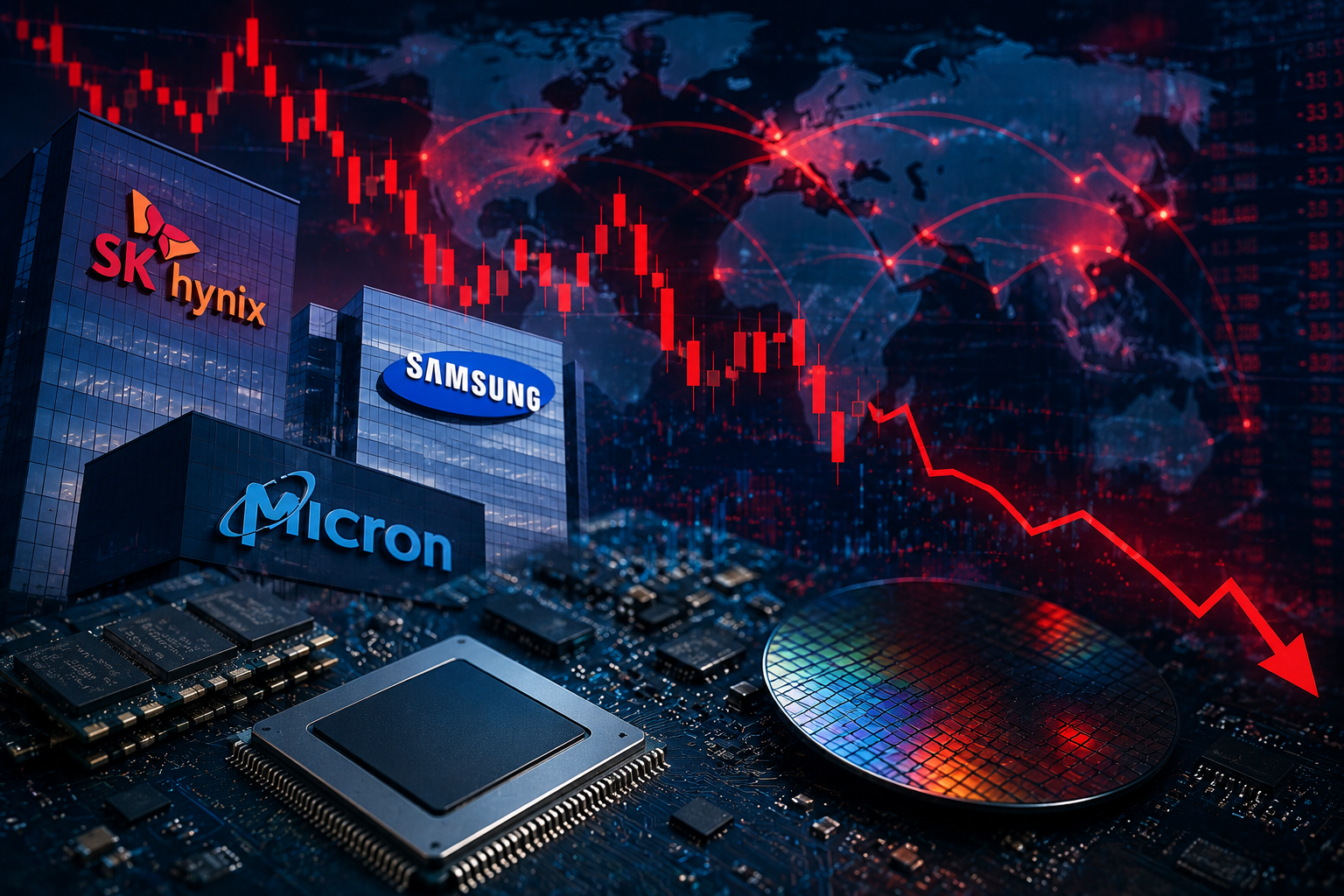
Sharp Selloff in SK Hynix, Samsung and Micron Triggers Global Tech Correction Amid Valuation and Demand Concerns
The global technology sector witnessed a significant bout of profit-booking as investors reassessed the sustainability of the artificial intelligence (AI) boom that has fueled stock market rallies worldwide over the past two years. Leading semiconductor companies including SK Hynix, Samsung Electronics, and Micron Technology came under intense selling pressure, sparking a broader decline across global equity markets and raising fresh concerns about whether AI-related investments have run ahead of fundamentals.
The selloff reverberated across Asia, Europe, and the United States, dragging benchmark indices lower and weighing heavily on investor sentiment. In India, the impact was visible as the Sensex and Nifty recorded their sharpest single-day declines in June, reflecting the growing influence of global technology trends on domestic markets.
While analysts continue to remain optimistic about the long-term potential of AI, the recent correction highlights the market's increasing focus on profitability, return on investment, and realistic growth expectations.
Semiconductor Stocks Lead the Global Decline
The biggest shock emerged from South Korea, home to some of the world's largest semiconductor manufacturers.
Shares of major chipmakers witnessed steep declines as concerns surfaced regarding future demand for AI-related memory chips and infrastructure.
Major Market Movers
Among the hardest-hit companies were:
- SK Hynix
- Samsung Electronics
- Micron Technology
- Other semiconductor and AI-linked firms
The decline in these stocks quickly spread across the broader technology sector, impacting investors globally.
Why Investors Are Suddenly Worried
For much of the past two years, markets have rewarded companies linked to AI, cloud computing, advanced semiconductors, and data centre infrastructure.
However, investor sentiment appears to be shifting from optimism to scrutiny.
Key Concerns Emerging
Market participants are increasingly questioning:
- Whether AI spending can continue at the current pace
- If technology companies are overinvesting in infrastructure
- Whether future revenues will justify massive capital expenditures
- The sustainability of elevated earnings expectations
These concerns have triggered a reassessment of valuations across the technology ecosystem.
High-Bandwidth Memory Market Under Focus
One of the major triggers behind the selloff was growing uncertainty surrounding the future demand outlook for High-Bandwidth Memory (HBM), a critical component used in AI servers and advanced computing systems.
HBM technology has been one of the strongest growth segments within the semiconductor industry due to its importance in supporting large-scale AI workloads.
Why HBM Matters
High-Bandwidth Memory is essential for:
- Artificial intelligence model training
- Large language models
- Data centres
- Machine learning applications
- High-performance computing systems
Any indication of slower expansion plans can significantly affect investor expectations for future earnings growth.
Reports of Capacity Moderation Spark Selling
Investor anxiety intensified following reports suggesting that some industry participants may be reviewing the pace of future memory capacity expansion.
While no major structural slowdown has been confirmed, even the possibility of moderation was enough to trigger aggressive profit-booking.
Market Interpretation
Investors interpreted the reports as a sign that:
- AI demand growth could normalize
- Supply expansion may slow
- Revenue growth expectations could be revised
- Valuation multiples may need adjustment
This led to widespread selling across AI-linked stocks.
AI Valuations Come Under Pressure
The AI boom has created enormous wealth for investors, with many technology stocks experiencing extraordinary gains over the past two years.
However, rapid share price appreciation has also resulted in elevated valuations.
The Valuation Challenge
Several AI-related companies now trade at:
- Historically high earnings multiples
- Aggressive future growth assumptions
- Premium valuations compared to historical averages
When expectations become extremely high, even minor disappointments can result in sharp market reactions.
This dynamic appears to be driving the current correction.
Micron Earnings Become a Key Market Event
Investors are now closely watching upcoming results from Micron Technology, one of the world's largest memory chip manufacturers.
The company's earnings and guidance are expected to provide important clues about the health of the AI ecosystem.
What Analysts Are Looking For
Markets will focus on:
- Demand for AI memory products
- Data centre investment trends
- Future order visibility
- Pricing environment
- Capacity expansion plans
Strong guidance could help restore confidence, while weaker commentary may intensify concerns.
Massive AI Investments Face Greater Scrutiny
Technology companies globally have committed unprecedented amounts of capital toward AI infrastructure.
Major investments have been directed toward:
- AI data centres
- Cloud computing infrastructure
- Advanced processors
- Semiconductor manufacturing
- Machine learning platforms
While these investments have supported growth for chipmakers, investors increasingly want evidence that spending will translate into sustainable earnings.
Return on Investment Becomes Critical
The next phase of the AI story may depend less on spending announcements and more on measurable financial returns.
Investors are asking:
- How quickly AI investments can be monetized
- Whether productivity gains justify spending
- How much incremental revenue AI can generate
- Which companies will emerge as long-term winners
These questions are likely to dominate market discussions going forward.
Indian Markets Feel the Impact
The weakness in global technology stocks also affected Indian equities.
Technology-related counters and broader market indices came under pressure as investors reacted to negative international cues.
Why Indian Markets Are Sensitive
Indian markets remain closely linked to global technology sentiment because:
- IT services contribute significantly to exports
- Foreign institutional investors actively participate in Indian equities
- Global risk appetite influences capital flows
As a result, sharp corrections in international technology stocks often impact domestic market performance.
Long-Term AI Opportunity Remains Intact
Despite the recent volatility, most industry experts continue to believe that artificial intelligence remains one of the most transformative technological developments of the decade.
The correction is largely being viewed as a reassessment of valuations rather than a collapse of the AI growth narrative.
Structural Growth Drivers Remain Strong
The AI ecosystem continues to benefit from:
- Rising enterprise adoption
- Increasing automation
- Cloud infrastructure expansion
- Data generation growth
- Digital transformation initiatives
These trends are expected to support long-term demand for advanced semiconductors and computing infrastructure.
Market Enters a More Mature Phase
The recent correction may signal a transition in how investors evaluate AI-related companies.
During the early stages of a technological revolution, markets often reward future potential. As industries mature, investors begin focusing more on execution and profitability.
What Matters Now
Investors are increasingly evaluating:
- Revenue growth quality
- Margin expansion
- Return on capital
- Cash flow generation
- Competitive positioning
This shift could result in greater differentiation between winners and losers within the AI ecosystem.
Outlook: Healthy Correction or Warning Signal?
The coming weeks are likely to be crucial for global technology markets.
Earnings reports, guidance updates, and spending forecasts from major semiconductor companies will help determine whether the recent decline represents a temporary correction or the beginning of a more prolonged adjustment.