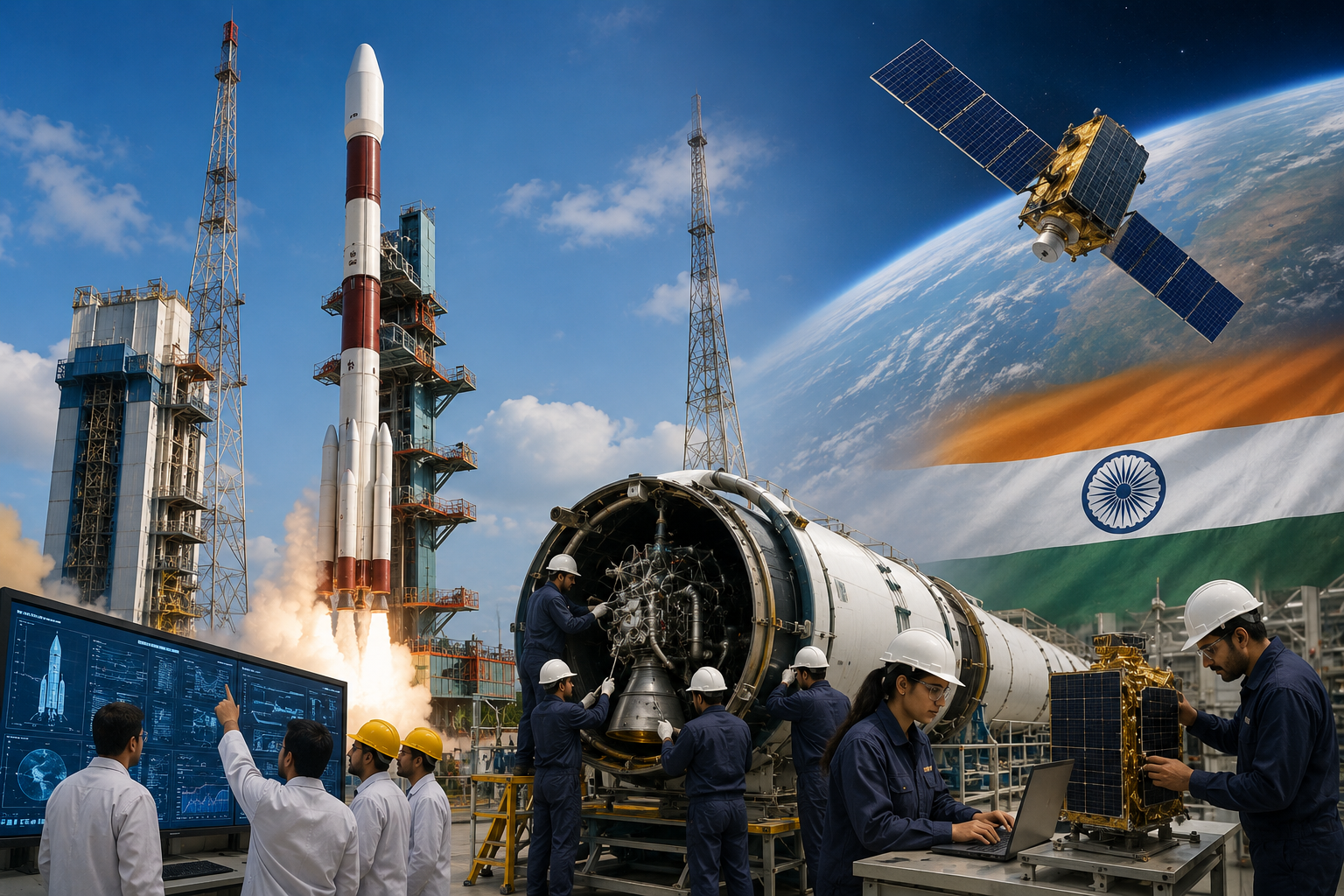
Government's Technology Transfer Plan Aims to Create Globally Competitive Space Companies and Expand India's Launch Capabilities
In a landmark move that could reshape India's space industry, the government has announced plans to transfer technology related to the Polar Satellite Launch Vehicle (PSLV)—the country's most successful and reliable rocket—to the private sector. The initiative is expected to accelerate the growth of India's space ecosystem, boost domestic rocket manufacturing, and strengthen the country's position in the rapidly expanding global space economy.
The decision marks another significant milestone in India's space sector reforms, which have encouraged private participation and innovation since the industry was opened to non-government players in 2019.
PSLV Technology Transfer to Drive Private Sector Participation
The Indian National Space Promotion and Authorization Centre (IN-SPACe), the regulatory body established to facilitate private-sector participation in space activities, has issued an Expression of Interest (EOI) inviting companies to participate in the technology transfer process.
According to IN-SPACe Chairman Pawan Goenka, only companies that are majority-owned and controlled by Indian entities will be eligible to receive the technology.
The initiative is aimed at enabling private companies to manufacture, operate, and further develop PSLV-class launch vehicles using the technological expertise built by the Indian Space Research Organisation (ISRO) over decades.
Industry observers view the move as one of the most significant technology transfers in India's strategic sectors.
PSLV: The Backbone of India's Space Success
The Polar Satellite Launch Vehicle has been the cornerstone of India's space program for more than three decades.
Since its first successful launch, PSLV has established itself as one of the world's most reliable launch vehicles, successfully carrying satellites for India and numerous international customers.
The rocket has played a pivotal role in several historic missions, including:
- Chandrayaan-1 Moon Mission
- Mars Orbiter Mission (Mangalyaan)
- Earth Observation Satellite Launches
- Navigation Satellite Deployments
- Multiple International Satellite Missions
Its ability to launch multiple satellites in a single mission at competitive costs has made it a preferred option for global customers.
The PSLV's proven track record gives private players a strong foundation upon which to build commercial launch businesses.
Strengthening India's Position in the Global Space Economy
The global space industry is entering a period of unprecedented growth.
Driven by increasing demand for satellite communications, Earth observation services, broadband internet, defense applications, navigation systems, and climate monitoring, the space economy is expected to exceed $1 trillion in value over the coming decades.
India currently accounts for only a small share of this global market despite possessing strong technical capabilities and a cost-efficient launch ecosystem.
By transferring PSLV technology to domestic companies, policymakers hope to:
- Increase launch frequency
- Expand manufacturing capacity
- Improve commercial competitiveness
- Attract international customers
- Create high-value jobs
- Strengthen India's share of the global space economy
The move is expected to complement India's broader ambition of becoming a major space-faring and technology-exporting nation.
Space Reforms Have Triggered a Startup Revolution
India's space sector has witnessed dramatic transformation since the government liberalized the industry in 2019.
The reforms opened the door for private enterprises to participate in:
Rocket Manufacturing
Several startups are now developing indigenous launch vehicles aimed at serving the small satellite market.
Satellite Production
Companies are building satellites for communications, remote sensing, agriculture, defense, and environmental monitoring applications.
Space Data Services
A growing number of firms are leveraging satellite imagery and analytics for commercial applications across industries.
Deep Technology Innovation
Private companies are increasingly investing in propulsion systems, advanced materials, artificial intelligence, and reusable launch technologies.
The result has been the emergence of a vibrant ecosystem comprising hundreds of space-tech startups and technology companies.
Rising Interest from Corporate India
The space sector is no longer attracting interest solely from startups.
Several large industrial groups and technology companies are actively exploring opportunities in satellite communications, launch services, space manufacturing, and downstream applications.
Growing commercial interest is being driven by:
- Expanding satellite demand
- National security requirements
- Broadband connectivity needs
- Space-based communication services
- Earth observation opportunities
Industry experts believe the PSLV technology transfer could encourage even larger investments from established corporate players seeking entry into the sector.
Satellite Boom Creating New Opportunities
The timing of the government's initiative coincides with a surge in global satellite deployment activity.
The rapid growth of:
- Low-Earth Orbit (LEO) satellite constellations
- Broadband internet networks
- Climate monitoring systems
- Navigation services
- Defense surveillance platforms
is generating strong demand for reliable and cost-effective launch services.
India's PSLV has historically excelled in launching small and medium-sized satellites, positioning the country well to capitalize on this trend.
As satellite deployment volumes continue to increase globally, launch capacity is becoming an increasingly valuable strategic asset.
Recent PSLV Setbacks Seen as Temporary
The announcement comes despite two recent PSLV mission failures over the past year.
However, officials have emphasized that these incidents do not diminish the rocket's long-term reliability.
Over its operational history, PSLV has achieved an impressive record with more than 60 successful launches and has earned global recognition for its consistency and cost efficiency.
Industry experts note that occasional setbacks are not uncommon in the space industry and that the platform's decades-long success remains intact.
The government continues to view PSLV as one of the most dependable launch systems available for commercial and scientific missions.
Creating a Self-Reliant Space Manufacturing Ecosystem
Beyond launch services, the technology transfer initiative aligns with India's broader push for technological self-reliance.
By enabling domestic companies to manufacture sophisticated launch vehicles, the country aims to:
- Reduce dependence on foreign technologies
- Strengthen strategic capabilities
- Expand high-tech manufacturing
- Build globally competitive aerospace firms
- Create export opportunities
The initiative also supports India's ambition to become a hub for advanced manufacturing and innovation-driven industries.