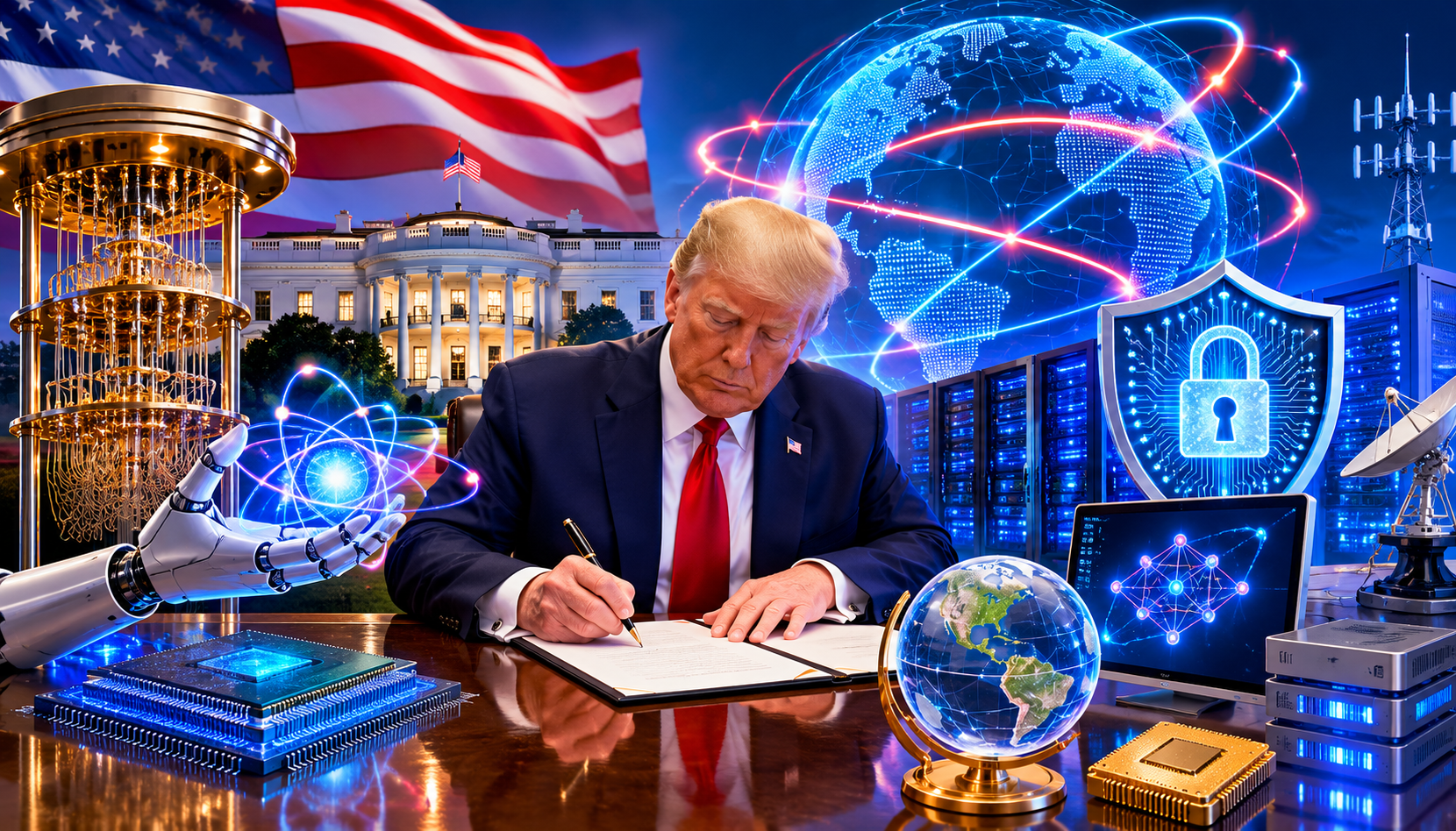
Executive Orders Aim to Accelerate Quantum Research, Strengthen Cybersecurity, and Counter China's
In a significant move to reinforce America's leadership in advanced technologies, US President Donald Trump signed a series of executive orders aimed at accelerating quantum computing development, enhancing national cybersecurity defenses, and expanding federal adoption of next-generation technologies.
The initiative represents one of the most comprehensive federal efforts to date in the rapidly evolving quantum sector and highlights the growing strategic importance of quantum computing in global technological competition.
The White House described the move as a critical step toward ensuring that the United States remains at the forefront of innovation while safeguarding national security interests in an increasingly digital world.
Quantum Computing Becomes a National Priority
Quantum computing has emerged as one of the most promising technological frontiers, with the potential to transform industries ranging from healthcare and finance to defense and scientific research.
Unlike traditional computers that process information using binary bits, quantum computers utilize quantum bits, or qubits, which can perform multiple calculations simultaneously through the principles of quantum mechanics.
This capability could enable future quantum systems to solve highly complex problems that would take conventional supercomputers years—or even centuries—to process.
Recognizing its transformative potential, governments around the world have significantly increased investments in quantum technologies, making the sector a critical area of geopolitical competition.
US-China Technology Race Intensifies
The latest executive orders come amid an intensifying technological rivalry between the United States and China.
Both countries are investing heavily in quantum research, viewing the technology as a key determinant of future economic and military strength.
Quantum breakthroughs could influence a wide range of strategic capabilities, including:
-
Advanced defense systems
-
Secure communications networks
-
Artificial intelligence development
-
Cryptography and cybersecurity
-
Space exploration technologies
-
Scientific simulations and drug discovery
US policymakers increasingly view quantum leadership as essential to maintaining the country's competitive advantage in the global technology landscape.
Government Targets Research-Grade Quantum Computer by 2028
One of the cornerstone initiatives announced by the administration is a national effort to develop a research-capable quantum computer within the next two years.
According to White House officials, the government believes a functional quantum machine capable of conducting meaningful scientific calculations could be operational by 2028.
The project will be overseen primarily by the Department of Energy, which will establish technical specifications and coordinate development through national laboratories and research facilities.
Officials emphasized that the system would serve as a foundational platform for future advancements and could pave the way for more powerful quantum computers capable of solving real-world industrial and scientific challenges.
Federal Agencies to Adopt Quantum Technologies
The executive orders direct several federal agencies to begin preparing for broader integration of quantum technologies.
Departments including Defense, Energy, Commerce, and NASA have been instructed to explore practical applications of quantum-enabled systems over the next five years.
Potential areas of deployment include:
Quantum Sensors
Highly sensitive quantum sensors could improve navigation systems, geological exploration, defense surveillance, and scientific measurements.
Quantum Networks
Future quantum communication networks may provide unprecedented levels of security for government communications and critical infrastructure.
Scientific Research
Quantum computing could accelerate breakthroughs in materials science, energy storage, climate modeling, and pharmaceutical research.
The federal government plans to leverage existing budgets and resources to begin implementing these initiatives.
Strengthening America's Cybersecurity Infrastructure
Perhaps the most immediate focus of the executive orders is cybersecurity.
Experts have long warned that future quantum computers could potentially break many of today's encryption systems, posing a significant threat to global digital security.
Current encryption methods protect:
-
Banking transactions
-
Government databases
-
Defense communications
-
Healthcare information
-
Corporate networks
A sufficiently advanced quantum computer could theoretically decrypt sensitive information in a fraction of the time required by traditional systems.
To address this risk, the administration has launched an accelerated transition toward quantum-resistant security standards.
Post-Quantum Cryptography Takes Center Stage
A key component of the strategy involves adopting post-quantum cryptography across federal agencies.
Post-quantum cryptography refers to encryption algorithms specifically designed to withstand attacks from future quantum computers.
The executive orders establish a timeline requiring high-value government assets to migrate to these advanced security standards by 2031.
The initiative builds upon earlier efforts by the Commerce Department, which approved several quantum-resistant cryptographic algorithms in recent years.
Cybersecurity experts consider the transition one of the most important digital security projects of the coming decade.
Major Technology Companies Expected to Benefit
The White House did not identify specific companies that will participate in future quantum projects, but officials confirmed that collaboration with domestic technology firms will play a central role.
Industry leaders attending the signing ceremony included:
-
Ruth Porat
-
Arvind Krishna
The presence of senior executives from major technology companies underscores the importance of public-private partnerships in advancing quantum innovation.
Investors reacted positively to the announcement, with shares of IBM gaining in after-hours trading.
Billions in Funding to Support Quantum Ecosystem
The executive orders complement broader efforts by the administration to strengthen America's quantum industry.
Earlier this year, the Commerce Department announced plans to provide more than $2 billion in support for selected quantum technology companies through strategic investment arrangements.
Companies expected to benefit include:
-
IBM
-
GlobalFoundries
-
Emerging quantum computing startups
-
Semiconductor and hardware manufacturers
-
Advanced cybersecurity firms
The funding is expected to accelerate research, commercialization, and workforce development across the sector.
Protecting Quantum Intellectual Property
The administration is also focusing on safeguarding critical quantum technologies from espionage and intellectual property theft.
The executive orders include measures to:
-
Protect sensitive research
-
Strengthen domestic supply chains
-
Increase cooperation with allied nations
-
Prevent unauthorized technology transfers
-
Enhance national security screening mechanisms
These steps reflect growing concerns about global competition for strategic technologies and the need to maintain control over critical innovations.
Building the Quantum Workforce of the Future
One of the biggest challenges facing the industry is a shortage of skilled talent.
To address this issue, the administration has directed agencies to expand workforce development initiatives through:
-
Apprenticeship programs
-
University research partnerships
-
Technical education grants
-
Specialized training programs
The goal is to create a sustainable pipeline of scientists, engineers, cybersecurity specialists, and technicians capable of supporting the industry's long-term growth.
Why Investors Are Paying Attention
Quantum computing remains in its early stages, but investor enthusiasm has grown significantly over the past year.
The rapid rise of artificial intelligence has increased interest in other breakthrough technologies that could reshape the global economy.
Many analysts view quantum computing as a potential multi-trillion-dollar industry over the coming decades, with applications extending across virtually every major sector.
Government support, increased private investment, and accelerating research progress are expected to create significant opportunities for companies operating in the quantum ecosystem.
Smart Investment Take
Trump's executive orders signal a major acceleration in America's quantum computing ambitions and reinforce the technology's growing importance in national security and economic competitiveness. While commercial quantum computing remains years away from widespread deployment, the government's commitment to funding research, cybersecurity modernization, and industry partnerships could create substantial long-term opportunities for technology, semiconductor, cybersecurity, and advanced computing companies. Investors should closely monitor developments in the quantum sector, as it increasingly emerges as one of the most strategic technology themes of the next decade.