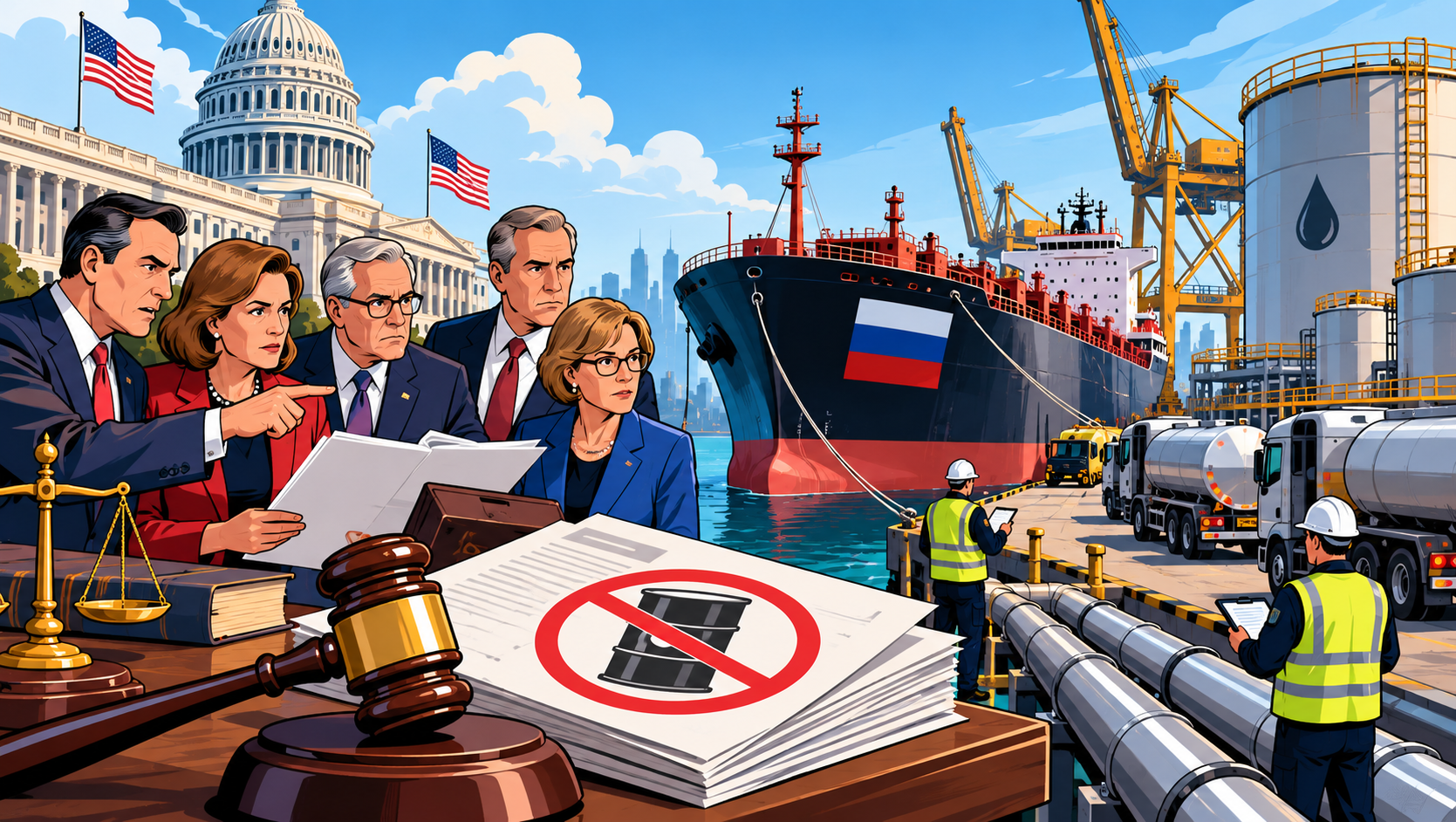
Bipartisan US lawmakers have cautioned major financial institutions, port authorities and fuel distributors against facilitating Russian diesel imports, warning of potential criminal and civil liability as shipments reportedly head towards American ports.
A bipartisan group of US lawmakers has warned American banks, port authorities and fuel distributors that facilitating imports of Russian-origin diesel could trigger congressional investigations and potential legal action. The warning comes amid reports that shipments of Russian diesel are heading towards the United States following a recent waiver granted by President Donald Trump that could allow Moscow to supply diesel to international markets, including the US.
In letters addressed to the heads of major financial institutions, port authorities and fuel distribution companies, the lawmakers urged recipients not to participate in transactions involving Russian-origin diesel unless the applicable legal requirements had been met. They also called on the companies to preserve all records relating to proposed or completed imports.
The intervention highlights the continuing tension between energy supply considerations and Washington’s efforts to restrict revenue streams that could support Russia’s military campaign in Ukraine.
Lawmakers Cite US Law Restricting Russian Energy Imports
The legislators referred to Section 2 of the Ending Importation of Russian Oil Act of 2022, which generally prohibits the importation of Russian-origin energy products, including diesel fuel.
Under the provision cited in the letters, such imports are permitted only after the US President certifies to Congress that Russia has ceased all military hostilities in Ukraine and no longer poses an immediate threat to NATO members.
The lawmakers argued that companies facilitating Russian diesel imports without satisfying the statutory conditions could expose themselves to legal and regulatory consequences.
Their warning covers a broad range of commercial activities, including purchasing, transporting, importing, unloading, storing, financing and distributing Russian-origin diesel. It also calls for scrutiny of other transactions involving Russian diesel under General License 135, as described in the letters.
The correspondence signals that companies involved in the fuel supply chain may face questions not only about the physical movement of shipments but also about the financial arrangements and commercial services supporting them.
Major Banks and US Port Authorities Receive Letters
The letters were addressed to the chief executives of six major US financial institutions: JPMorgan Chase, Bank of America, Citigroup, Wells Fargo, Goldman Sachs and Morgan Stanley.
Port authorities responsible for facilities in Houston, Corpus Christi and Beaumont in Texas, as well as the Port of New York and New Jersey, were also among the recipients.
The lawmakers asked the organisations to preserve records relating to any proposed or actual importation of Russian-origin diesel. Such documentation could become relevant if congressional committees or other authorities examine whether companies facilitated transactions that may violate US law.
Banks can play a role in commodity trade by providing financing, processing payments and supporting trade-related financial arrangements. Ports and fuel distributors, meanwhile, may be involved in the unloading, storage, transportation and onward sale of imported products.
By addressing multiple participants in the supply chain, the lawmakers are seeking to discourage companies from facilitating transactions that they believe could conflict with the statutory restrictions.
However, the letters themselves do not establish that any named institution or port authority has violated the law. Any determination of liability would depend on the applicable legal provisions and the specific facts of individual transactions.
Russian Diesel Shipments Reportedly Heading Towards US Ports
Citing public reports and vessel-tracking data, the lawmakers said ships carrying Russian diesel were on course to reach Beaumont, Texas, and the Port of New York and New Jersey as early as the end of October.
The shipments have drawn attention because they could test the relationship between the administration’s reported waiver and the statutory restrictions cited by the legislators.
The reported waiver, granted earlier in October, has raised questions about how the administration intends to balance energy-market requirements with existing restrictions on Russian-origin energy products.
The precise legal treatment of individual cargoes will depend on the terms and scope of the relevant authorisations, as well as the statutory requirements applicable to the transactions. The lawmakers’ letters indicate that they believe companies should refrain from facilitating the shipments unless the necessary legal conditions have been satisfied.
The reported arrival of cargoes at US ports could therefore bring greater scrutiny to the origin of fuel supplies, shipping documentation, financial arrangements and the interpretation of applicable authorisations.
Bipartisan Intervention Highlights National Security Concerns
The signatories include Democratic Senators Jeanne Shaheen, Ron Wyden, Sheldon Whitehouse, Chris Coons and Elizabeth Warren, alongside Republican Senator Thom Tillis. Democratic Representative Gregory Meeks of New York also signed the correspondence.
The participation of lawmakers from both major US political parties underscores the national security concerns surrounding revenue generated from Russian energy exports.
In their letters, the legislators argued that proceeds from Russian diesel sales could help finance Moscow’s continued war against Ukraine. They described the reported shipments as a concern for US security interests and expressed support for maintaining restrictions on Russian-origin energy products.
The lawmakers also called on the recipients to avoid facilitating the transactions until the relevant statutory requirements were met.
Their position places financial institutions and companies operating critical infrastructure in a potentially difficult position: they must assess the commercial opportunity associated with fuel shipments while ensuring that their activities comply with US law and any applicable government authorisations.
Potential Implications for Energy Trade and Compliance
The dispute highlights the complexity of international energy trading, where a single cargo may involve producers, traders, shipping companies, insurers, banks, port operators, storage providers and fuel distributors across multiple jurisdictions.
For financial institutions, the controversy could increase the importance of checking the origin of commodities, reviewing shipping documentation and assessing whether transactions fall within the scope of applicable restrictions or authorisations.
Port operators and fuel distributors may also need to examine the documentation associated with incoming cargoes and clarify their obligations before providing services. Companies involved in commodity trading could face additional compliance costs if the legal status of particular shipments remains contested.
The letters also demonstrate how congressional oversight can influence corporate decision-making even before any formal investigation or legal proceeding has been announced. Companies may become more cautious about transactions that could attract regulatory attention, particularly when national security and sanctions-related issues are involved.
Nevertheless, the extent of any commercial disruption will depend on the number of affected shipments, the scope of the relevant authorisations and the actions taken by the administration, Congress and other authorities.
Implications for Global Oil and Diesel Markets
Developments involving Russian diesel imports could influence expectations for refined fuel supply, particularly if uncertainty over US restrictions affects the movement of cargoes or the willingness of financial institutions and distributors to handle them.
Diesel is a critical fuel for freight transportation, agriculture, construction, industrial operations and several other economic activities. Changes in the availability or cost of diesel can therefore affect transportation expenses, manufacturing costs and inflation.
If shipments face delays or companies withdraw from transactions because of legal uncertainty, traders may need to redirect cargoes or seek alternative suppliers. Depending on the scale of any disruption, this could influence regional fuel balances and trade flows.
However, the impact on prices is not automatic. Global diesel markets also respond to refinery production, inventories, seasonal demand, crude oil prices, freight costs and the availability of alternative supplies. The effect of the reported shipments will depend on how the situation develops and whether other market participants adjust their trading strategies.
For energy-importing economies, including India, changes in global refined-product trade flows can affect procurement costs and price benchmarks. The actual impact would depend on international price movements, supply availability, freight rates and domestic pricing mechanisms.
Market Outlook
The immediate focus will be on the legal status of the reported Russian diesel shipments, the scope of the administration’s waiver and whether banks, port authorities and fuel distributors decide to proceed with the transactions. Any clarification from the US administration or further action by Congress could influence how companies interpret their compliance obligations.
For global energy markets, the key factors to monitor are potential delays or rerouting of cargoes, changes in diesel supply availability, shipping costs and movements in refined fuel prices. Greater uncertainty could encourage some traders to adopt a more cautious approach, although the overall price impact will depend on the volume of affected shipments and broader market conditions.
For investors, the issue highlights the continuing influence of geopolitics, trade restrictions and regulatory uncertainty on the energy sector. Companies involved in commodity financing, shipping, refining and fuel distribution may face additional compliance considerations, while oil and diesel price movements could affect transportation, manufacturing and other fuel-intensive industries.
The situation remains dependent on further legal and policy developments, and the reported shipments should not be treated as proof of a violation by any particular company.