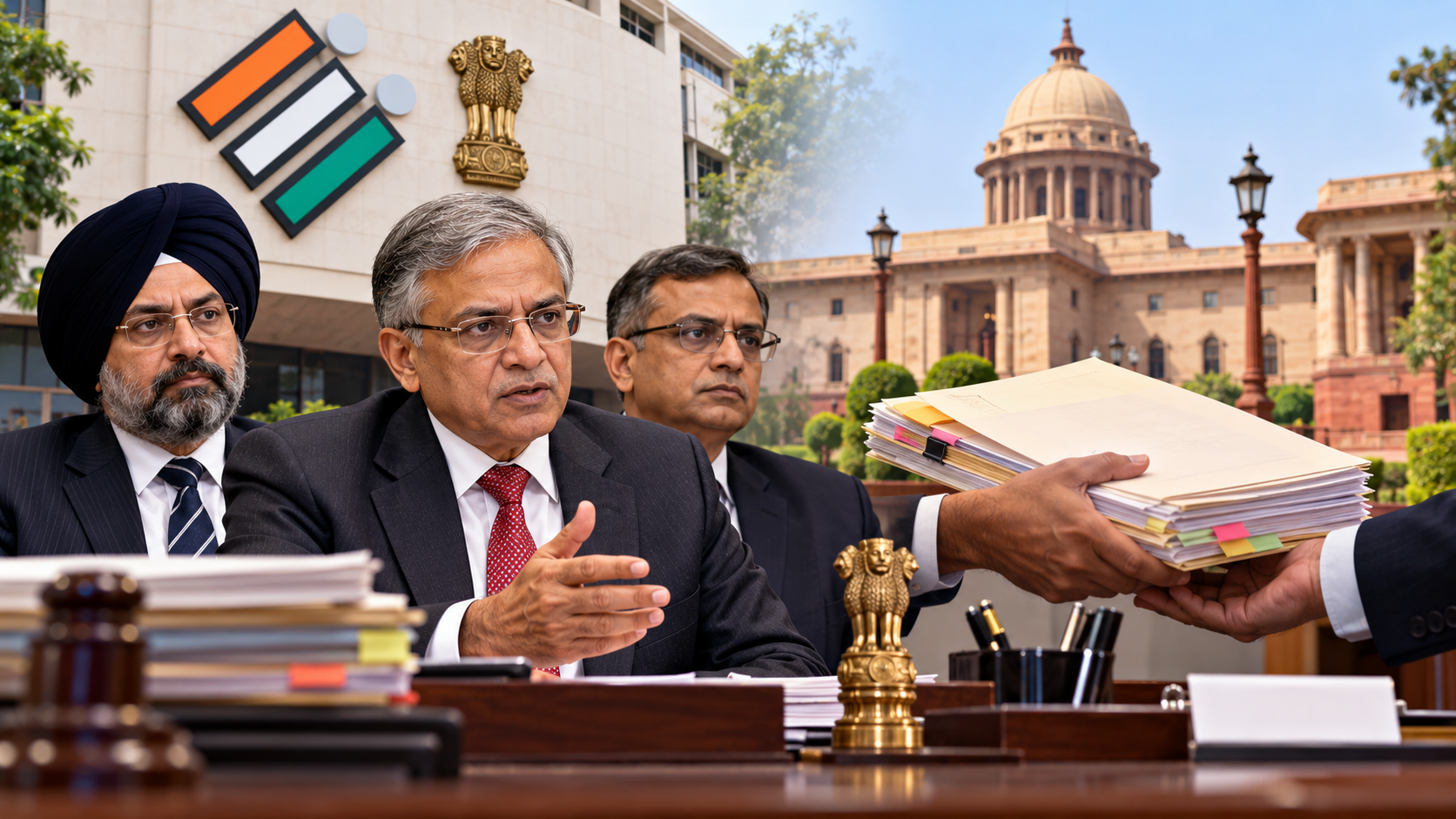
Complaints concerning a senior Election Commission official were referred to the Chief Election Commissioner and the Department of Personnel and Training after the Cabinet Secretariat said acting on individual letters could be viewed as executive interference in an independent constitutional institution.
The Cabinet Secretariat forwarded complaints submitted by two Election Commissioners to Chief Election Commissioner (CEC) Gyanesh Kumar and the Department of Personnel and Training (DoPT), according to documents disclosed through a Right to Information (RTI) application. The records shed light on how the government handled concerns raised by Election Commissioners Sukhbir Singh Sandhu and Vivek Joshi regarding the conduct of a senior official in the Election Commission of India (ECI).
The Cabinet Secretariat reportedly decided against initiating direct action, reasoning that the communications had been submitted by individual commissioners rather than representing an official decision of the Election Commission as a collective body. It noted that acting on such correspondence without an institutional decision could be interpreted as executive interference in the functioning of a constitutional authority.
The disclosure provides details of the administrative process followed after the complaints were received, although the RTI response does not reveal the contents of the letters themselves.
RTI Documents Reveal Timeline of Complaints
According to the records, Election Commissioners Sukhbir Singh Sandhu and Vivek Joshi sent separate letters to Cabinet Secretary T V Somanathan on July 29, raising concerns about the conduct of a senior deputy election commissioner. The Cabinet Secretariat received the communications on July 30.
Subsequent file notings dated August 3 and 4 indicate that officials examined whether the letters could be treated as formal representations from the Election Commission as an institution.
The Cabinet Secretariat concluded that the correspondence had been submitted in the commissioners’ individual capacities. It therefore considered direct intervention inappropriate in the absence of an official decision by the Commission.
On August 5, the Cabinet Secretary forwarded the communications to the office of CEC Gyanesh Kumar and the Department of Personnel and Training. The records indicate that DoPT was asked to retain the matter for possible future administrative consideration concerning the officer.
The documents do not establish that disciplinary action was initiated or that the complaints resulted in a formal finding of misconduct.
Dispute Over Work Allocation at the Election Commission
The complaints reportedly followed a work-allocation order issued on July 28 by a senior deputy election commissioner who had been given additional charge of the administration division.
The order became a point of disagreement within the Commission, with the two Election Commissioners raising concerns about the officer’s conduct. However, the specific allegations contained in their letters remain undisclosed in the RTI response.
The episode highlights the administrative sensitivities surrounding the distribution of responsibilities within an institution entrusted with conducting elections and overseeing the implementation of electoral laws.
Work-allocation decisions can affect the functioning of different departments, particularly when responsibilities involve administration, technology and election-related systems. In this case, the disagreement also brought attention to the procedures governing internal oversight and the resolution of differences among senior officials.
Election Commission’s September Statement
In a statement issued in September, the Election Commission said the correspondence concerned the functioning of an officer on deputation. It maintained that the work-redistribution orders were not implemented after the two Election Commissioners intervened.
The Commission also stated that oversight of the IT division by the deputy election commissioner had not been withdrawn.
These details provide important context to the dispute. While the RTI documents explain how the Cabinet Secretariat processed the letters, the Commission’s statement describes its position regarding the work-allocation issue and the subsequent administrative arrangements.
The available information does not, by itself, establish that the official involved committed any wrongdoing. The complaints, the government’s handling of the correspondence and the Election Commission’s public explanation represent different aspects of the same administrative episode.
ECINet Platform and Review Committee
The Election Commission also addressed questions concerning ECINet, its digital platform supporting election-related operations and information access.
According to the Commission’s September statement, field officers continue to receive role-based access to ECINet in accordance with their statutory powers. The Commission further announced a review committee headed by a senior deputy election commissioner, with an independent expert from an Indian Institute of Technology (IIT) or an Indian Institute of Information Technology (IIIT).
The committee was expected to review the platform’s compliance with applicable electoral laws and rules.
The proposed review places technology governance and statutory compliance among the issues connected to the broader administrative discussion. Digital systems play an increasingly important role in election management, making access controls, responsibility allocation and adherence to legal requirements significant considerations.
However, the available RTI information does not establish that the committee was constituted specifically to investigate the complaints submitted to the Cabinet Secretariat.
Why the Cabinet Secretariat Chose to Forward the Letters
The Cabinet Secretariat’s recorded reasoning centres on the distinction between individual representations and formal institutional decisions.
The Election Commission is a constitutional body, and the Secretariat’s file notings indicate concern that direct executive action based solely on individual commissioners’ letters could be perceived as interference in its functioning.
Forwarding the communications to the CEC and DoPT allowed the matter to be placed before the relevant authorities without the Cabinet Secretariat independently initiating action on the allegations.
The records also indicate that DoPT was asked to keep the matter on file for possible future administrative consideration. This does not necessarily mean that further action was taken, and the disclosed documents do not confirm any subsequent disciplinary proceedings or final administrative decision.
The distinction is important when interpreting the RTI disclosure: the documents establish how the correspondence was processed, but they do not provide a complete account of the underlying allegations or their eventual outcome.
Transparency and Institutional Accountability in Focus
The disclosure has renewed attention on transparency, accountability and the procedures through which concerns involving senior public officials are addressed.
RTI applications can help clarify the movement of official correspondence, the reasoning recorded in government files and the responsibilities assigned to different departments. In this instance, the records provide a timeline of the letters, the Cabinet Secretariat’s assessment and the subsequent forwarding of the matter.
At the same time, assessing the substance of the dispute requires caution because the actual contents of the commissioners’ letters have not been made public through the disclosed records.
The case also raises broader questions about how internal disagreements within constitutional institutions should be addressed while preserving institutional independence and ensuring appropriate administrative oversight.
The balance between accountability and autonomy is particularly significant for the Election Commission because of its responsibility for administering elections and safeguarding the electoral process.
RTI Application Brings Official Correspondence to Light
The records were obtained through an RTI application filed by transparency activist Commodore Lokesh K Batra (Retd).
The disclosure offers a clearer picture of the administrative steps taken after the two Election Commissioners wrote to the Cabinet Secretary in July. It shows that the Cabinet Secretariat did not initiate direct action on the basis of the individual letters, but forwarded them to the CEC’s office and DoPT for consideration and record-keeping.
The contents of the complaints, any subsequent findings and the final administrative outcome remain unclear from the information disclosed.
For now, the key takeaway is that the RTI documents reveal the official handling of the correspondence, rather than a determination on the merits of the allegations. Further clarification from the Election Commission or the concerned government departments would be needed to establish whether any additional action followed.