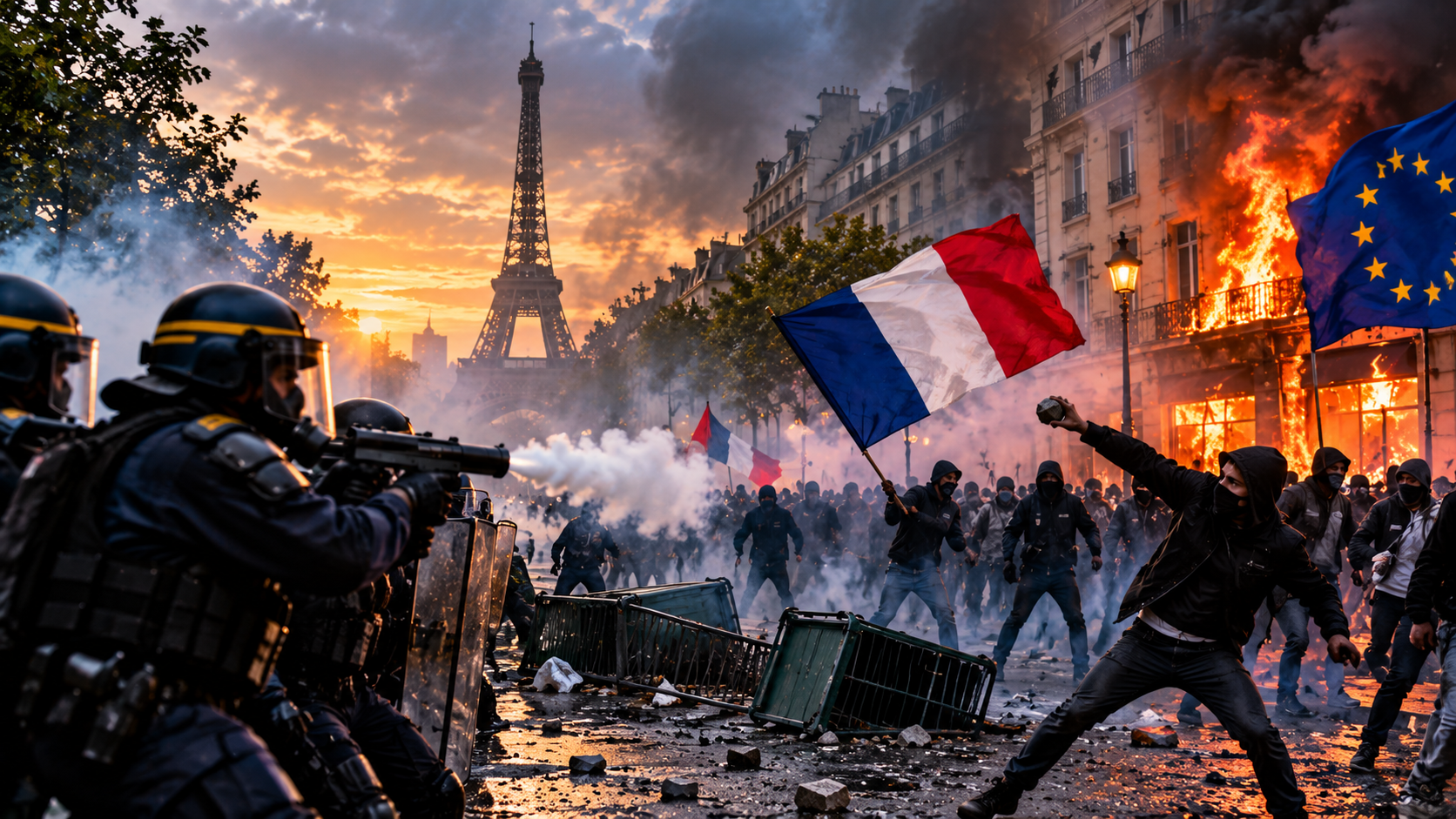
Looting, Arson and Clashes With Police Intensify Political Tensions Ahead of Elections; Macron Vows Tough Action as Businesses Face Heavy Losses
Violent demonstrations across France over rising living costs have triggered growing concern across Europe, with authorities increasingly worried that social unrest could spread as several countries approach important elections in 2027. Protests that initially reflected public frustration over economic pressures have escalated into looting, arson and clashes with security forces, placing additional pressure on governments already struggling with fiscal constraints and political divisions.
The unrest has raised questions about the effectiveness of economic policies, the affordability of everyday essentials and the ability of governments to maintain public order while addressing citizens' concerns. The scale of the violence has also heightened fears that similar demonstrations could recur during politically sensitive periods across the continent.
French President Emmanuel Macron has vowed a firm response against rioters, describing the destruction of public and private property as unacceptable. However, tensions remained high in Paris even as he addressed the nation on Sunday evening.
Cost-of-Living Pressures Fuel Nationwide Anger
Economic hardship has emerged as a central issue behind the demonstrations, with protesters expressing frustration over the rising cost of essential goods, fuel, housing and other household expenses.
The protests reportedly attracted more than half a million people across France. However, the scale of the demonstrations has increasingly been overshadowed by violence against public buildings, shops and restaurants.
Concerns about the affordability of everyday life have become particularly sensitive as households face pressure on their purchasing power and governments confront limited room to increase spending.
The unrest also reflects a broader debate about inequality and the perceived inability of public policies to deliver sufficient economic relief. Pollster Bernard Sananes, head of Elabe, identified a common thread across European countries: dissatisfaction with public policies and a widespread perception that economic opportunities are not being distributed fairly.
Weak economic growth can intensify these grievances by limiting employment opportunities, wage increases and improvements in living standards. When households feel that their financial position is deteriorating, frustration can increasingly spill into political debate and street demonstrations.
Violence Escalates as Shops and Public Buildings Are Targeted
The demonstrations in France turned increasingly violent over the weekend, with reports of looting, arson and confrontations between protesters and police in multiple locations.
Businesses were among the worst affected. Alexandre Bompard, chief executive of Carrefour and head of the French trade and distribution federation, estimated that the damage could cost hundreds of millions of euros to repair.
According to his remarks cited in the report, approximately 1,500 shopkeepers were affected, while around 20 Carrefour supermarkets were looted.
The destruction has created additional challenges for retailers already dealing with operating expenses, consumer uncertainty and pressure on margins. Small businesses can be particularly vulnerable because repairing damaged premises, replacing inventory and dealing with temporary closures may consume a substantial portion of their available cash.
Beyond the immediate financial losses, prolonged unrest can disrupt transport, discourage shoppers from visiting commercial districts and delay normal business operations. Insurers, local authorities and business owners may also face additional costs associated with assessing damage and restoring affected properties.
The economic consequences could extend beyond the locations directly affected if demonstrations continue or consumer confidence deteriorates.
Macron Promises Tough Action to Restore Public Order
President Emmanuel Macron has pledged a hard-line response to those involved in violence and destruction. He has also acknowledged public concerns over rising living costs, including the impact of higher fuel prices linked in the report to the United States' conflict with Iran.
Macron has argued that economic grievances cannot justify attacks on businesses, public infrastructure or private property. He indicated that regional authorities could prohibit certain rallies if necessary to prevent further disorder.
The government faces a difficult balancing act. It must protect public safety and ensure that businesses and residents can operate without fear, while also responding to the economic concerns that have brought demonstrators onto the streets.
A response focused exclusively on security may not resolve the underlying dissatisfaction if households continue to experience financial pressure. Conversely, allowing violent demonstrations to continue unchecked could undermine public confidence in the state's ability to protect property and maintain stability.
The coming weeks will therefore be important in determining whether the authorities can contain the violence without further escalating political tensions.
Political Polarisation Raises Concerns Ahead of Elections
The unrest has added to France's existing political divisions, with leaders from both the far right and far left using the crisis to challenge their opponents.
Marine Le Pen, the far-right leader, criticised the situation as evidence of a country caught between violence and political powerlessness. She also accused the political camp associated with far-left leader Jean-Luc Mélenchon of downplaying violence.
Mélenchon, meanwhile, blamed police provocation for some of the disorder while distancing himself from vandalism and looting.
Former prime minister Édouard Philippe, who is also a presidential candidate, warned that the crisis touches on a fundamental democratic responsibility: ensuring that citizens can expect their property and possessions to be protected by the state.
The competing explanations reflect the broader political struggle over how France should address economic inequality, public security and social discontent.
The intensity of the unrest has raised concerns about the potential for further clashes as the political campaign develops. With elections expected across several European countries in 2027, France's experience is being watched closely by political leaders and policymakers elsewhere.
European Countries Face Similar Social Pressures
France is not the only European country experiencing demonstrations linked to economic hardship.
In Italy, protests in Milan reportedly escalated into rioting and looting over the weekend, with further clashes between police and groups of young people on Sunday. Demonstrations were also reported in Belgium and Portugal.
Spain was expected to see strike action over housing affordability and wages in the following month, shortly before a snap general election.
These developments suggest that concerns over living standards, housing costs and inequality are influencing political debate across several European economies.
The specific causes and intensity of protests vary by country, but pressure on household budgets can create similar challenges for governments. Housing shortages, wage growth that fails to keep pace with expenses, and concerns about access to public services can contribute to public dissatisfaction.
For policymakers, the challenge is to address these issues without creating unsustainable fiscal commitments or weakening confidence in economic management.
France's Budget Challenges Limit Scope for Additional Spending
The unrest comes at a difficult time for France's public finances. The country's National Assembly has begun discussions on a proposed 2027 budget that includes approximately €43 billion in deficit-reduction measures.
The fiscal debate has been complicated by political divisions and concerns over rising government borrowing costs.
The government must balance demands for better-funded public services and economic relief against the need to control deficits and reassure financial markets. Large-scale spending commitments could increase borrowing requirements, while aggressive spending cuts could deepen dissatisfaction among households that already feel financially stretched.
The situation illustrates a wider European policy dilemma: governments are under pressure to improve living standards and provide public services, but their capacity to spend is constrained by debt, borrowing costs and competing priorities.
The effectiveness of France's budget strategy could influence both domestic confidence and the broader perception of the country's economic stability.
Economic and Business Implications of Prolonged Unrest
Continued unrest could affect several parts of the French economy, particularly retail, tourism, hospitality, transportation and small businesses.
Retail and hospitality: Looting, property damage and temporary closures can reduce sales, increase repair expenses and discourage customers from visiting affected areas.
Consumer confidence: Uncertainty and disruptions may lead households to postpone discretionary purchases, potentially affecting businesses that depend on domestic consumption.
Public finances: The cost of restoring damaged infrastructure and maintaining security could add to fiscal pressures at a time when the government is seeking deficit reduction.
Investment sentiment: Persistent political instability can make companies more cautious about expansion plans and may increase the risk premium investors demand for holding assets exposed to economic uncertainty.
Labour relations: Planned strike action could disrupt transport, public services and business operations if negotiations between unions and the government fail to ease tensions.
The ultimate economic impact will depend on the duration and geographical spread of the unrest, the scale of business disruption and the government's ability to restore normal conditions.
November 5 Strike Call Adds to Uncertainty
Five labour unions in France have called for a strike on November 5, demanding higher wages and increased funding for public services. Pensioners and high-school students have also been invited to participate.
The planned action could create another flashpoint if economic grievances remain unresolved. Its impact will depend on participation levels, the sectors affected and the government's response.
Transport services, public administration and other essential activities could face disruption if the strike attracts broad participation. Businesses may also need to prepare for possible interruptions to staffing, deliveries and customer access.
At the same time, the strike provides a potential channel for organised labour to communicate its demands through collective action. Whether it leads to negotiations or further confrontation will be an important test of the government's ability to manage the crisis.
Market Outlook
France's escalating protests highlight the economic and political risks that can emerge when cost-of-living pressures intersect with inequality, fiscal constraints and deep political divisions. The immediate concerns include damage to businesses, disruption to commercial activity and the possibility of further demonstrations in the coming weeks.
For European markets, the broader implications will depend on whether the unrest remains concentrated in affected areas or develops into a prolonged source of political and economic uncertainty. A sustained deterioration in confidence could weigh on consumer spending and business investment, while additional public expenditure on security and reconstruction could complicate deficit-reduction efforts.
Investors will need to monitor the government's handling of public order, progress on the 2027 budget, the November 5 strike and the broader European political calendar. Any evidence of prolonged disruption could influence expectations for growth, corporate earnings and the region's fiscal outlook.
For businesses, the priority is to assess operational risks, protect employees and property, and prepare for potential interruptions to trading and logistics. For policymakers, restoring public order will be essential, but addressing the underlying concerns over wages, housing, fuel costs and public services will also be critical to reducing the risk of recurring unrest.
The central issue is whether France and other European governments can restore confidence by combining effective law enforcement with credible economic measures. Without progress on both fronts, the risk of further social and political instability is likely to remain a concern for businesses, households and financial markets.