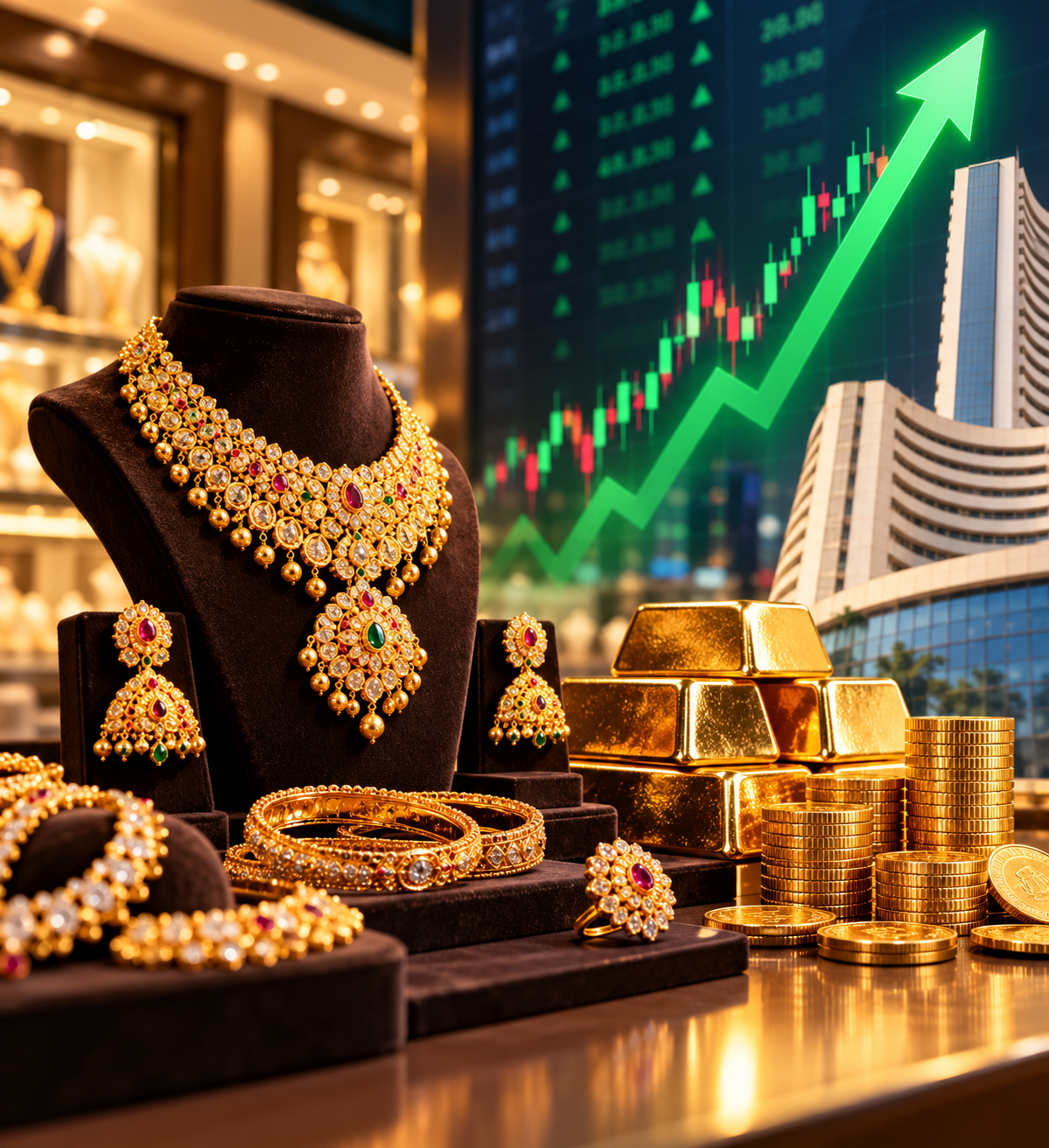
Strong Q2 FY27 business updates, festive demand, premiumisation and gains by organised jewellery retailers lift investor sentiment, while debt reduction and export expansion add company-specific triggers
Shares of Indian jewellery companies surged on Friday, October 16, as investors responded to encouraging business updates and expectations of sustained demand during the festive and wedding seasons. PC Jeweller, Senco Gold, Sky Gold and Diamonds, Shanti Gold International and Thangamayil Jewellery were among the stocks that recorded sharp gains, with select shares advancing as much as 17% during intraday trading on the BSE.
The rally came despite gold prices remaining elevated. According to analysts at Choice Institutional Equities, domestic jewellery demand remained healthy during the second quarter of FY27, supported by festive purchases, premiumisation and continued market-share gains by organised players. The trend suggests that consumers are adapting to higher gold prices, even as the impact on affordability and discretionary spending remains an important risk.
Company-specific developments also helped fuel buying interest. PC Jeweller reported strong revenue growth and said it had repaid its outstanding bank debt, while Sky Gold's expansion plans and rising export contribution have attracted attention. However, sharp share-price increases do not necessarily mean that all jewellery stocks offer similar valuations or earnings prospects.
PC Jeweller Surges to a 52-Week High
PC Jeweller was among the strongest performers in Friday's session, with its share price climbing to a new 52-week high of ₹17.15 during intraday trading, according to the figures reported. Trading volumes also rose sharply, indicating increased market participation.
The company reported approximately 28% year-on-year growth in consolidated revenue for Q2 FY27, reflecting continued business momentum. The update provided a positive signal for investors looking for evidence that jewellery demand remains resilient despite higher bullion prices.
A major development was the company's announcement that it had repaid outstanding bank debt ahead of the scheduled repayment dates, achieving debt-free status with respect to its bank borrowings. The move is expected to reduce interest expenses and could support profitability, provided operating performance remains healthy.
PC Jeweller also received approximately ₹142 crore in remittances from outstanding export debtors during the quarter. Recovering export receivables can improve liquidity and reduce the amount of working capital tied up in unpaid balances.
Nevertheless, investors should distinguish between revenue growth, cash collection and sustainable earnings improvement. The durability of demand, operating margins, cash flow generation and the company's ability to maintain a stronger balance sheet will remain important measures of progress.
Sky Gold and Diamonds: Expansion Beyond India Supports Growth Prospects
Sky Gold and Diamonds also attracted buying interest, with its share price touching a fresh 52-week high of ₹1,073.85 during the session. The stock had risen approximately 33% during October up to the time covered by the report and had gained substantially from its February low.
Sky Gold manufactures gold jewellery and supplies products to major organised retail chains. Its business prospects are linked to the expansion of jewellery retailers, demand for differentiated designs, product development and the ability to increase manufacturing capacity.
International expansion is emerging as an important growth avenue. The company has established a presence in Dubai to develop business in the Gulf Cooperation Council (GCC) region, where jewellery preferences and retail demand create opportunities for suppliers offering customised designs.
According to figures cited from the company's FY26 annual report takeaways by Equirus Securities, exports increased from around 3% of revenue in FY23 to approximately 12%. Management has indicated an ambition to increase exports to around 20% of total sales by FY29–30, with the UK, Malaysia and Singapore identified as additional markets alongside its existing Gulf presence.
Achieving this target would require successful customer acquisition, consistent product quality, effective logistics and the ability to manage currency and working-capital risks. Export expansion can diversify revenue, but the benefits will depend on execution and the profitability of new business.
Senco Gold, Thangamayil and Other Jewellery Stocks Join the Rally
The buying interest extended beyond PC Jeweller and Sky Gold. Senco Gold, Shanti Gold International and Thangamayil Jewellery advanced approximately 7–8% each during intraday trading, while PNGS Reva Diamond Jewellery gained around 10%. Tribhovandas Bhimji Zaveri also rose about 5% and touched a new 52-week high, according to the report.
The broad-based movement suggests investors are responding to the jewellery sector's demand outlook rather than to a single corporate announcement. Organised retailers have benefited from growing consumer preference for branded products, transparent billing, a wider range of designs and established retail networks.
At the same time, the reasons behind each stock's movement may differ. Retail jewellers are influenced by store expansion, same-store sales, product mix and consumer spending, whereas jewellery manufacturers are more directly exposed to orders from retail chains, capacity utilisation, client concentration and manufacturing margins.
Investors should therefore avoid treating the entire sector as a uniform investment opportunity. Strong sales growth at one company does not automatically imply comparable earnings growth or valuation support at another.
Why Jewellery Demand Remains Resilient Despite Expensive Gold
Gold prices were approximately 28% higher year-on-year during the period discussed, yet jewellery demand remained healthy in Q2 FY27, according to Choice Institutional Equities. Three factors have been particularly important: festive purchases, premiumisation and the increasing market share of organised retailers.
Festive and wedding demand: Jewellery purchases are closely linked to festivals, weddings and other family occasions. These purchases can remain relatively resilient even when gold becomes more expensive, although buyers may adjust quantities, designs or the timing of purchases.
Premiumisation: Consumers are increasingly opting for differentiated designs, studded jewellery and higher-value products. This can increase the average transaction value, helping retailers report revenue growth even when the quantity of gold sold grows more slowly.
Organised-sector gains: Established jewellery chains can benefit from consumer preference for trusted brands, standardised product quality, transparent pricing and broader retail networks. As organised players gain share, their growth may outpace the wider jewellery market.
However, higher prices can also make jewellery less affordable, especially for price-sensitive households. A rise in revenue should not automatically be interpreted as an equivalent rise in the volume of gold sold.
Titan and Kalyan Jewellers Provide Evidence of Sector Demand
Business updates from major listed jewellery retailers also point to healthy demand during the quarter.
Titan reported 21% year-on-year growth in its jewellery business, with studded jewellery growing in the early 30% range and plain gold jewellery increasing by 20%, according to the figures cited in the brokerage preview.
Kalyan Jewellers reported 27% year-on-year growth in its India business, supported by same-store sales growth of approximately 20%. Same-store sales growth is useful because it measures performance at existing outlets, helping investors distinguish underlying store productivity from growth driven by opening new stores.
These figures support the view that established retailers continued to attract customers despite the higher gold-price environment. Still, sales growth needs to be assessed alongside margins, inventory costs, store-opening expenses and working-capital requirements to understand how much additional revenue translates into profit.
Festive Calendar Shift Could Affect Quarterly Comparisons
Although demand remained healthy during Q2 FY27, Choice Institutional Equities noted some softening towards the end of the quarter as part of the festive calendar shifted into Q3 FY27.
This timing effect matters when comparing quarterly results. Jewellery purchases often cluster around auspicious dates and major festivals, so a shift in the calendar can move revenue between reporting periods without necessarily indicating a structural change in demand.
Investors will therefore need to assess Q2 results alongside Q3 business updates before drawing conclusions about the sector's underlying growth trajectory. Wedding demand, customer footfall, average ticket sizes and same-store sales will be useful indicators to monitor.
B2B Jewellery Manufacturers: Growth Opportunities and Margin Risks
Jewellery manufacturers supplying organised retailers are also expected to benefit from healthy demand. According to Choice Institutional Equities, growth opportunities include capacity expansion, new customer additions, deeper penetration among organised retailers and diversification into categories such as bridal and studded jewellery.
A broader product portfolio can help manufacturers serve more customer segments and reduce dependence on a narrow range of products. Additional retail partnerships can also increase order visibility and support utilisation of manufacturing capacity.
However, the brokerage cautioned that the benefit from low-cost gold inventory is largely over and that margins may normalise. When gold prices rise, manufacturers holding inventory purchased at lower prices can temporarily benefit from favourable inventory economics. As that inventory is replenished at higher prices, this advantage may fade.
Consequently, strong revenue growth may not translate into equally strong profit growth. Investors should monitor gross margins, inventory turnover, working-capital needs and customer concentration when evaluating jewellery manufacturers.
What Investors Should Watch Next
The next phase of the jewellery-stock rally will depend on whether encouraging business updates translate into sustainable financial performance. Important factors include:
-
Revenue and volume growth: Determine whether higher sales reflect more jewellery sold, higher average prices or a combination of both.
-
Operating margins: Assess the effects of gold costs, product mix, discounting and normalising inventory benefits.
-
Cash flow and debt: Review debt reduction, receivables collection and working-capital requirements.
-
Festive and wedding demand: Track footfall, same-store sales and customer spending in Q3 FY27.
-
Valuations: Compare share prices with expected earnings, cash flows and business risks rather than relying solely on recent price momentum.
Sharp rallies can increase volatility, particularly in stocks that have already advanced substantially over a short period. A strong business outlook and an attractive share price are not necessarily the same thing.
Market Outlook
The jewellery sector entered the second half of FY27 with encouraging demand signals, supported by festive purchases, premiumisation and continued gains by organised retailers. PC Jeweller's debt repayment and revenue growth, along with Sky Gold's export ambitions, have added company-specific catalysts to the broader sector narrative.
The outlook is nevertheless not without risks. Elevated gold prices may constrain affordability, festive-calendar shifts can distort quarterly comparisons, and manufacturers may face margin normalisation as low-cost inventory benefits fade. Investors should focus on earnings quality, cash generation, valuations and company-specific execution rather than assuming that the recent rally will continue across all jewellery stocks.
This article is for informational purposes only and does not constitute investment advice or a recommendation to buy or sell any security.