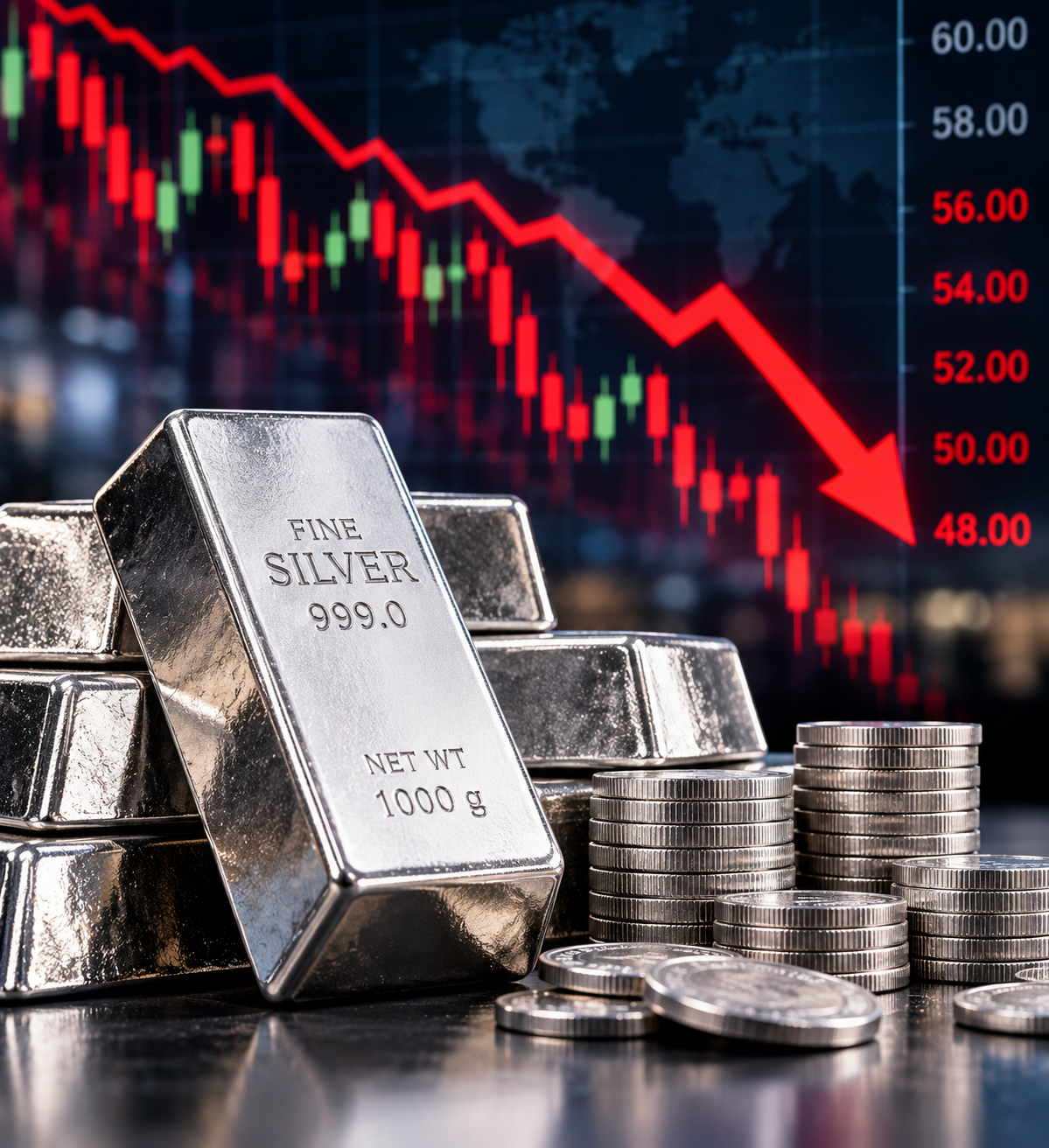
Rising US inflation, interest-rate uncertainty and weak ETF flows pressure silver, while higher inventories in China add to downside risks
Silver prices are facing renewed downward pressure as concerns over persistent inflation in the United States, the possibility of tighter monetary policy and weakening investment demand weigh on the precious metal. Praveen Singh, head of commodities at Mirae Asset Sharekhan, has cautioned that silver could decline towards $50 and potentially $48 if it decisively breaks the important support level of $54.50 an ounce.
The assessment follows a sharp sell-off in the international silver market. Spot silver dropped approximately 6% on October 15 to around $55.40 an ounce, its lowest level since July 17, before recovering alongside a rise in US bond yields. At the time of the analyst's assessment on the night of October 15, silver was trading near $57 an ounce, up around 2.5% on the day. Despite the recovery, the metal remained under pressure and was down approximately 20% year-to-date, according to the cited report.
The immediate direction of silver will depend on whether prices can stabilise above key technical support levels and whether inflation and investment-demand trends improve.
US Inflation Revives Interest-Rate Concerns
One of the principal factors weighing on silver is the latest US inflation data. September's consumer price index (CPI) rose 0.6% month-on-month, while annual inflation accelerated to 3.7%, above the previous reading of 3.4%. Core CPI inflation, which excludes food and energy, increased to 2.6% year-on-year and rose 0.3% from the previous month.
Producer-price data also pointed to persistent price pressures. The US Producer Price Index for final demand climbed 1.3% month-on-month in September, significantly exceeding the forecast of 0.6%. Annual producer-price inflation reached 6.3%, while core producer prices increased 0.7% during the month.
These figures have raised concerns that inflation could remain elevated for longer than anticipated, potentially limiting the scope for interest-rate cuts or increasing the risk of tighter monetary conditions.
Higher interest rates generally make non-yielding assets such as silver less attractive relative to interest-bearing investments. They can also support the US dollar and increase the opportunity cost of holding precious metals. However, the relationship is not automatic: silver can also respond to industrial demand, currency movements, geopolitical risks and changes in investor positioning.
Oil Prices and Geopolitical Risks Add to Market Uncertainty
Energy prices and geopolitical developments remain important variables for the silver market. At the time of the cited assessment, Brent crude futures were trading around $106 a barrel, while West Texas Intermediate crude had risen more than 3%.
Elevated oil prices can increase transportation, manufacturing and energy costs, potentially feeding into broader inflation. If energy-driven inflation prevents central banks from easing policy, precious metals could face additional pressure.
At the same time, geopolitical tensions across the Middle East and the Russia-Ukraine conflict are contributing to uncertainty in energy markets. Developments involving oil supply, sanctions and regional security could trigger abrupt movements in crude prices and financial markets.
For silver, the impact is not necessarily one-directional. Geopolitical stress can increase demand for safe-haven assets, but if the resulting inflation leads to higher interest-rate expectations and a stronger dollar, that pressure may offset some of the support. Traders will therefore need to assess the interaction between energy prices, inflation expectations, bond yields and currency movements rather than relying on geopolitical headlines alone.
ETF Outflows Signal Weakening Investment Demand
Investment flows are another concern highlighted by Singh. Global silver exchange-traded funds (ETFs) held approximately 800 million ounces of silver, down 7.94% so far in 2026, according to the figures cited in the report. Holdings have declined from a cycle peak of around 869 million ounces recorded on December 23, 2025.
ETF flows are closely watched because they provide an indication of investor participation in the precious-metals market. Sustained outflows can reflect profit-taking, reduced appetite for precious metals or a shift towards other assets. Weak flows may also limit the market's ability to recover quickly after a sharp decline.
Silver's relative weakness compared with gold is particularly noteworthy. Gold often attracts defensive investment demand during periods of uncertainty, while silver has an additional industrial-demand component. As a result, silver can react differently to changing expectations for economic growth, manufacturing activity and interest rates.
A sustained improvement in ETF demand could help stabilise prices, but the current flow picture does not yet provide a strong bullish signal.
COMEX and Chinese Inventories Raise Supply-Side Questions
Inventory data present a mixed picture. Registered silver stocks at COMEX stood at approximately 103.09 million ounces, around 48% below the record peak of 201 million ounces seen in September 2025. However, inventories had recovered more than 37% from their cycle low recorded on April 28.
Lower exchange inventories can sometimes indicate tighter immediately available supply, but the figures must be interpreted alongside demand, deliveries and changes in the broader inventory system. A decline in stocks alone does not guarantee higher prices.
Chinese inventory trends are more challenging for the bullish case outlined by the analyst. Shanghai Futures Exchange silver stocks available for warrant delivery were reported at around 1,415 tonnes, nearly 5% below the cycle high of 1,490 tonnes recorded on September 30. Nevertheless, inventories had climbed sharply from approximately 252 tonnes in March.
The large recovery in Chinese stocks may indicate improved availability within the exchange-tracked system. If inventories continue to rise while investment demand remains subdued, prices could find it difficult to sustain a meaningful recovery.
China’s Silver Imports Remain Strong on an Annual Basis
China imported nearly 260 tonnes of silver in August, down 9.77% from July but approximately 30% higher than a year earlier. Cumulative imports through August were up nearly 45% year-on-year, according to the cited data, supported by particularly strong imports in March and April.
Import figures are an important part of the silver-demand picture because China is a major participant in global industrial and precious-metals markets. Strong annual import growth can point to underlying demand, although monthly fluctuations and inventory accumulation complicate the interpretation.
The key question is whether imported silver is being absorbed by industrial users and investors or accumulating in inventories. Strong imports may support prices if they reflect sustained end-user demand, but rising stocks can have the opposite implication when supply grows faster than consumption.
Low LBMA Lease Rates Indicate Comfortable Availability
The one-month London Bullion Market Association (LBMA) silver lease rate was reported at 0.02%, substantially below the historical average range of approximately 0.3% to 0.6% cited by the analyst.
Lease rates reflect the cost of borrowing physical metal and can offer clues about immediate supply conditions. Very low rates are consistent with relatively comfortable availability of silver in the London market, reducing the evidence of physical tightness that might otherwise support prices.
Lease rates are only one indicator, however. They should be considered alongside exchange inventories, physical premiums, ETF holdings, industrial consumption and futures-market positioning before drawing conclusions about the overall supply-demand balance.
Silver Price Levels: $54.50 Support in Focus
The technical outlook identified by Singh remains cautious. The analyst highlighted the following international price levels:
-
Key support: $54.50 per ounce
-
Potential downside targets after a decisive breakdown: $50 and $48 per ounce
-
Resistance levels: $59, $60, $61 and $63.30 per ounce
A decisive break below $54.50 could indicate that selling pressure is strengthening and expose silver to further declines towards $50 and, potentially, $48. Such a move would depend on follow-through selling and confirmation from broader market conditions; the targets are scenarios, not guaranteed outcomes.
On the upside, silver would need to recover and sustain levels above the nearby resistance zone to improve its short-term technical picture. A move above $59–$60 could be an early sign of stabilisation, while further resistance around $61 and $63.30 may limit recovery attempts.
The analyst's reported approach favours selling into rallies with a strict stop-loss. This is an attributed market view, not a suitable strategy for every investor. Silver is volatile, and leveraged futures positions can magnify losses when prices move sharply against a trade.
Market Outlook
Silver's near-term outlook remains bearish according to Mirae Asset Sharekhan's Praveen Singh, with persistent US inflation, interest-rate uncertainty, weak ETF flows and rising Chinese inventories among the principal concerns. The $54.50 level is the key technical threshold to monitor: a confirmed break could open the way towards $50 and $48, while a sustained recovery above resistance levels would weaken the immediate bearish case.
Several developments could change this assessment, including softer US inflation, a weaker dollar, lower bond yields, renewed ETF inflows or stronger industrial demand. Conversely, further inflation surprises and tighter monetary-policy expectations could deepen selling pressure.
For Indian investors, international silver prices are only one part of the equation. Domestic prices are also influenced by the rupee-dollar exchange rate, import costs, taxes and local premiums. International dollar-denominated levels should therefore not be directly treated as Indian market price targets.
Important disclaimer: This article summarises an analyst's market assessment and is intended for information only. Price levels and forecasts are uncertain, not guaranteed outcomes, and should not be treated as personalised investment advice or a recommendation to buy or sell silver. Investors should assess volatility, transaction costs and their individual risk tolerance before making decisions.