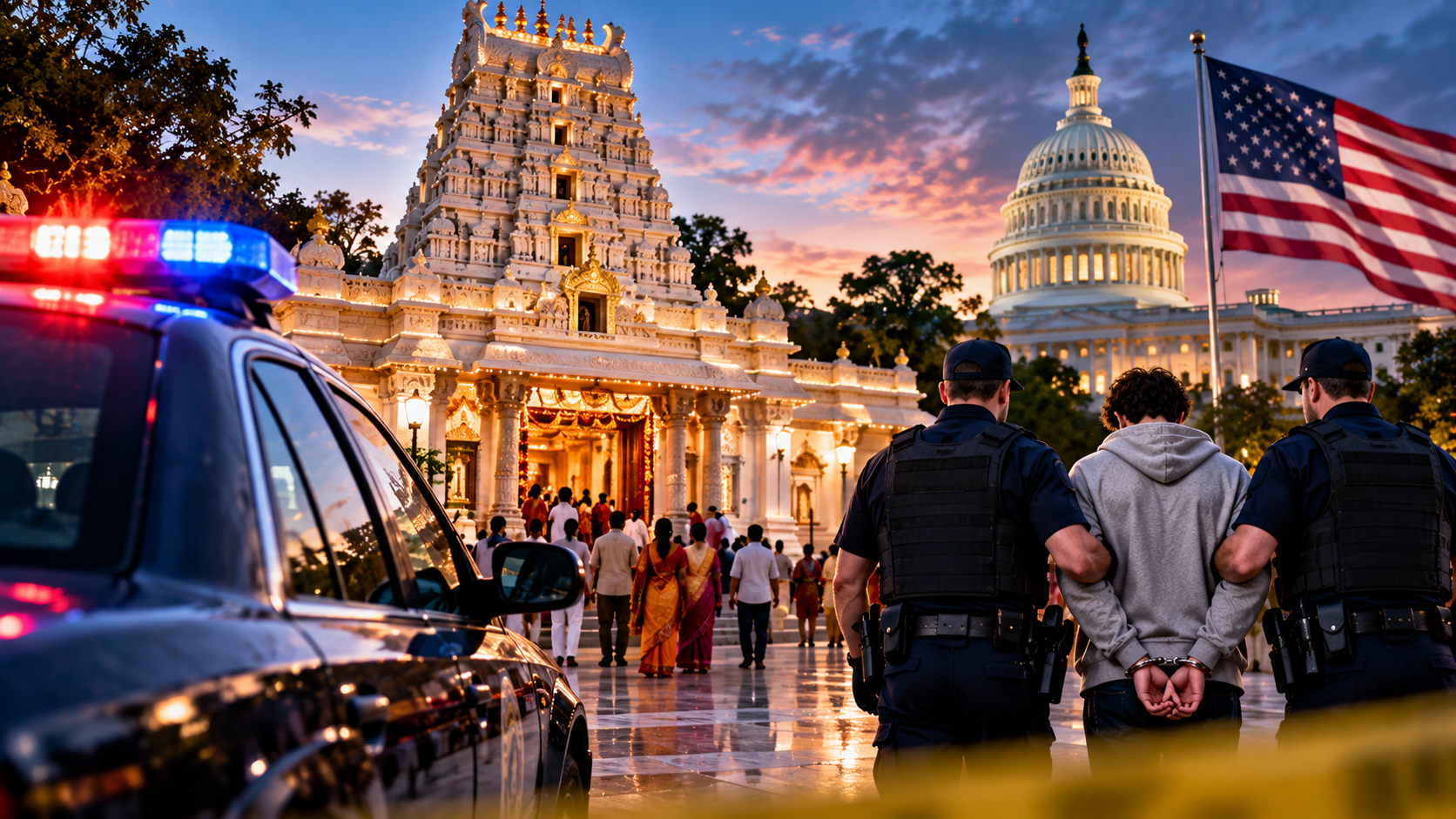
Arrest of a 19-year-old over an alleged attack plan targeting Sri Venkateswara Temple in Aurora sparks concern across Washington, with lawmakers and advocacy groups warning that anti-Indian and anti-Hindu hostility must be confronted before it escalates into violence
A reported plot to carry out a mass shooting at a Hindu temple in Illinois has triggered strong reactions from US lawmakers and civil rights organisations, renewing concerns about anti-Indian sentiment, religious intolerance and the safety of places of worship across the country.
A 19-year-old suspect was arrested in Palatine, near Chicago, over an alleged plan to attack the Sri Venkateswara Temple in Aurora, Illinois. According to the reported account, the incident was prevented after the firearm allegedly failed to discharge. The suspect appeared in court on October 14, 2026, facing charges of making a terrorist threat and unlawful possession of weapons.
The alleged plot has drawn condemnation from lawmakers across party lines, including Senate Democratic Leader Chuck Schumer, Senator John Cornyn and Senator Jacky Rosen. Several members of the US House of Representatives and advocacy organisations have also called for stronger action against hate-driven threats targeting Indian Americans, Hindus and other minority communities.
The incident has renewed a broader debate over how inflammatory rhetoric, online hostility and extremist ideologies can contribute to threats against vulnerable communities. Officials and community representatives have emphasised the importance of protecting religious freedom and ensuring that people can attend places of worship without fear.
US Senators Condemn Anti-Indian and Anti-Hindu Hostility
Chuck Schumer expressed concern that hostility directed at Indian Americans and Hindus was becoming increasingly dangerous. He praised law enforcement for responding to the alleged threat and stressed that people of every racial and religious background should be able to practise their faith openly.
Senators John Cornyn and Jacky Rosen also commended the authorities' intervention. Their responses reflected a broader concern in Washington that threats against religious institutions require a serious and coordinated response, regardless of the community being targeted.
The reactions have extended beyond the Senate. Lawmakers from different political backgrounds have called for unity against racial and religious discrimination, arguing that violence or intimidation directed at a community undermines the principles of religious freedom and equal protection.
The statements also highlight the importance of distinguishing political disagreement from hostility directed at people because of their ancestry, nationality or religion. Lawmakers have warned that rhetoric that portrays entire communities as threats can deepen social divisions and create an environment in which targeted intimidation becomes more likely.
Congressional Asian Pacific American Caucus Warns of Wider Threat
The Congressional Asian Pacific American Caucus (CAPAC) described the alleged plot as a serious warning about the risks facing minority communities and places of worship.
In a statement signed by lawmakers including Suhas Subramanyam, Grace Meng and Judy Chu, the caucus said the incident should not be viewed in isolation. It raised concerns about white supremacist ideology and the potential for extremist beliefs to translate into threats against religious institutions.
CAPAC also cited a reported 240 per cent increase in anti-South Asian hate speech on the social media platform X over the preceding two years. The organisation linked the trend, in part, to the amplification of racist rhetoric, the scapegoating of immigrant communities and the wider circulation of xenophobic messages.
The figure cited by the caucus relates specifically to its reported assessment of activity on one social media platform. It should not be interpreted as a direct measure of all hate incidents across the United States, but it underscores concerns about the reach and visibility of online hostility.
The caucus urged public figures and political leaders to reject discriminatory language and make clear that threats against any racial or religious group are unacceptable.
Civil Rights Groups Raise Concerns About Places of Worship
The Anti-Defamation League (ADL), a non-profit organisation that works to combat antisemitism and other forms of hate, also expressed concern about the vulnerability of religious institutions to extremist threats.
The concerns extend beyond Hindu temples. Churches, mosques, synagogues and other places of worship have faced threats and acts of violence in different parts of the United States. Civil rights organisations argue that protecting these institutions requires a sustained effort involving law enforcement, community leaders, schools, technology platforms and elected representatives.
Religious institutions often serve as more than places for prayer. They can function as cultural centres, community gathering spaces and sources of support for families. Threats against them can therefore affect people well beyond those who are physically present at a particular location.
Community representatives have stressed that public condemnation should be accompanied by practical measures, including the responsible reporting of threats, cooperation with authorities and support for people affected by discrimination.
Alleged Plot Raises Questions About Online Radicalisation
The incident has also brought renewed attention to the relationship between online hostility and real-world threats. Social media platforms allow communities to communicate and organise, but they can also be used to circulate discriminatory content, amplify conspiracy theories and expose individuals to extremist narratives.
The progression from hateful language to violence is not automatic, and the motivations behind an alleged criminal act must be established through evidence and legal proceedings. Nevertheless, researchers and civil rights organisations have repeatedly warned that dehumanising language and the normalisation of prejudice can increase risks for targeted communities.
The case reinforces the importance of taking credible threats seriously and ensuring that reports are assessed by appropriate authorities. It also highlights the need for careful public discussion that condemns extremism without assigning collective blame to any racial, religious or national group.
Any determination of the suspect's motives and the facts of the alleged plan must ultimately be based on evidence presented through the legal process.
Lawmakers Call for Unity and Accountability
Several lawmakers urged political leaders to avoid rhetoric that divides communities along racial, religious or national lines.
Congressman Tom Suozzi warned that language vilifying people because of their background can damage social cohesion. Congressman Greg Stanton described the alleged plot as an example of white supremacist hatred directed at Indian Americans, while Senator Jacky Rosen emphasised that no religious community should be targeted because of its identity.
Congressman Bill Foster also called for people to speak out against hatred and bigotry wherever they emerge. Congressman Jonathan Jackson urged President Donald Trump to condemn the alleged act explicitly and reconsider rhetoric that critics believe can encourage hostility towards minority groups.
These comments illustrate the political sensitivity surrounding hate crimes and extremist threats. While lawmakers may disagree over the causes and appropriate policy responses, the reactions to the Illinois case reflected broad support for the principle that people should be free to worship without intimidation or violence.
The Pakistani-American Public Affairs Committee also expressed concern, noting that the alleged threat affected a temple where Congressman Raja Krishnamoorthi and his family were reportedly present. Its response underscored how threats against religious institutions can affect families and communities across ethnic and national backgrounds.
Religious Freedom and Community Safety Remain Central
The alleged plot has prompted renewed calls for stronger protection of religious institutions and closer engagement between law enforcement and community organisations.
Places of worship can face distinctive security challenges because they are intended to be open and welcoming. Measures to improve safety must therefore balance security needs with accessibility and the ability of communities to practise their faith freely.
Authorities and religious leaders can support prevention through threat reporting, emergency preparedness, community outreach and cooperation with local law enforcement. Public institutions also have a role in ensuring that hate incidents are investigated fairly and that affected communities receive appropriate support.
At the same time, civil rights advocates stress that long-term efforts must address discrimination and extremist narratives, not just the immediate security risks. Building trust between communities and public authorities can help encourage the reporting of threats and reduce the isolation that often follows targeted hostility.
Outlook: A Test of America's Commitment to Religious Freedom
The alleged shooting plot at Sri Venkateswara Temple has become a focal point for a wider discussion about anti-Indian hostility, anti-Hindu prejudice and the safety of religious minorities in the United States.
The swift response by law enforcement has been welcomed by lawmakers, while the public reaction has placed renewed emphasis on preventing hate-driven violence and ensuring accountability when credible threats emerge. The case also highlights concerns about the potential consequences of extremist ideologies and discriminatory rhetoric in both online and public spaces.
The immediate legal proceedings will be important in establishing the facts of the alleged plan. Beyond the courtroom, the incident presents a challenge for political leaders, civil rights organisations and local communities: ensuring that condemnation of hatred is matched by practical steps to protect people and institutions at risk.
For Indian Americans and other minority communities, the central issue is the ability to participate fully in public life without fear because of their identity. Protecting that freedom requires effective law enforcement, responsible public discourse and a consistent commitment to equal treatment under the law.