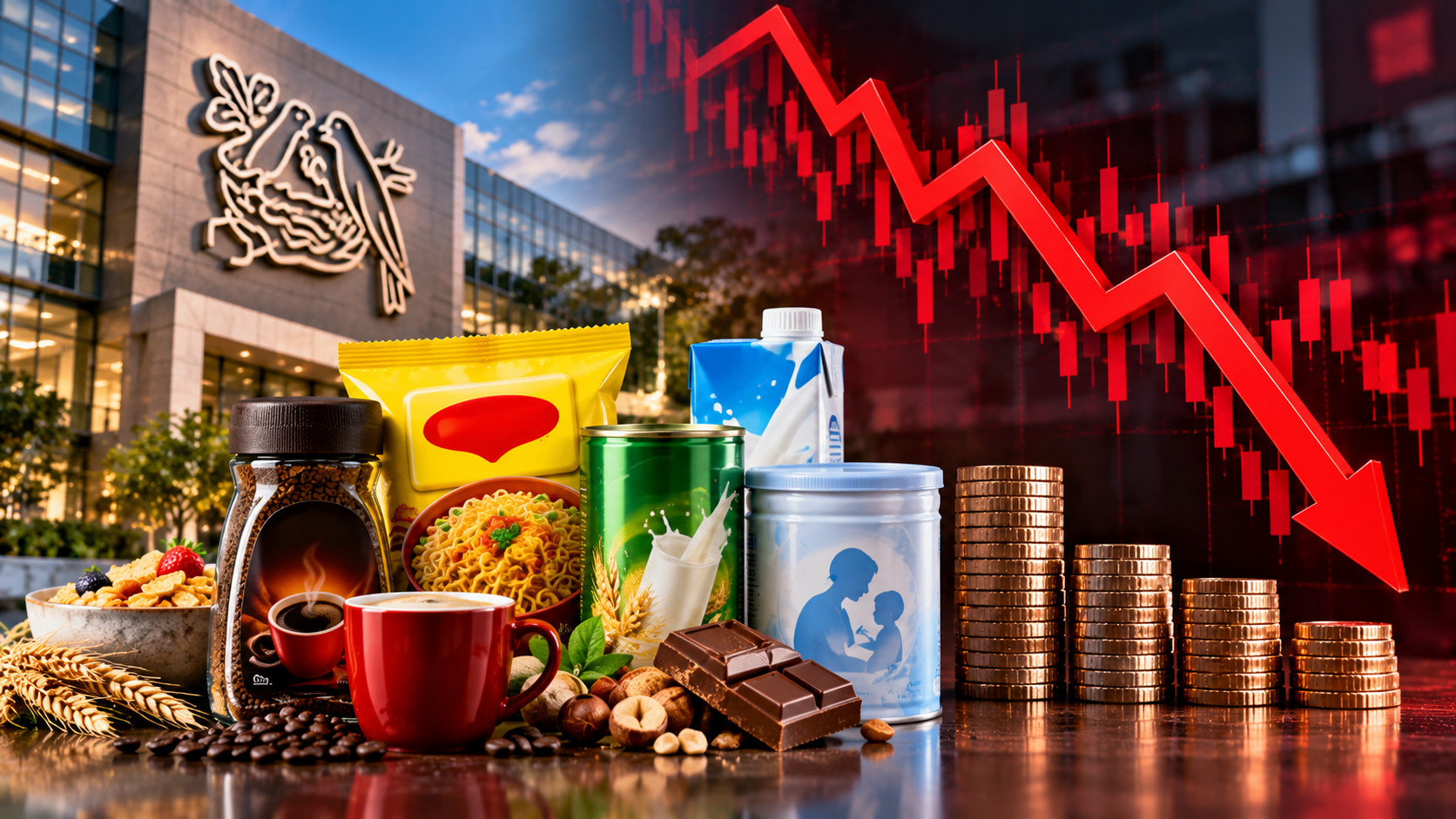
Strong double-digit volume growth and improved operating margins fail to reassure investors as rising food inflation, elevated input costs and concerns over future sales growth trigger a reassessment of the FMCG major's valuation
Shares of Nestlé India came under significant selling pressure on October 15 and 16, 2026, declining approximately 9 per cent over two sessions despite the company's strong second-quarter performance for FY27. The market reaction reflects growing investor concerns about rising food inflation, volatile commodity prices and the possibility that sales growth could moderate in the second half of the financial year.
The packaged-food major reported a substantial increase in profit, higher revenue and double-digit volume growth for the July–September quarter. However, management's caution regarding input-cost pressures has shifted attention towards the sustainability of margins and consumer demand.
The stock slipped to an intraday low of ₹1,257.10 on Friday after opening at ₹1,289.70. It had closed 7.7 per cent lower at ₹1,275.80 on Thursday, following the announcement of its quarterly results. The decline indicates that investors are weighing future earnings risks more heavily than the reported growth in the latest quarter.
Nestlé India Q2 FY27 Results: Profit Rises 36%, Revenue Grows 20%
Nestlé India reported consolidated net profit of ₹1,000.61 crore for Q2 FY27, an increase of 35.81 per cent from ₹734.17 crore in the corresponding quarter of the previous financial year.
Revenue from the sale of products rose 20.45 per cent year-on-year to ₹6,782.17 crore, compared with ₹5,630.23 crore a year earlier. The results reflect broad-based demand across product categories, supported by stronger volumes and continued market development.
Earnings before interest, tax, depreciation and amortisation (EBITDA) increased 33.3 per cent to ₹1,570 crore. The EBITDA margin improved by more than 200 basis points to 23.1 per cent, indicating that the company was able to expand profitability despite an inflationary operating environment.
The improvement in margins was partly supported by savings in employee costs, according to brokerage commentary. However, the persistence of elevated input prices could make it more challenging to maintain the same level of profitability in coming quarters.
Double-Digit Volume Growth Supports the Business
One of the strongest features of Nestlé India's quarterly performance was its volume growth. Chairman and Managing Director Manish Tiwary said the September quarter continued to see strong and broad-based growth across product groups, with total sales increasing by approximately 20.5 per cent.
Domestic sales rose 20.4 per cent to ₹6,514.74 crore, while export revenue increased 22 per cent. The company attributed the performance to robust volume growth, portfolio expansion and continued market development.
Analysts estimated volume growth at around 12 per cent, suggesting that the improvement was not driven solely by higher product prices. This distinction matters for consumer-goods companies because volume-led growth can indicate stronger underlying demand and better customer acceptance.
Nevertheless, the ability to sustain this momentum will depend on household purchasing power, competitive pricing, product availability and the extent to which higher input costs are passed on to consumers.
Rising Food Inflation Emerges as the Biggest Concern
Despite the strong results, management flagged inflation and higher commodity prices as key challenges. Packaging materials, edible oils and agricultural commodities are among the cost areas creating pressure for the business.
Food inflation can affect packaged-food manufacturers through two channels. First, higher raw-material and packaging expenses can reduce operating margins. Second, if companies increase selling prices to offset those costs, consumers may reduce purchases, switch to cheaper alternatives or become more selective in their spending.
Nestlé India has indicated that tax reductions and selective price adjustments have supported sales growth. However, further price increases may need to be balanced against affordability, particularly in categories where consumers are sensitive to changes in retail prices.
The company plans to address the challenge through continued product innovation, investment in brands, productivity improvements and greater operational efficiency. These measures can help protect profitability, but their effectiveness will depend on the scale and duration of commodity-cost pressures.
Sunny Agrawal, head of fundamental research at SBI Securities, observed that the quarterly numbers were broadly in line with expectations, while warning that rising food inflation could affect demand and put pressure on margins in the near term.
The market's response suggests that investors are increasingly focused on the outlook beyond the latest quarter rather than the headline growth figures alone.
Commodity Prices Create an Uneven Cost Outlook
The outlook for Nestlé India's input costs remains mixed, with different commodities following different price trends.
According to the company's commentary, coffee and wheat prices are expected to remain range-bound. Sugar and edible-oil prices have stabilised at elevated levels, while cocoa continues to face volatility associated with weather-related crop concerns in key producing regions.
Milk prices have strengthened seasonally, although the company expects improved supplies during the flush season to provide some relief.
This varied commodity environment makes cost management more complex. Even if certain raw materials become cheaper, increases in other inputs can offset the benefit. Packaging costs and agricultural commodity prices may also respond differently to supply-chain conditions, weather patterns and global demand.
For investors, the key consideration is whether the combined effect of these costs remains manageable without requiring price increases that weaken volume growth.
Why the Share Price Fell Despite Strong Earnings
The sell-off highlights the difference between reported financial performance and market expectations for future results.
Nestlé India's profit and revenue growth were strong, but investors appear concerned about whether the company can maintain its pace of expansion while input costs remain elevated. Expectations of slower sales growth in the second half of FY27 have added to the cautious sentiment.
A high valuation can amplify such reactions. When investors assign a premium to a consumer-staples business because of its brand strength, distribution network and earnings visibility, even a modest deterioration in the outlook can trigger a reassessment of the price they are willing to pay.
The broader valuation pressure across the consumer sector has also influenced brokerage assessments. As investors become more selective, companies may need to demonstrate not only strong sales growth but also durable margins, cash generation and reasonable earnings valuations.
The recent decline does not, by itself, establish that Nestlé India's fundamentals have deteriorated. It does, however, show that the market is demanding greater clarity on the sustainability of its growth and profitability.
What Analysts Say About Nestlé India's Growth Outlook
Brokerages generally acknowledged the company's strong execution and volume performance but adjusted their valuations and target prices to reflect the changing cost environment and wider sector repricing.
JM Financial said the Q2 FY27 performance was broadly in line with expectations and highlighted the company's execution capabilities. It expects reported sales growth to appear lower in H2 FY27 than in H1, primarily because of the base effect rather than a fundamental deterioration in the business. The brokerage reduced its target price to ₹1,450 from ₹1,610 while retaining an 'Add' rating.
Elara Capital reiterated its 'Accumulate' recommendation but cut its target price to ₹1,506 from ₹1,625. Its revised valuation was based on a lower price-to-earnings multiple applied to estimated September FY28 earnings.
Nirmal Bang remained constructive on India's packaged-food opportunity and Nestlé India's longer-term growth prospects, citing double-digit sales growth across categories. It assigned a target price of ₹1,485 and maintained a 'Hold' rating.
The reductions in target prices, despite the strong reported quarter, reflect concerns about valuation multiples, future growth and the broader consumer-sector environment. These estimates are brokerage opinions and may change as commodity prices, demand and company performance evolve.
Base Effect Could Make H2 Growth Look Slower
Analysts have cautioned that a moderation in reported sales growth during the second half of FY27 would not necessarily signal weakening underlying demand.
A base effect occurs when current-period growth is compared with an unusually strong or weak period in the previous year. If the comparison quarter had already recorded robust growth, maintaining the same year-on-year percentage increase becomes more difficult.
For Nestlé India, analysts expect H2 growth to look lower than H1 partly because of this comparison effect. The distinction between a statistical slowdown and a genuine deterioration in business fundamentals will therefore be important when interpreting upcoming results.
Investors should evaluate volume growth, market-share trends, product-category performance and margins alongside headline revenue figures. A moderation in revenue growth accompanied by healthy volumes and stable profitability would carry a different implication from slower sales combined with falling volumes and shrinking margins.
What Investors Should Monitor in the Coming Quarters
Nestlé India's next few quarters will help establish whether its strong volume momentum can withstand higher food inflation and the effects of selective price increases.
Key indicators include:
-
Volume growth: Whether consumer demand remains robust across product categories.
-
Input-cost trends: Changes in the prices of edible oils, cocoa, milk, wheat, sugar and packaging materials.
-
EBITDA margin: Whether productivity gains and cost savings can offset commodity inflation.
-
Pricing strategy: The extent to which price adjustments support revenue without weakening demand.
-
Sales growth: Whether any slowdown in H2 is largely attributable to the base effect or signals softer underlying consumption.
-
Valuation: Whether the market price adequately reflects expected earnings growth and the risks to profitability.
The interaction between these factors will be more informative than any single quarterly headline. Strong brands and distribution capabilities can provide resilience, but they do not eliminate exposure to inflation, consumer affordability or valuation risk.
Market Outlook
Nestlé India's Q2 FY27 results demonstrate that the company continues to generate strong revenue growth, healthy volume expansion and improved operating profitability. However, rising food inflation and elevated input costs have raised questions about how much of this performance can be sustained through the remainder of the financial year.
The approximately 9 per cent decline in the stock over two sessions reflects investor caution around future margins, the possibility of slower reported growth and valuation pressure across the consumer sector. The expected H2 slowdown may partly reflect the base effect, but the company's ability to protect volumes and profitability will remain central to the outlook.
Investors should focus on the trajectory of commodity prices, demand trends, margin performance and management's ability to balance pricing with affordability. Nestlé India's brand strength and market position remain important advantages, while the next set of quarterly results will provide further evidence of whether operational momentum can withstand the inflationary environment.