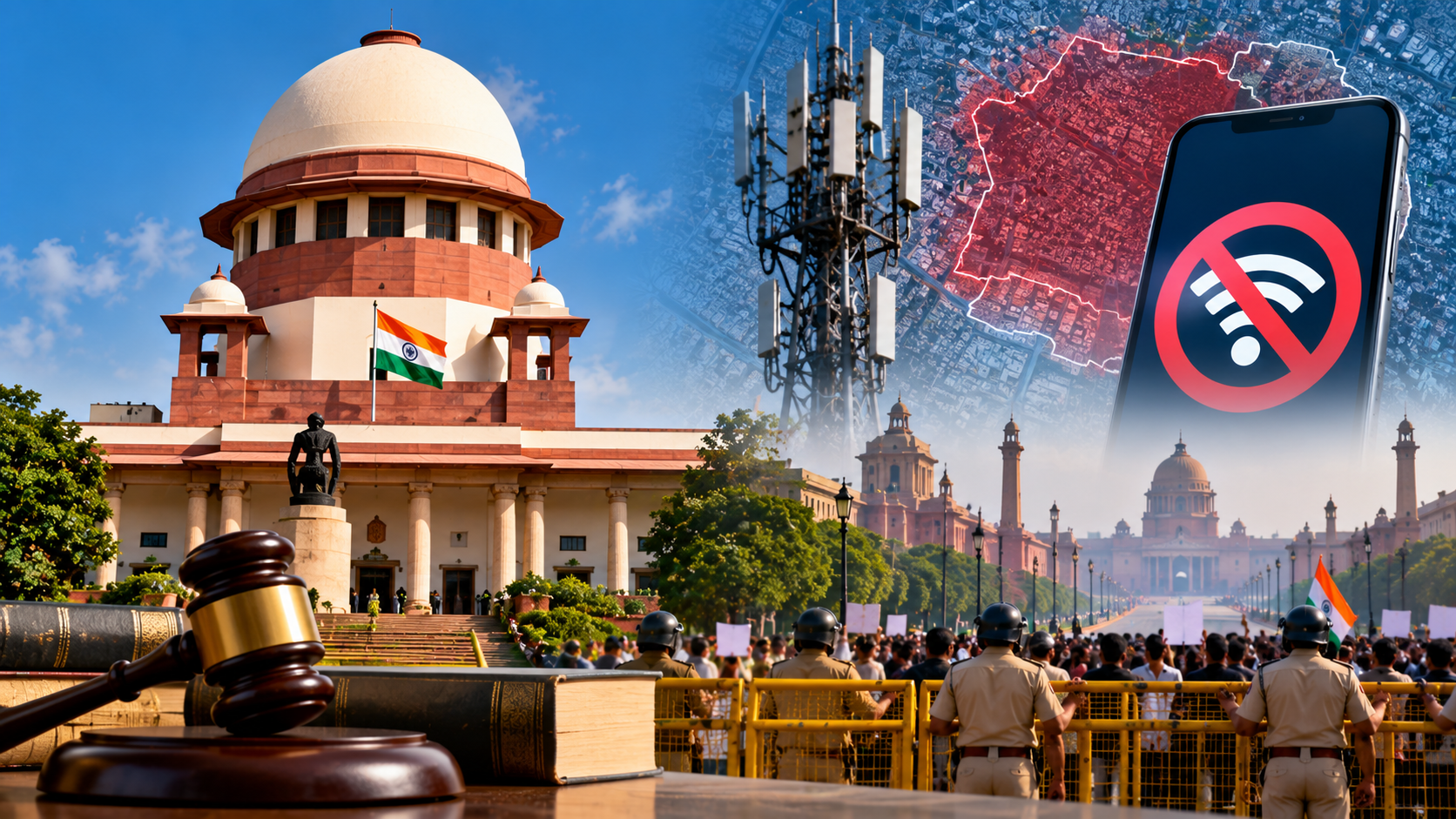
Home Secretary Govind Mohan Says Cellular Internet Was Suspended for 24 Hours Within a 4-Km Radius of Raisina Hill; Supreme Court to Examine Contempt Allegations and Public-Order Measures
The Union government has tendered an unconditional and unqualified apology to the Supreme Court over restrictions imposed in Delhi on October 10, 2026, while denying that the measures amounted to a wilful violation of the court's directions. The matter concerns restrictions introduced around a protest called by the Cockroach Janta Party (CJP), which demanded the resignation of Chief Election Commissioner Gyanesh Kumar over alleged electoral irregularities.
Union Home Secretary Govind Mohan submitted an affidavit to the apex court explaining the circumstances behind the restrictions, including the temporary suspension of cellular internet services in parts of the national capital. He said the measures were intended to maintain public order and were processed in accordance with the law.
The proceedings follow the Supreme Court's October 11 order, in which it observed that the petitioners had made out a prima facie case of contempt over the alleged violation of its direction that there should be no complete prohibition on Metro and train services in Delhi in connection with the protest.
The case raises questions about the balance between public safety, the right to protest, access to public transport and the limits of executive restrictions during demonstrations.
Home Secretary Explains the Internet Suspension
In his affidavit, Mohan said the Delhi Police had requested a one-day suspension of cellular internet services until 10 PM on October 10. According to the submission, the request was examined and considered under the applicable legal framework.
The government argued that the measure was proportionate to the situation and intended to prevent disturbances to public order in the national capital.
Mohan stated that cellular internet services were suspended from 10 PM on October 9 until 10 PM on October 10 within a radius of four kilometres of Raisina Hill.
He clarified that the restriction applied specifically to cellular internet services. It did not extend to non-cellular internet connections or telecommunications services such as Wi-Fi and broadband.
The distinction is relevant because cellular internet access and fixed broadband services operate through different infrastructure. However, the practical impact of a restriction can still vary depending on users' access to alternative connections and the geographical area covered.
Government Seeks Modification of Supreme Court Order
Alongside its apology, the government has asked the Supreme Court to modify its October 11 order to the extent necessary to permit internet suspensions in situations where authorities consider them necessary for maintaining public order.
Mohan argued that a temporary suspension within a defined geographical area, subject to statutory safeguards, is a recognised measure that may be considered in appropriate circumstances.
The request seeks to clarify the scope for such action under applicable law rather than treating every temporary restriction as automatically permissible. Any measure would still need to satisfy the relevant legal requirements and safeguards.
The Supreme Court's response will be important in determining how authorities should interpret the existing directions and what conditions must be met before restrictions on communications are imposed during public demonstrations.
Supreme Court Had Found a Prima Facie Case of Contempt
On October 11, the Supreme Court observed that the petitioners had made out a prima facie case of contempt regarding the alleged breach of its direction concerning Metro and train services.
The court issued notices to Union Home Secretary Govind Mohan, Delhi Police Commissioner Anurag Kumar and Delhi Metro Rail Corporation Chairperson D. Thara.
A prima facie observation means that the court considers there to be sufficient initial grounds to examine the allegations. It does not amount to a final finding that contempt has been established.
The proceedings will therefore need to consider the relevant court directions, the restrictions actually imposed, the authorities' explanations and whether the actions were consistent with the court's order.
Mohan's apology and affidavit form part of the government's response to the matter. The ultimate determination rests with the Supreme Court.
October 10 Protest Focused on the Chief Election Commissioner
The restrictions were imposed in connection with a protest called by the Cockroach Janta Party on October 10. The demonstration sought the resignation of Chief Election Commissioner Gyanesh Kumar over allegations of electoral irregularities.
The dispute surrounding the protest brought several issues into focus, including the management of large demonstrations in sensitive areas of Delhi and the availability of public transport during such events.
Authorities may impose security arrangements to prevent violence, protect public infrastructure and manage crowds. However, such decisions must operate within the law and remain consistent with any binding judicial directions.
The controversy demonstrates how operational decisions taken during protests can become subject to judicial scrutiny when they affect access to essential services or appear to conflict with court orders.
Public Order Versus Access to Essential Services
The case highlights a broader governance challenge: how authorities can maintain public order without imposing restrictions that are wider or more severe than necessary.
Temporary internet suspensions are sometimes defended as a means of preventing the spread of rumours or coordinating unlawful activity. At the same time, restrictions can affect ordinary communication, access to information, digital payments and business operations.
Similarly, disruptions to Metro and train services can affect commuters, workers, students and businesses, particularly in a densely populated city such as Delhi.
The legal and administrative assessment of such measures depends on their necessity, duration, geographical scope, proportionality and compliance with applicable safeguards. The existence of a public-order concern does not, by itself, settle whether a particular restriction is lawful.
The Supreme Court's consideration of the case could help clarify how public-order decisions should be reconciled with judicial directions and the practical needs of residents.
What Happens Next?
The Supreme Court bench comprising Chief Justice Surya Kant and Justice Joymalya Bagchi was scheduled to hear the matter on Thursday, October 15, according to the report.
The court will have to consider the government's explanation, the apology, the request to modify the earlier order and the allegations raised by the contempt petitioners.
Key questions include whether the restrictions complied with the court's directions, whether the internet suspension met the applicable legal requirements and what clarification, if any, is needed to govern future restrictions during public demonstrations.
The outcome could have implications for how authorities plan security measures around protests, especially where restrictions may affect transport networks or digital communications.
Outlook
The government's unconditional apology acknowledges the seriousness of the Supreme Court proceedings, while its denial of wilful defiance indicates that it disputes the allegation of deliberate non-compliance. The affidavit also seeks greater clarity on the circumstances in which temporary internet suspensions may be permitted.
The matter remains a judicial question, and the government's explanation should not be treated as a final determination of legality or contempt. The Supreme Court's examination of the evidence and applicable directions will be central to resolving the dispute.
The key takeaway: The case tests the limits of executive authority during public demonstrations and reinforces the importance of proportional restrictions, compliance with court orders and judicial oversight of measures affecting public access and communication.