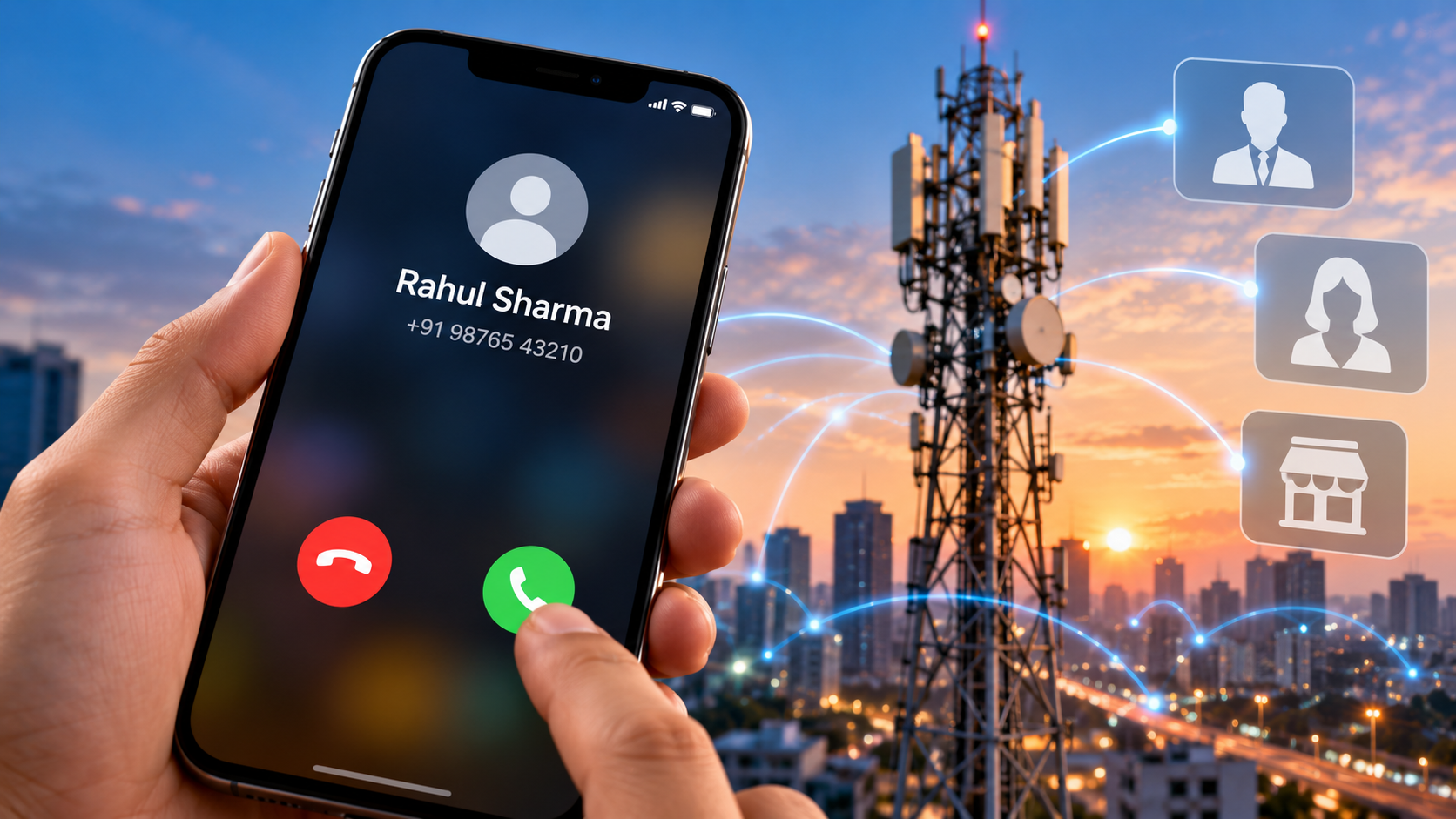
New Calling Name Presentation Rules Aim to Improve Caller Identification; Domestic Callers’ Registered Names Will Appear, International Calls Will Be Labelled Separately, and Verified Businesses Can Display Approved Trade Names
The Indian government has directed telecom service providers to introduce the Calling Name Presentation (CNAP) service across their service areas from November 1, 2026. Under the new guidelines, recipients will be able to see a caller's name alongside the telephone number on their phone screen, making it easier to identify incoming calls from numbers that are not saved in their contacts.
The initiative is intended to strengthen caller identification and help users make more informed decisions about answering incoming calls. Unlike third-party caller identification applications, the CNAP service will use subscriber information maintained by the originating telecom service provider.
According to a circular dated October 13, 2026, telecom operators have conducted trials of the service on wireless terrestrial networks using 4G and higher-generation technologies. The service is expected to be provided without requiring users to submit a separate request.
However, the introduction of CNAP on 2G and 3G networks, as well as public switched telephone networks, will be examined separately.
What Is the Calling Name Presentation Service?
Calling Name Presentation is a telecom-based feature that displays the caller's name during an incoming call. It uses information available in the originating telecom service provider's subscriber records and forms part of the calling line identification system.
Currently, a phone generally displays the number of an incoming caller, while the caller's saved contact name appears if the recipient has stored that number. CNAP adds a network-based name identification facility for numbers that are not saved in the recipient's contact list.
Under the new guidelines, the displayed calling line identification will contain two fields: the caller's telephone identifier and the caller's name.
The name shown will depend on whether the recipient has saved the number. If the number is already stored in the phone's contacts, the saved contact name will appear. For an unsaved domestic number, the name recorded in the originating telecom operator's subscriber database will be displayed.
This could make it easier for users to distinguish between known contacts, unfamiliar callers and certain types of unsolicited calls.
How Will the New Caller Name Rules Work?
The CNAP system will operate through the telecom network rather than relying solely on an application installed on the recipient's device.
The process is expected to work as follows:
-
Saved contacts: If the incoming number is already stored in the recipient's phone, the locally saved contact name will appear.
-
Unsaved domestic numbers: The caller's name will be retrieved from the originating telecom service provider's subscriber records.
-
International calls: Such calls will be labelled “International Call” under the guidelines, rather than displaying a domestic subscriber name through this process.
-
Business and bulk connections: Eligible users may apply to display a verified preferred name, subject to the prescribed conditions.
-
Users with caller ID restrictions: Subscribers who have activated the Calling Line Identification Restriction (CLIR) facility in accordance with applicable guidelines will not have their calling name identity displayed.
The system's reliance on telecom subscriber records is a central feature of the new framework. However, the accuracy of the displayed name will depend on the quality and verification of the underlying records.
Will Users Need to Install an App or Register Separately?
No separate user request is required for the planned introduction of CNAP on supported networks, according to the circular described in the report.
Because the service is designed to operate through telecom infrastructure, users are not expected to depend on a separate caller identification application simply to receive the network-based name display.
This differs from third-party caller identification services, which may use their own databases, user-contributed information or other data sources. CNAP instead relies on subscriber information maintained by the originating telecom operator.
The service's rollout and actual availability may depend on network compatibility and the implementation by individual telecom providers. Users on 2G and 3G networks, or fixed-line services, may not receive the feature immediately because those categories are subject to separate examination.
International Calls to Be Labelled Separately
The guidelines provide different treatment for international calls. If a number is not saved in the recipient's contact list, the incoming call will be labelled “International Call”.
This distinction may help recipients identify calls originating from outside India. It is particularly relevant as users increasingly receive calls from overseas businesses, service providers and individuals.
However, the label should not be treated as a complete security assessment. It does not, by itself, establish whether a call is legitimate, fraudulent or unwanted. Users should continue to exercise caution when callers request sensitive information, passwords, one-time passwords or financial transfers.
Can Businesses Display Their Brand or Trade Name?
The new guidelines provide a mechanism for eligible business and bulk connections to display a preferred name instead of the name recorded in the subscriber database.
The preferred name must satisfy prescribed registration requirements. It may be a trademark registered in the user's name with the Trade Marks Registry or a trade name registered on the Goods and Services Tax (GST) portal.
The originating telecom service provider must verify the proposed name before permitting it to be displayed.
For new connections, the preferred name must be recorded in the customer application form and subscriber data records. For existing connections, telecom operators must establish a process through which eligible customers can apply to update their preferred names.
The operator may amend the records after examining and verifying the application.
This provision could help customers identify calls from legitimate businesses, including companies that use a recognised registered brand name. It may also reduce confusion when a business's registered legal name differs from the name familiar to its customers.
Nevertheless, displaying a business name should not be treated as a guarantee that every call is safe. Users should verify sensitive requests through official contact channels, particularly when a caller asks for money or confidential information.
Security Safeguards and Data Protection Requirements
The circular refers to Rule 48(1) of the Telecommunications (Authorisation for Provision of Principal Telecommunication Services) Rules, 2026. The provision requires authorised entities to present calling line identification in a manner secured against tampering and in accordance with the specified requirements.
Telecom service providers must follow a security-by-design approach when implementing the service. Under the prescribed query-response mechanism, the calling name identity must not be retained after the incoming call is completed.
Operators are also required to maintain adequate databases, network capacity and connectivity infrastructure to process calling name identity queries efficiently. The system must retrieve and deliver the relevant information within the required time while maintaining applicable quality-of-service standards.
These safeguards are important because a network-based caller identification service depends on the integrity of subscriber information and the secure handling of identity queries.
The effectiveness of the framework will depend on implementation, database accuracy, technical safeguards and compliance by telecom providers.
How Will Complaints Be Resolved?
Telecom service providers must establish technical and organisational arrangements to receive, record and maintain grievances relating to CNAP.
Complaints will be handled through the provider's grievance redressal mechanism within the applicable time frame. This gives users a formal route to raise concerns about incorrect caller names or other problems associated with the service.
The complaint mechanism will be particularly relevant if subscriber records are outdated, a business name is displayed incorrectly or users experience technical issues during the rollout.
Users should check their operator's official guidance for the applicable complaint procedure and documentation requirements once the service becomes available.
Will CNAP Eliminate Spam Calls and Digital Fraud?
CNAP could improve basic caller identification by displaying names from telecom subscriber records. This may make some unfamiliar calls easier to recognise and help users decide whether to answer.
However, it should not be considered a complete solution to spam calls, impersonation or digital fraud.
A displayed name does not automatically verify the caller's intentions, and fraudulent communication can involve other channels, including messaging applications, email and online platforms. Users should never disclose an OTP, banking password, card details or other sensitive information solely because an incoming call displays a familiar name.
The service's principal function is caller identification. Its broader effect on fraudulent calls will depend on how it works alongside existing anti-spam measures, complaint mechanisms and enforcement against misuse.
What the New Rules Mean for Telecom Operators and Users
For telecom operators, the rollout will require network readiness, reliable subscriber records, secure identity-query systems and effective grievance management. Business customers seeking preferred-name display may also need to complete verification procedures.
For ordinary users, the main change is that an unsaved domestic caller's name may appear on the phone screen without requiring a separate application or registration request.
For businesses, the verified-name provision could improve recognition of legitimate calls, provided their preferred names meet the eligibility and verification requirements.
The rollout may also increase attention on the accuracy of subscriber databases and the importance of maintaining updated customer records.
Outlook
The government's planned CNAP rollout from November 1, 2026, represents a significant change in how incoming calls may be identified across supported telecom networks in India. By displaying a caller's registered name alongside the number, the system aims to improve transparency and make it easier for users to assess unfamiliar calls.
The rules establish separate treatment for domestic and international calls, provide a verification route for eligible business names and prescribe security and grievance-handling requirements for telecom operators.
The key issues to monitor will be the smoothness of the rollout, the accuracy of displayed names, the availability of the service across different network generations and the effectiveness of privacy and security safeguards.
The bottom line: CNAP could make incoming calls more informative, but a displayed name should not be treated as proof that a caller is genuine or trustworthy.