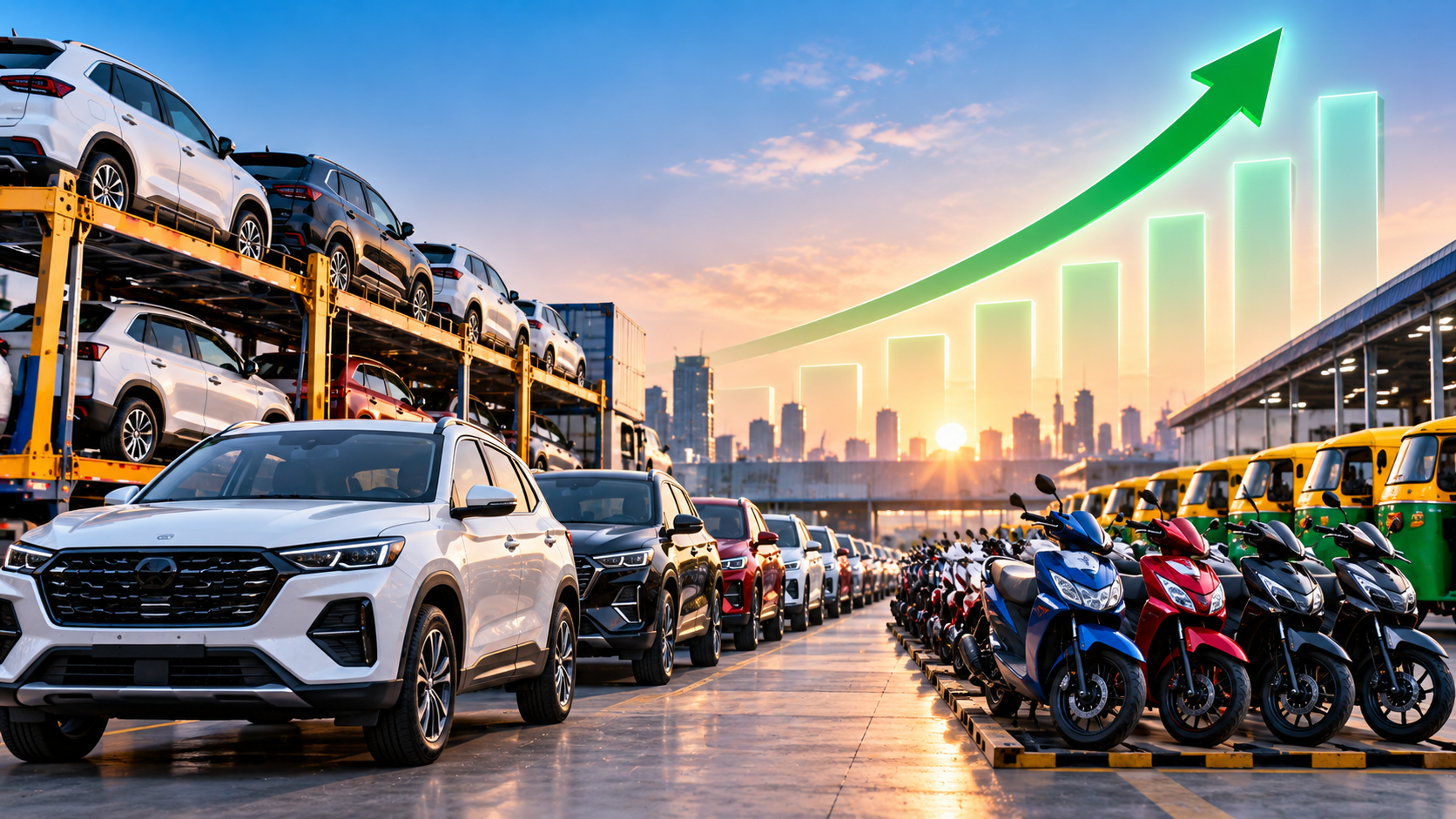
Two-Wheeler Shipments Rise 13.5% to 24.63 Lakh Units, While Three-Wheeler Dispatches Grow 16%; Strong Vehicle Demand Supports the Automotive Sector
India's automobile industry recorded strong year-on-year growth in September 2026, with passenger vehicle dispatches to dealers increasing 21.8% to 4,54,574 units, according to the Society of Indian Automobile Manufacturers (SIAM). The growth reflects continued demand across key vehicle categories and provides a positive signal for automakers, component suppliers and businesses connected to the automotive value chain.
Passenger vehicle dispatches stood at 3,73,347 units in September 2025. The increase in shipments this year indicates a substantial improvement in the volume of vehicles supplied by manufacturers to dealerships compared with the same month last year.
The growth extended beyond passenger cars and utility vehicles. Two-wheeler dispatches rose 13.5% year-on-year to 24.63 lakh units, while three-wheeler shipments increased 16% to 98,162 units. The latest figures suggest that demand momentum remained broad-based across the domestic automobile market.
Passenger Vehicle Dispatches Rise 21.8%
Passenger vehicle dispatches climbed to 4.55 lakh units in September 2026, compared with approximately 3.73 lakh units in the corresponding month of the previous year.
Passenger vehicles include cars, utility vehicles and vans. The segment is closely watched by investors because its performance can reflect consumer confidence, household purchasing power, financing availability and demand for personal mobility.
The strong increase in dispatches is encouraging for manufacturers, although wholesale dispatches do not necessarily represent the number of vehicles purchased by end customers during the same period. Dealer inventory levels, retail registrations and waiting periods also influence how the figures should be interpreted.
If retail demand continues to absorb the additional supply, automakers could benefit from higher production volumes, better capacity utilisation and stronger operating leverage. However, a sustained increase in dealer inventory could eventually lead to discounts or production adjustments.
Two-Wheeler Dispatches Grow 13.5% to 24.63 Lakh Units
India's two-wheeler segment also recorded healthy growth, with dispatches increasing to 24.63 lakh units in September 2026 from 21.70 lakh units a year earlier.
Two-wheelers remain an important part of India's mobility market, serving daily commuters, rural households, delivery businesses and first-time vehicle buyers. Demand is influenced by affordability, fuel costs, financing conditions, rural income trends and the availability of new models.
Growth in this category can support manufacturers across motorcycles, scooters, electric two-wheelers and related components. However, the headline dispatch figure covers the broader two-wheeler market and should not be interpreted as the growth rate of any single company or powertrain category.
Investors will also look for evidence that higher shipments are translating into stronger retail sales and sustainable market share gains.
Three-Wheeler Dispatches Increase 16%
Three-wheeler dispatches to dealers rose 16% year-on-year to 98,162 units in September 2026, compared with 84,635 units in September 2025.
Three-wheelers play an important role in passenger transport, last-mile connectivity and commercial goods movement. Demand in this segment is closely linked to urban mobility, small-business activity, logistics requirements and replacement purchases.
Growth can benefit manufacturers of passenger and cargo three-wheelers, as well as suppliers of tyres, batteries, motors, transmissions and other automotive components. The transition towards electric mobility is another factor investors may monitor, although the September dispatch figures cited by SIAM do not by themselves establish how much of the growth came from electric vehicles.
What Is Driving Growth in India's Automobile Market?
The September figures indicate that vehicle shipments increased across passenger vehicles, two-wheelers and three-wheelers. Several factors can influence this performance, including new product launches, seasonal purchasing patterns, replacement demand, financing availability and changes in consumer preferences.
Passenger vehicle demand is also affected by the growing popularity of sport utility vehicles and the availability of models at different price points. In the two-wheeler market, scooters and motorcycles continue to serve a wide range of urban and rural customers, while three-wheelers benefit from their role in public transport and commercial operations.
Nevertheless, the reported year-on-year growth should be assessed alongside monthly retail registrations, inventory levels and subsequent sales data. One month's increase does not establish a long-term demand trend.
Potential Impact on Automakers and Auto Ancillaries
A sustained increase in vehicle production and sales can create opportunities across the automotive ecosystem.
Vehicle manufacturers: Higher volumes may improve factory utilisation and support revenue growth, provided pricing and product mix remain favourable.
Auto component suppliers: Increased vehicle production can lift demand for components such as tyres, braking systems, electronics, bearings, batteries and powertrain parts. The benefits will vary according to each supplier's customer base and exposure to different vehicle categories.
Dealerships and financing companies: Higher retail activity can support dealership turnover and vehicle-loan demand. However, profitability will also depend on inventory management, financing costs and the level of discounts offered.
Electric vehicle businesses: Growth in overall vehicle volumes creates a larger potential market, but investors should separately assess electric-vehicle penetration, charging infrastructure, battery costs and company-specific economics rather than assuming that all industry growth benefits EV manufacturers equally.
Key Risks Investors Should Monitor
Despite the positive dispatch data, the automobile sector remains exposed to several risks.
-
Dealer inventory: Wholesale shipments may rise faster than end-customer purchases, potentially leading to excess inventory and higher discounts.
-
Input costs: Changes in steel, aluminium, rubber, energy and other raw-material prices can affect manufacturers' margins.
-
Financing conditions: Higher borrowing costs or tighter vehicle-loan availability could weigh on demand, particularly among price-sensitive buyers.
-
Competition: Aggressive pricing, new model launches and changing consumer preferences can affect market share and profitability.
-
Regulatory and technology shifts: Emission standards, safety requirements and the transition towards electrification may require additional investment.
-
Uneven demand: Growth can differ significantly across vehicle categories, regions, price segments and manufacturers.
Investors should therefore examine company-level retail sales, market share, margins, order books, dealer inventory and management commentary before drawing conclusions from industry-wide dispatch numbers.
Market Outlook
India's automobile industry delivered a strong performance in September 2026, with passenger vehicle dispatches rising 21.8% to 4,54,574 units, two-wheeler shipments increasing 13.5% to 24.63 lakh units and three-wheeler dispatches climbing 16% to 98,162 units.
The broad-based growth provides an encouraging demand signal for automakers and automotive suppliers. If the momentum continues and retail sales keep pace with wholesale shipments, higher production volumes could support revenue growth and capacity utilisation across the industry.
However, the sustainability of the recovery will depend on retail demand, dealer inventory, vehicle affordability, input costs and competition. For investors, the next step is to compare these industry figures with individual companies' sales growth, margins and valuations.
The key takeaway: September's dispatch numbers are positive for India's automotive sector, but confirmation from retail sales and company-level earnings will be crucial in determining whether the growth translates into lasting shareholder value.