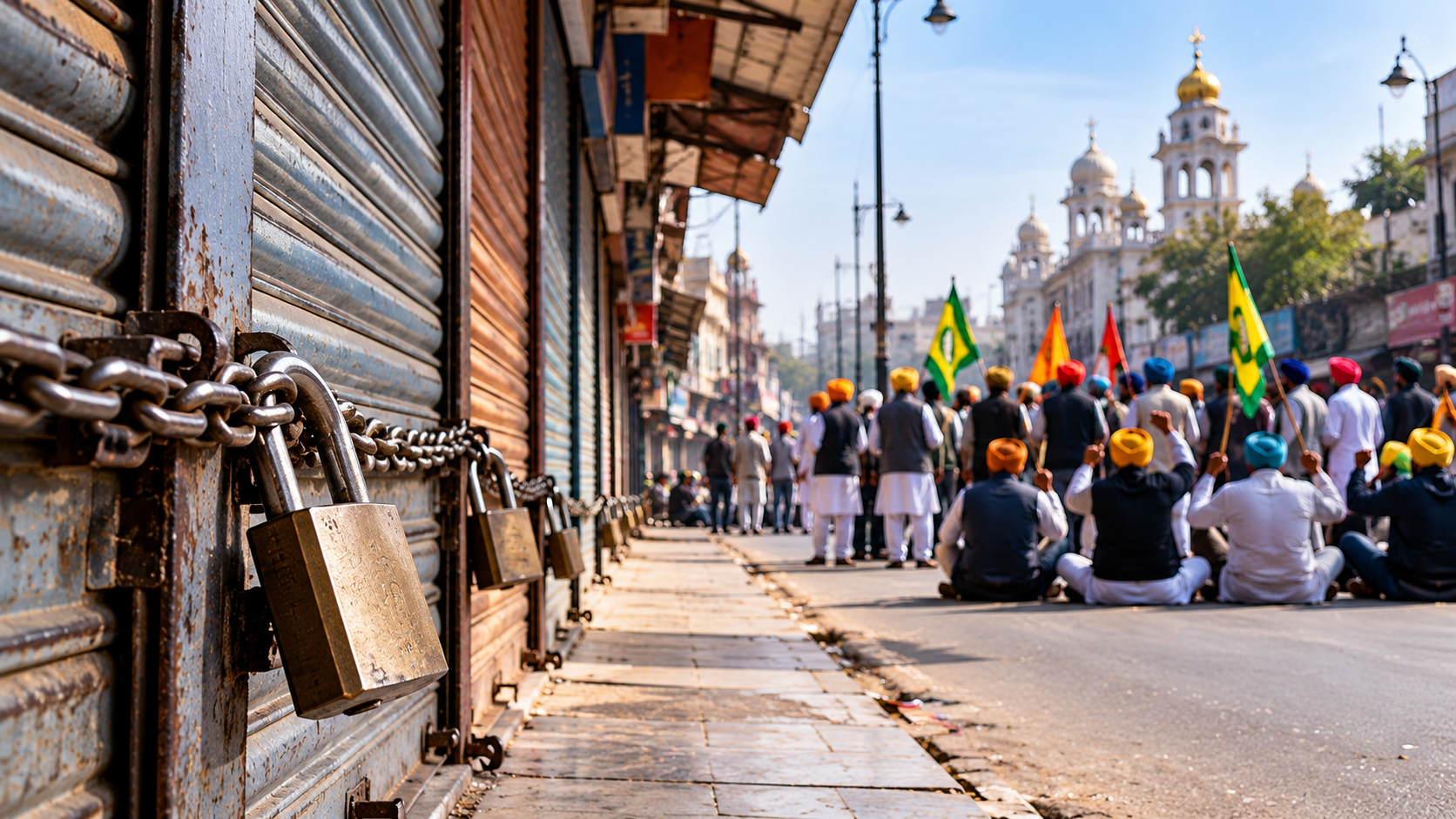
Family, Political Parties and Farmers’ Unions Back Statewide Shutdown; Protesters Demand CBI Probe and Accountability Over Punjab’s Drug Menace
Markets remained closed and several private schools suspended classes across parts of Punjab on Thursday, October 15, following a statewide bandh called after the killing of anti-drug activist Parvinder Singh, popularly known as Jhota. The shutdown received support from political parties, farmers’ organisations and government employees’ unions, turning the incident into a wider debate over drug abuse, public safety and law enforcement in the state.
Jhota was shot dead in broad daylight at a busy marketplace in Mansa on Tuesday. He was known for publicly challenging the alleged illegal sale of addictive substances and raising concerns about drug abuse.
The bandh affected commercial activity in several locations, including Mansa, Hoshiarpur and Ferozepur. Several private schools in districts such as Hoshiarpur, Jalandhar, Moga and Mansa also declared a holiday. Emergency services, however, remained operational.
Who Was Parvinder Singh Jhota?
Parvinder Singh Jhota had become known for confronting suspected drug-related activities and speaking publicly against the sale of addictive substances. His activism frequently brought him into direct contact with people and businesses he believed were involved in the problem.
According to the report, the fatal incident occurred while Jhota was broadcasting a Facebook Live session and questioning a medical store owner over the alleged sale of addictive substances to an elderly man. He was shot during the confrontation in a crowded marketplace in Mansa.
The incident has intensified concerns among residents and activist groups about the risks faced by people who publicly challenge suspected illegal activities. It has also prompted calls for a thorough investigation into the circumstances surrounding the shooting.
Accused Taken Into Custody in Rajasthan
Ashwani Kumar, the medical store owner accused of opening fire on Jhota, was taken into custody in Rajasthan’s Salasar on Wednesday, according to the report.
The circumstances leading to the shooting and the evidence available to investigators will be central to the legal proceedings. Allegations against the accused remain subject to investigation and judicial determination.
The killing has triggered widespread public anger, with supporters of Jhota demanding accountability and stronger action against the illegal sale of addictive substances. The bandh was called by his family and subsequently backed by political and farmers’ organisations.
Political Parties and Farmers’ Unions Support Punjab Bandh
The shutdown received support from several political parties, including the Congress, Shiromani Akali Dal, Bharatiya Janata Party and Akali Dal Waris Punjab De. The Samyukta Kisan Morcha, other farmers’ organisations and state government employees’ unions also supported the call.
The broad backing reflects how the incident has moved beyond a criminal investigation to become a political issue ahead of Punjab’s next Assembly election cycle.
In Amritsar, the Kisan Mazdoor Sangharsh Committee organised a demonstration against the Aam Aadmi Party government. Led by farmer leader Sarwan Singh Pandher, protesters accused the state government of failing to contain the drug problem and burned an effigy of Chief Minister Bhagwant Mann near the Golden Gate.
Pandher called for the resignation of the chief minister and Director General of Police Gaurav Yadav, arguing that the authorities should be held accountable for the prevailing situation.
Protesters Demand CBI Investigation and Senior Officials’ Resignations
A joint action committee formed by various organisations and social activists following Jhota’s death has raised several demands.
These include a probe by the Central Bureau of Investigation (CBI), the resignation of Chief Minister Bhagwant Mann and DGP Gaurav Yadav, and action against senior police and administrative officials in Mansa.
The committee has also demanded the removal of the Mansa Senior Superintendent of Police, Deputy Superintendent of Police, Station House Officer and drug inspector.
These are demands made by the protesters and do not constitute findings of official misconduct. Whether the case is transferred to the CBI or further departmental action is taken will depend on decisions by the competent authorities.
Punjab’s Drug Menace Returns to the Centre of Debate
The killing has renewed attention on Punjab’s long-running struggle with drug abuse and illegal drug distribution. The issue affects public health, families, policing and the wider social environment, making it a recurring subject of political debate.
Activists and opposition parties argue that stronger enforcement is needed to disrupt supply networks, investigate suspected illegal sales and protect people who report such activities. They have also called for greater accountability from officials responsible for maintaining law and order.
Addressing the drug problem requires more than arrests alone. Effective action can involve investigations into supply chains, monitoring of illegal pharmaceutical sales, treatment and rehabilitation services, prevention programmes and coordination between law enforcement and public-health authorities.
The case is likely to intensify scrutiny of the state government's existing measures and the results achieved in tackling drug trafficking and substance abuse.
Chief Minister Bhagwant Mann Promises Strict Action
Chief Minister Bhagwant Mann has promised the strictest punishment for the accused and reiterated his government's zero-tolerance policy towards drug trafficking.
He also appealed to the public to maintain peace, stating that anyone found conspiring in connection with the incident would not be spared.
Opposition leaders, meanwhile, have accused the government of failing to maintain law and order and described the situation in the state in strongly critical terms. The competing claims have added to the political pressure on the administration as the investigation proceeds.
The government's response, the progress of the criminal case and any additional action against suspected drug-related networks will be important factors in determining how public confidence develops in the coming days.
Markets and Schools Affected, Emergency Services Continue
The bandh led to closures in several markets and commercial areas, disrupting ordinary business activity. Private schools in multiple districts announced holidays as a precaution amid the shutdown.
Emergency services remained operational, according to the report. The extent of disruption varied by location, and the available information does not establish that every market or school across Punjab was closed.
For local businesses, a shutdown can mean lost sales, interruptions to deliveries and reduced customer movement. Families may also face inconvenience when schools suspend classes at short notice.
The continuation of essential services was particularly important to ensure that medical assistance and other urgent requirements remained accessible during the protests.
What Happens Next?
The immediate focus remains on the criminal investigation, the legal proceedings against the accused and the authorities’ response to demands for an independent probe. Protesters are also seeking accountability from senior officials and stronger measures to address the drug problem.
The incident has become a test of the state government's ability to respond to public anger while ensuring that the investigation proceeds on the basis of evidence. Any decision on a CBI inquiry, departmental action or wider enforcement measures will be closely watched.
For Punjab, the broader challenge extends beyond this individual case. Restoring public confidence will require a credible investigation into Jhota’s killing, effective action against illegal drug distribution and sustained efforts to address substance abuse through enforcement, prevention and rehabilitation.
The bandh has demonstrated the depth of public concern. The next steps taken by law enforcement and the state administration will determine whether that concern leads to measurable action and greater confidence in public safety.