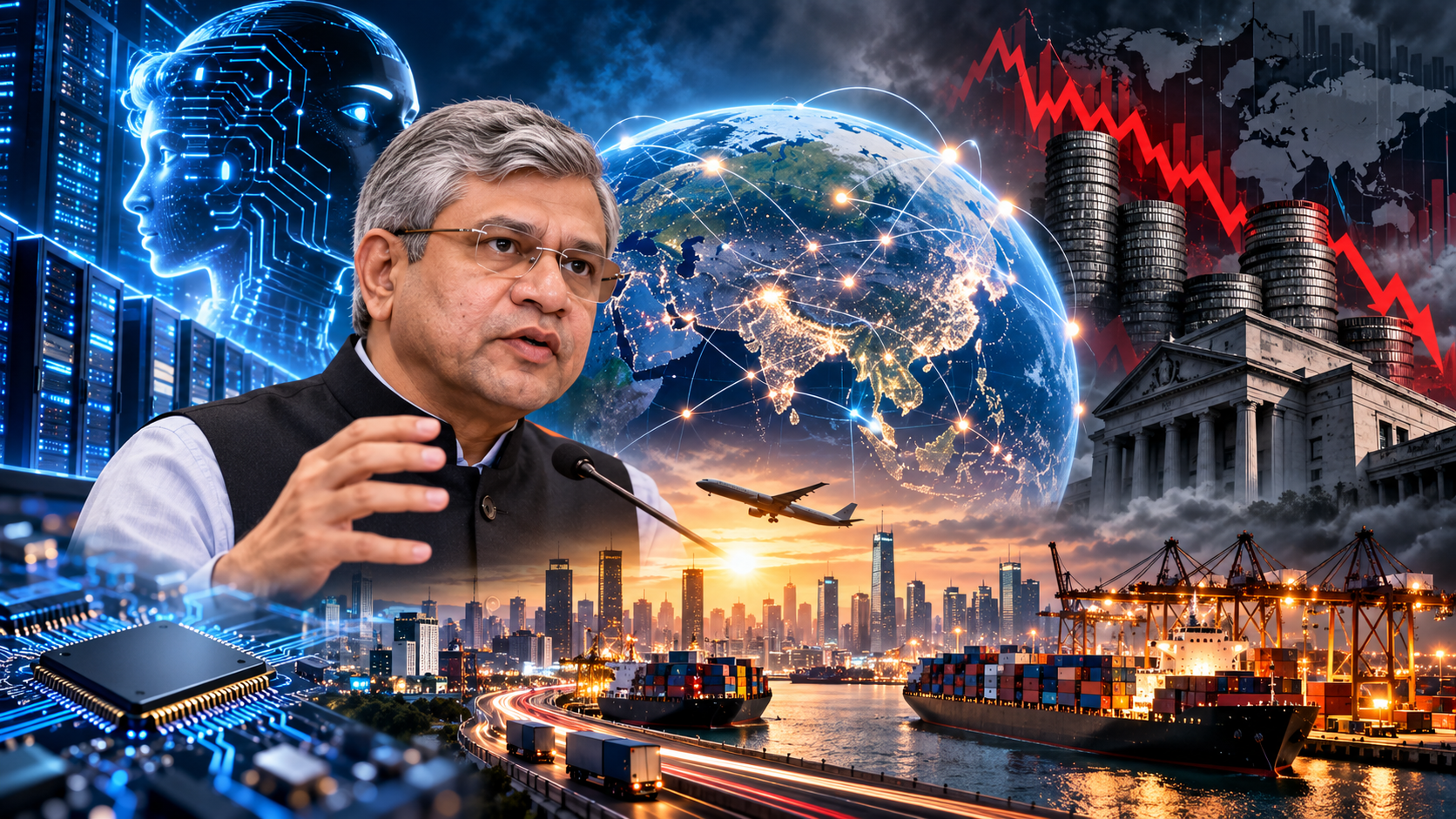
India is strengthening its economic and technological resilience as rapid advances in artificial intelligence, rising debt levels in developed economies and growing cybersecurity concerns threaten to reshape global business and technology supply chains
Technology and Financial Risks Could Make the Coming Years More Uncertain
Global economic uncertainty could intensify over the next three to five years as rapid technological transformation and financial vulnerabilities converge, Union Minister Ashwini Vaishnaw warned on Wednesday. Speaking at the Bloomberg New Economy Forum 2026, the minister highlighted artificial intelligence (AI), high debt levels in developed economies and growing strategic dependencies as key sources of potential disruption.
Vaishnaw, who oversees Electronics and Information Technology, Information and Broadcasting, and Railways, said India was working to strengthen its economic and technological resilience to withstand external shocks.
According to the minister, the next phase of global uncertainty could be more challenging than previous decades because technology-led changes in employment and business operations may coincide with financial instability arising from debt accumulated by wealthier economies.
He cautioned that countries and companies must prepare for this possibility rather than assume that established economic and business models will remain reliable.
AI Could Reshape Employment and the Services Industry
Artificial intelligence is emerging as one of the most significant forces capable of changing how businesses operate, how workers perform their jobs and how companies allocate capital. Vaishnaw warned that AI-driven disruption could become more pronounced by the time financial pressures in developed economies intensify.
The services sector could face substantial changes as businesses adopt AI tools for software development, customer support, data processing, research, financial analysis and other knowledge-intensive activities.
While automation may improve productivity and reduce operating costs, it could also alter job requirements and reduce demand for certain routine tasks. Businesses may increasingly seek employees who can work alongside AI systems, manage complex processes and apply specialised technical or domain knowledge.
The transition is unlikely to affect every industry or occupation equally. Some roles may be automated, others may evolve, and new employment opportunities could emerge in areas such as AI development, cybersecurity, data infrastructure and technology implementation.
For India, where information technology and business-process services are important sources of employment and export earnings, the pace of AI adoption will be particularly significant. Companies may need to invest more heavily in reskilling, workforce development and higher-value services to remain competitive.
The broader challenge will be ensuring that productivity gains translate into sustainable business growth and new economic opportunities while workers and institutions adapt to changing skill requirements.
High Debt Levels in Developed Economies Raise Financial Stability Concerns
Vaishnaw also pointed to the high debt burden in developed economies as a potential source of turbulence. He suggested that adjustments in these debt levels over the next three to five years could create wider economic consequences.
High public debt does not automatically lead to a financial crisis. However, the risks can increase when borrowing costs remain elevated, economic growth weakens or governments face difficulties managing interest payments and refinancing obligations.
A sharp deterioration in investor confidence could push up bond yields, increase borrowing costs and force governments to reconsider spending priorities. Financial-market volatility could then spread across currencies, equities, credit markets and international capital flows.
The consequences would not necessarily remain confined to the countries carrying the highest debt burdens. In an interconnected global economy, tighter financial conditions in major developed markets can affect emerging economies through foreign investment flows, exchange rates, trade and financing costs.
For India, changes in global interest rates and investor risk appetite can influence foreign portfolio investment, the rupee and the cost of raising capital. A combination of weaker global demand and volatile financial markets could also affect Indian exporters and businesses dependent on international funding.
The scale of any future disruption will depend on economic growth, fiscal policies, central-bank decisions and how effectively governments manage their debt obligations.
Strategic Trust Is Becoming as Important as Cost
Beyond AI and financial risks, Vaishnaw emphasised the importance of trust in global technology supply chains. He said international technology production would continue to depend on multiple countries and geographies, but companies and governments would need to reassess their partners and dependencies continuously.
The minister's remarks reflect a changing approach to globalisation. Businesses have traditionally prioritised cost efficiency, access to technology and production scale when selecting suppliers. Increasingly, cybersecurity, geopolitical reliability and the security of critical components are also becoming important considerations.
Semiconductors provide a clear example of this challenge. Advanced chips are essential to AI systems, smartphones, data centres, telecommunications networks and industrial applications. Concentration in particular parts of the semiconductor supply chain can expose businesses to shortages or geopolitical disruptions.
Companies may therefore seek to diversify suppliers, develop alternative sourcing arrangements and build stronger partnerships with countries considered reliable.
Such strategies can improve resilience, although they may also raise costs and require additional investment in manufacturing capacity, research and logistics.
Vaishnaw stressed that decisions about strategic dependencies must be revisited regularly to ensure that reliance on a particular country or company does not weaken a nation's ability to withstand external shocks.
India Aims to Strengthen Its Technology Capabilities
India's response to these challenges involves developing domestic capabilities while remaining connected to international technology networks. The minister's remarks suggest that self-reliance and global cooperation are not necessarily contradictory objectives.
Building stronger capabilities in electronics manufacturing, semiconductor production, digital infrastructure and technology research could help India reduce vulnerabilities in critical areas. At the same time, international partnerships can provide access to expertise, investment, intellectual property and established supply networks.
Developing these capabilities, however, requires sustained investment, skilled workers, reliable infrastructure and a business environment that encourages innovation. It also requires companies to meet international standards for quality, security and reliability.
Cisco Chairman and CEO Chuck Robbins supported India's approach, highlighting the country's engineering talent, scale and technological expertise. He also described India as a trusted partner for American and other global companies, noting that this trust can support investment decisions.
The comments underline the potential opportunity for India to attract technology investment as companies reconsider the geographical distribution of manufacturing, engineering and digital operations.
However, the long-term benefits will depend on whether investment translates into competitive products, stronger domestic supply chains, higher productivity and deeper participation in global value creation.
Cybersecurity and Semiconductor Concentration Add to the Risks
Cybersecurity has become another critical concern as businesses, governments and essential infrastructure become more dependent on interconnected digital systems.
AI adoption can improve threat detection and automate security operations, but it can also introduce new risks. Malicious actors may use advanced tools to improve the scale or sophistication of cyberattacks, while weaknesses in third-party software or hardware can expose entire networks.
Supply-chain concentration adds another layer of vulnerability. If a critical component, technology platform or service is controlled by a limited number of suppliers, an operational failure or geopolitical dispute can have consequences across several industries.
For businesses, this makes supplier diversification, secure system design, data protection and contingency planning increasingly important. Governments also face the challenge of balancing open technology markets with the need to protect critical infrastructure and sensitive information.
Vaishnaw's emphasis on trust suggests that future technology partnerships will be judged not only on price and performance but also on reliability, security and long-term strategic alignment.
What the Convergence of AI and Debt Risks Means for Businesses and Investors
The simultaneous rise of technological disruption and financial uncertainty could create an uneven environment for businesses and investors.
Companies that successfully integrate AI, improve productivity and maintain financial discipline may be better positioned to navigate the transition. Businesses with excessive leverage, weak competitive advantages or heavy dependence on a single supplier could face greater pressure if financing conditions tighten or supply chains are disrupted.
Investors may need to pay closer attention to corporate balance sheets, cash-flow generation, capital expenditure requirements and the durability of earnings growth. A strong technology narrative alone may not be sufficient if a company cannot convert innovation into sustainable profits.
Technology infrastructure could remain an important area of investment as demand grows for computing power, semiconductor capacity, cybersecurity solutions and data centres. Nevertheless, high capital requirements, intense competition and changing technology standards can create execution and valuation risks.
Similarly, Indian manufacturers and technology service providers may benefit from supply-chain diversification and rising demand for trusted partners. The extent of these gains will depend on their ability to deliver at scale, maintain quality and compete internationally.
These developments do not point to a guaranteed financial crisis or an inevitable collapse in employment. Rather, they highlight the importance of preparing for multiple possible outcomes as technological and financial changes reshape the global economy.
Outlook: Resilience Will Be a Competitive Advantage
Vaishnaw's warning highlights a central challenge for the global economy: AI-driven transformation may accelerate at the same time that financial vulnerabilities become more difficult to manage. The interaction between these forces could create uncertainty for governments, companies, workers and investors over the coming years.
For India, strengthening domestic technological capabilities while maintaining trusted international partnerships could help reduce exposure to external shocks and create opportunities for investment and industrial growth.
For businesses, the priorities are likely to include AI adoption, workforce reskilling, prudent debt management, cybersecurity and supply-chain diversification. For investors, a focus on financial strength, realistic valuations and sustainable earnings may become increasingly important in an environment where disruption can emerge from several directions at once.
The minister's message is not that globalisation will disappear, but that the terms of global economic cooperation are changing. In the years ahead, resilience, adaptability and trust may matter as much as cost efficiency and scale.