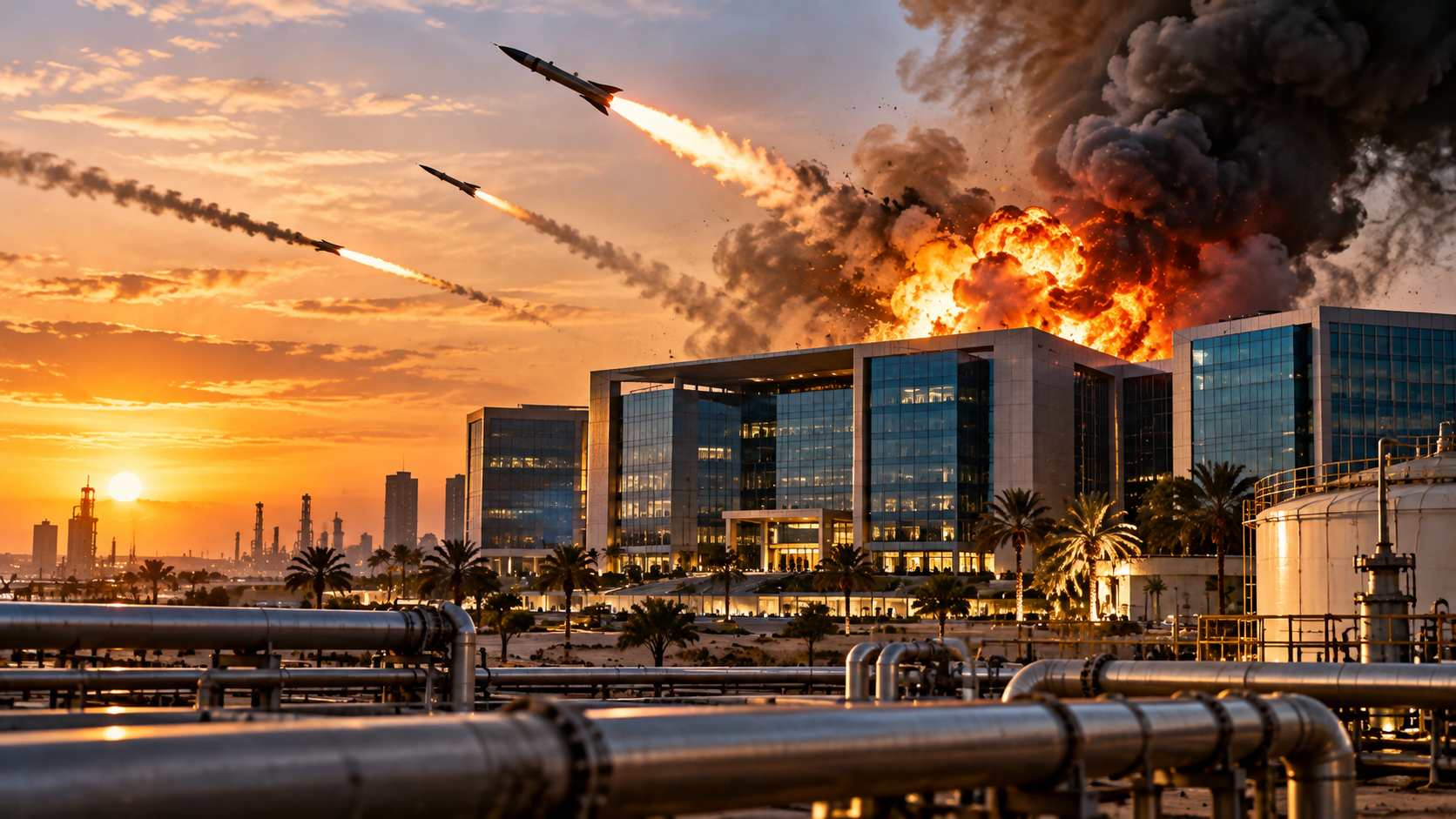
Missile attack sparks a limited fire at Aramco’s Dhahran office complex, raising fresh concerns over the security of Saudi Arabia’s oil infrastructure and the stability of global energy supplies
Missile Strike Targets Saudi Arabia’s Oil Heartland
Saudi Arabia’s oil sector has come under renewed pressure after Yemen’s Houthi militants targeted the executive headquarters complex of Saudi Aramco in Dhahran with missiles on Tuesday, October 13, according to reports citing the kingdom’s energy ministry.
The attack caused a limited fire in part of the office complex, but no injuries were reported, the ministry said. The incident has heightened concerns about the expanding conflict and the potential risks to critical energy infrastructure in one of the world’s most important oil-producing countries.
The Saudi-led coalition fighting in Yemen reported that Houthi missiles had targeted multiple Saudi cities, including the capital, Riyadh. It also said shrapnel from an intercepted missile fell in part of a residential area in Dhahran. Saudi authorities did not report casualties from the strike on the Aramco complex.
The attack marks a significant escalation because Dhahran lies at the centre of Saudi Arabia’s petroleum industry and is closely associated with the operations of Saudi Aramco, one of the world’s largest integrated energy companies.
Wave of Attacks Raises Security Concerns
The missile strike comes amid a broader wave of Houthi attacks on Saudi Arabia in recent days. Earlier attacks have reportedly targeted airports across the kingdom, leaving at least 18 people dead and hundreds injured, according to the supplied report.
The growing frequency of attacks has increased pressure on Saudi Arabia’s security infrastructure and raised questions about the protection of strategically important facilities. Airports, refineries, export terminals and pipelines are critical to the kingdom’s economic activity and international connectivity.
Saudi Arabia has faced threats to its energy infrastructure during previous periods of regional conflict. Any sustained disruption could affect oil production, refining, transportation or exports, depending on the location and severity of the damage.
Although the Dhahran incident reportedly caused only a limited fire, attacks on major energy companies can have consequences beyond the immediate physical damage. They can prompt additional security measures, disrupt employee operations and increase the risk premium associated with regional energy supplies.
Saudi Oil Infrastructure Faces Renewed Pressure
The latest incident follows other reported attacks on Saudi energy assets. A refinery in Jazan, in western Saudi Arabia, has remained shut since an earlier attack, according to the report. A key oil export port on the Red Sea coast has also been targeted.
In addition, a cross-country pipeline that provides an alternative route for transporting Saudi crude to international markets was temporarily shut last month following an attack launched from Iraq.
These developments underline the vulnerability of energy supply chains to security threats. Saudi Arabia’s oil-export system depends on a network of production fields, processing facilities, pipelines, storage infrastructure and export terminals. Disruption at any major point can complicate logistics even when overall crude production remains unaffected.
The country has invested in alternative transportation routes to reduce its dependence on individual export corridors. However, persistent threats across multiple locations could make it more difficult to maintain normal operations and could increase transportation, insurance and security costs.
The full operational impact of the latest Dhahran attack was not immediately clear. Saudi Aramco had not immediately responded to a request for comment at the time of the report.
Why Dhahran Matters to the Global Oil Industry
Dhahran is located in Saudi Arabia’s Eastern Province along the Persian Gulf coast and is central to the kingdom’s oil economy. The surrounding region hosts major oil fields and energy-related infrastructure, making it strategically important to both Saudi Arabia and international energy markets.
Saudi Aramco plays a pivotal role in global crude supply, supplying oil to customers across Asia, Europe and other regions. Consequently, any threat to its operations attracts close attention from traders, refiners, governments and energy companies.
However, a missile strike on an office complex does not automatically imply that crude production or exports have been disrupted. The distinction between damage to administrative facilities and damage to operational infrastructure is important when assessing the immediate effect on oil availability.
Markets will therefore focus on whether the latest incident remains an isolated security event or develops into a wider disruption affecting production facilities, refineries, pipelines or export terminals.
Potential Impact on Crude Oil Prices
The escalation could add volatility to international crude oil prices as traders assess the likelihood of supply disruptions. Geopolitical risk can push prices higher when markets fear that significant production or transportation routes may be affected, even before an actual reduction in supply is confirmed.
The scale and duration of any price reaction will depend on several factors: the frequency of further attacks, the extent of damage to energy facilities, Saudi Arabia’s operational response and the availability of alternative supplies.
If attacks remain limited and oil production and exports continue normally, the market impact could be temporary. However, a prolonged campaign targeting multiple energy assets could create a more persistent risk premium in crude prices.
Higher oil prices would have wider implications for importing economies, including India. An increase in crude prices can raise the country’s import bill, put pressure on the rupee and complicate efforts to manage inflation. Transport, aviation, logistics and other fuel-sensitive industries could also face higher costs if elevated prices persist.
For Indian investors, the potential consequences extend beyond oil producers. Refining and marketing companies, airlines, paint manufacturers, chemicals businesses and other crude-sensitive sectors may respond differently depending on their ability to pass on higher input costs.
Global Energy Markets Watch for Further Escalation
The latest strike highlights the connection between regional security and global energy-market stability. Saudi Arabia’s position as a major oil supplier means that sustained disruption to its infrastructure could have implications for crude benchmarks, shipping costs and energy procurement strategies.
Investors and market participants will closely monitor official updates on the Dhahran complex, the status of the Jazan refinery, activity at Red Sea export facilities and the operation of major pipelines.
The response from Saudi Arabia and its regional partners will also be important. Further military action could widen the conflict and increase uncertainty, while successful containment could help prevent the situation from developing into a more serious energy-supply shock.
At this stage, the reported limited fire at Aramco’s headquarters should not be treated as evidence of a confirmed nationwide oil-supply disruption. The key issue is whether the attacks spread to facilities directly responsible for producing, processing and transporting crude oil.
Market Outlook
The immediate outlook for global oil markets remains sensitive to developments in the Middle East. The attack on Saudi Aramco’s Dhahran headquarters has reinforced geopolitical concerns, but the direction of crude prices will depend on whether there is measurable damage to production or export infrastructure.
A sustained escalation could support crude prices and increase volatility across energy-related assets. Conversely, confirmation that operations remain unaffected could limit the market reaction and allow attention to return to global demand, inventories and broader economic conditions.
For India, prolonged strength in crude prices would be a potential macroeconomic headwind through the import bill, inflation and currency pressures. Investors should therefore watch verified updates on energy infrastructure and actual supply flows rather than relying solely on the headline impact of individual attacks.
The central question for markets is whether the latest strike remains a contained security incident or becomes part of a wider campaign capable of disrupting one of the world’s most important oil supply networks.