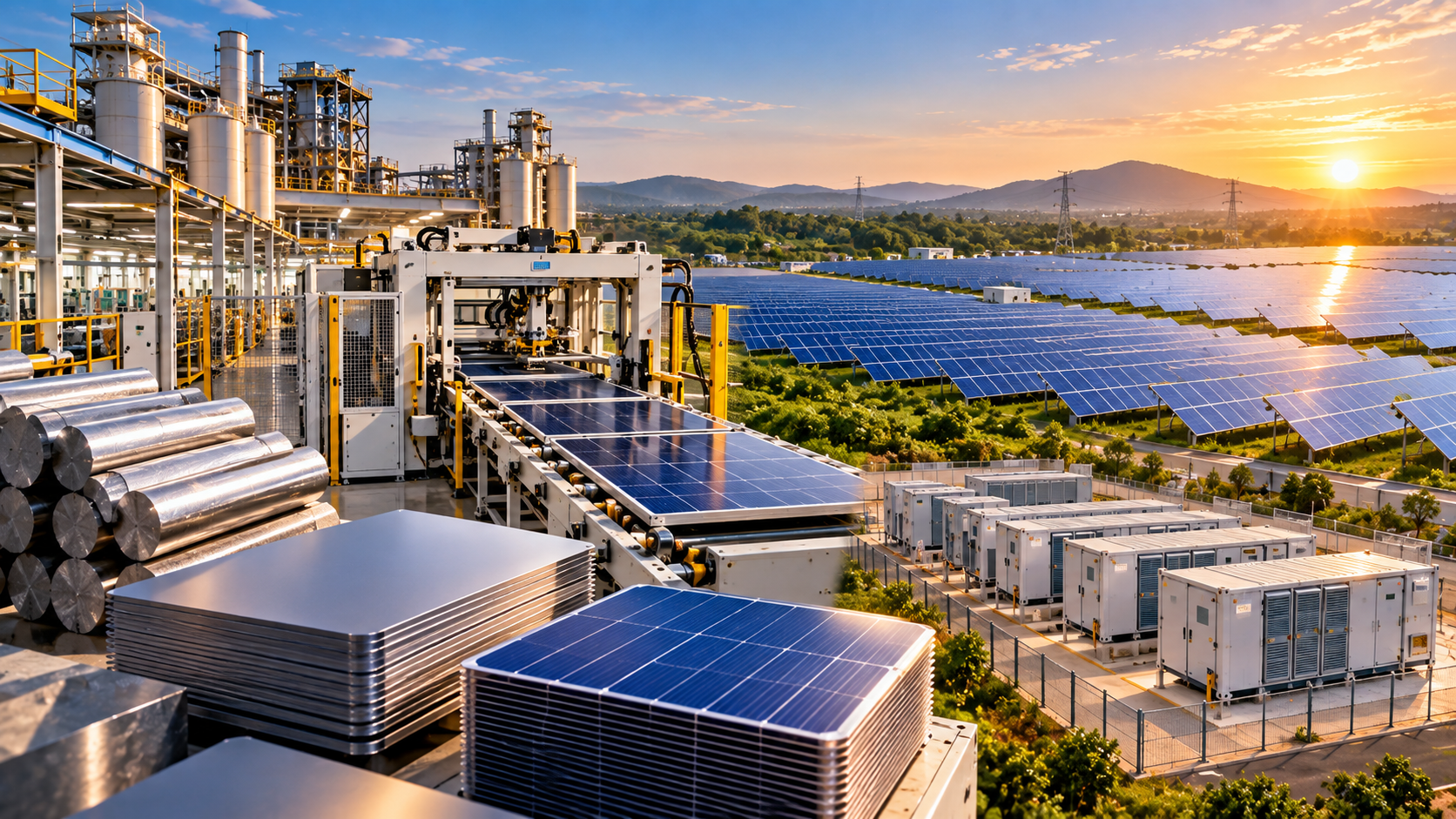
Surat-based solar manufacturer plans major expansion into cells, ingots, wafers, battery storage and renewable power projects across Gujarat and Maharashtra
Surat-based Navitas Solar has announced plans to invest ₹10,000 crore over the next five years as it seeks to transform itself from a solar module manufacturer into a more integrated clean-energy company.
The proposed investment programme will cover multiple segments of the renewable-energy value chain, including solar cells, ingots, wafers, battery energy storage systems and solar power generation. The expansion will be spread across Gujarat and Maharashtra and is aimed at strengthening domestic manufacturing capabilities and improving supply-chain integration.
The announcement comes at a time when India's solar industry is moving towards greater domestic manufacturing of critical components. Companies are increasingly looking beyond module assembly towards cells, wafers and other upstream components to reduce dependence on imported equipment and improve control over costs and supply.
2.4 GW Solar Cell Facility in Gujarat
A major component of Navitas Solar's expansion strategy is a planned 2.4 GW solar cell manufacturing facility at Sisodara in Gujarat.
The first phase of the project is expected to involve an investment of around ₹1,200 crore, with commercial operations targeted for July 2027. The facility is expected to strengthen the company's position in the higher-value portion of the solar manufacturing chain.
Moving into cell manufacturing could also allow Navitas Solar to capture more value from each stage of solar-panel production instead of relying primarily on the downstream module business.
The company is simultaneously developing pilot lines for ingot and wafer manufacturing. These pilot facilities are intended to build technical expertise and provide a base for potential larger-scale production in the future.
Expansion Beyond Solar Modules
Navitas Solar currently operates around 3 GW of annual solar module manufacturing capacity and manufactures Mono PERC as well as high-efficiency N-Type TOPCon modules.
Its modules can have capacities of up to 720 watts, reflecting the company's focus on higher-efficiency solar products.
The proposed investment programme represents a significant change in the company's business model. Rather than remaining focused predominantly on module manufacturing, Navitas wants to participate across both upstream manufacturing and downstream renewable-energy development.
This includes solar components, electricity storage and generation assets.
Battery Storage Facility Planned in Vadodara
Energy storage is another important component of Navitas Solar's expansion strategy.
The company plans to establish a 5 GWh battery energy storage facility in Vadodara, Gujarat.
Battery storage is becoming increasingly important as India's renewable-energy capacity expands. Solar generation is concentrated during daylight hours, while electricity demand can remain high after sunset. Large-scale battery storage can help bridge this timing gap by storing electricity when generation is high and releasing it when required.
For Navitas Solar, entering the battery storage segment could therefore complement its existing solar manufacturing operations and create an additional business avenue within the renewable-energy ecosystem.
The move also comes as India's power sector increasingly focuses on storage capacity alongside renewable generation.
Two Solar Parks Planned in Maharashtra
Navitas Solar is also expanding into renewable-power generation in Maharashtra.
The company is developing two solar parks with capacities of 200 MW and 25 MW. These projects are being pursued under engineering, procurement and construction (EPC) as well as independent power producer (IPP) models.
The shift towards project development gives Navitas an opportunity to participate not only in manufacturing equipment but also in the deployment and operation of renewable-energy assets.
An IPP model can provide recurring electricity-generation revenue once projects become operational, although project development also requires significant capital and carries execution, financing and power-market risks.
Backward Integration Could Strengthen Supply Chain
The company's ₹10,000-crore plan places considerable emphasis on vertical integration.
Solar manufacturers can face volatility in the availability and prices of cells, wafers, polysilicon and other components. Developing capabilities across several stages can potentially provide greater control over procurement and production planning.
Navitas has already been pursuing backward integration through its solar encapsulant business, Navitas Alpha.
The proposed ingot, wafer and cell initiatives would take that strategy considerably further.
However, integrated manufacturing also requires substantial capital expenditure, specialised technology and efficient utilisation of production capacity. The financial returns from the expansion will therefore depend on the company's ability to scale these facilities successfully.
India's Solar Manufacturing Push Creates Opportunity
Navitas Solar's expansion comes amid a broader increase in India's domestic solar manufacturing capacity.
Other manufacturers have also announced large investments in cells and modules. For example, Premier Energies recently commissioned a 7 GW N-type TOPCon G12R cell facility in Andhra Pradesh, taking its total cell capacity to 10.6 GW. The company has also outlined further expansion into ingots, wafers and battery storage.
This indicates that India's solar industry is gradually moving towards a more vertically integrated manufacturing ecosystem.
Domestic manufacturing is also being supported by regulatory and policy measures designed to increase the use of locally manufactured solar equipment.
For companies such as Navitas Solar, the resulting expansion of the domestic supply chain could create opportunities across manufacturing, project development and energy storage.
Scale and Technology Will Be Critical
Navitas Solar Director Ankit Singhania said the renewable-energy sector is entering a phase where scale, technology and supply-chain depth are expected to become increasingly important for competitiveness.
The ₹10,000-crore investment programme is therefore not limited to increasing manufacturing capacity. It is intended to create capabilities across several interconnected parts of the clean-energy ecosystem.
The strategy could provide diversification, but it also increases the complexity of the business. Each segment — from cells and wafers to battery storage and power generation — has different technology requirements, capital needs and competitive dynamics.
Solar Sector Faces a More Challenging Cost Environment
The expansion is taking place even as India's solar sector faces some pressure from rising project costs.
Recent industry analysis has pointed to higher costs for domestic cells, commodities and other equipment, while competitive tariffs continue to constrain the ability of developers to pass higher costs on to customers.
This makes manufacturing efficiency particularly important.
Companies expanding capacity will need to manage utilisation, technology upgrades, raw-material procurement and pricing carefully to generate adequate returns on the capital invested.
South Africa Adds an International Dimension
Alongside its domestic expansion, Navitas Solar's EPC business is expanding its presence in South Africa for utility-scale and independent power producer projects.
This gives the company exposure to an international renewable-energy market while potentially diversifying its project-development activities beyond India.
International expansion, however, brings additional considerations such as currency movements, regulatory frameworks, project financing and execution conditions in overseas markets.
From Module Maker to Integrated Clean-Energy Company
Founded in 2013, Navitas Solar has established itself as a solar module manufacturer with a focus on Mono PERC and N-Type TOPCon technologies.
The planned ₹10,000-crore investment represents a much broader ambition.
The company is targeting an ecosystem that could span:
-
Solar modules
-
Solar cells
-
Ingots
-
Wafers
-
Solar encapsulants
-
Battery energy storage
-
Solar power generation
-
EPC and IPP projects
Such vertical integration could give the company multiple revenue opportunities across the renewable-energy chain while reducing dependence on a single business segment.
At the same time, the scale of the investment means execution will be critical. Timely commissioning, capacity utilisation, technology competitiveness and access to capital will determine how effectively the announced plans translate into operating performance.
Market Outlook
Navitas Solar's ₹10,000-crore investment plan signals an ambitious expansion from solar module manufacturing into a broader integrated clean-energy business.
The 2.4 GW cell facility in Gujarat, planned 5 GWh battery storage project in Vadodara and solar parks in Maharashtra represent some of the most important elements of the strategy. The planned ingot and wafer pilot lines could provide an additional foundation for deeper backward integration.
The opportunity for the company is supported by India's growing renewable-energy requirements and the expansion of domestic solar manufacturing. However, the scale of the proposed capital expenditure also makes execution, project economics, technology choices and capacity utilisation important factors to monitor.
If Navitas successfully executes the expansion, the company could evolve from a module-focused manufacturer into a more diversified participant across India's renewable-energy value chain. The pace at which the planned facilities become operational and begin contributing to revenue will remain a key indicator of the strategy's progress.