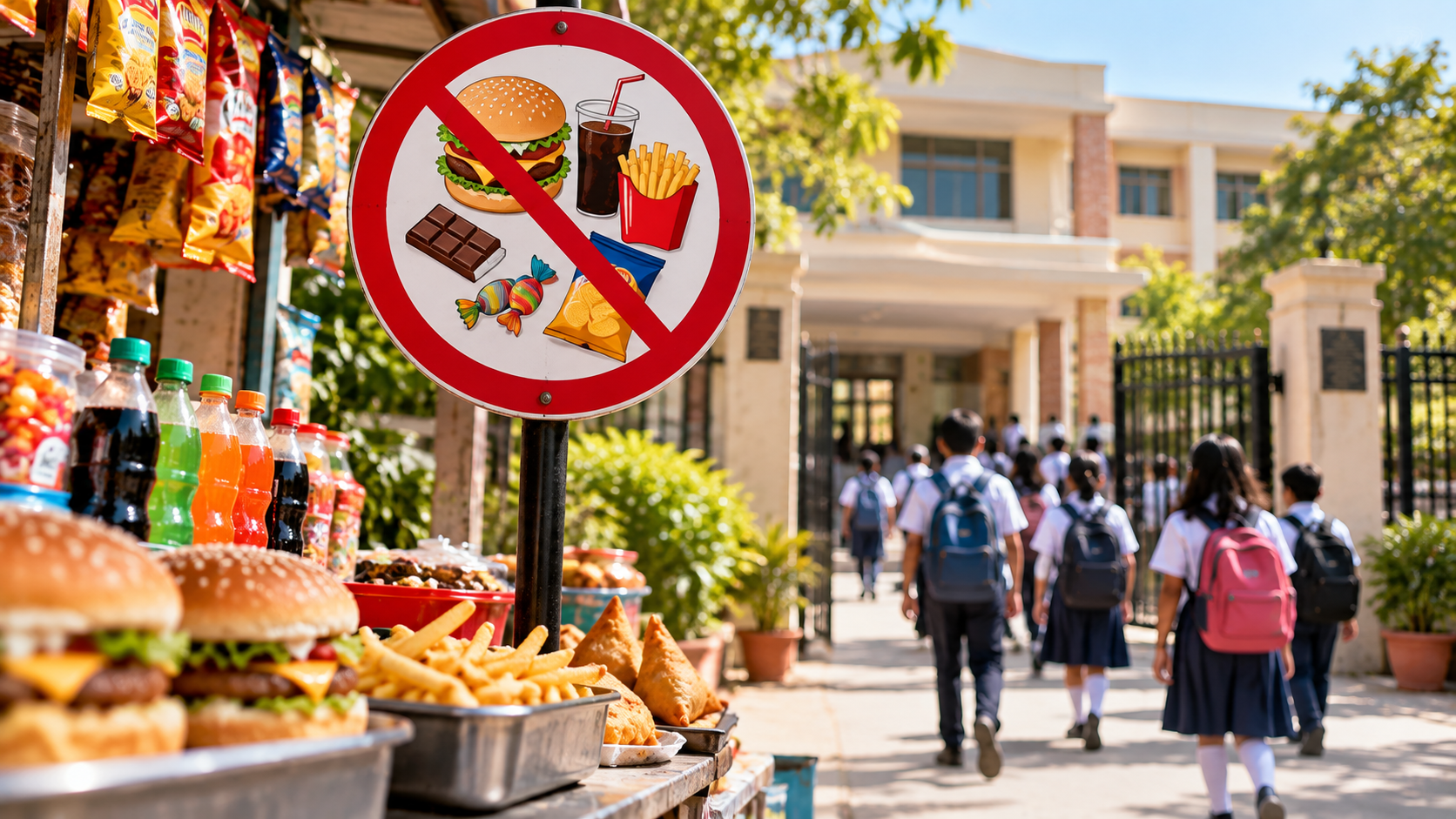
FSSAI's proposed rules could restrict sales of foods high in added fat, sugar and salt within 50 metres of schools, putting pressure on retailers while encouraging food companies to reformulate products
India is moving towards tighter restrictions on the sale of foods high in fat, sugar and salt around schools as authorities seek to address changing dietary habits and rising concerns over childhood obesity.
The Food Safety and Standards Authority of India (FSSAI) has proposed amendments to its rules governing safe food and balanced diets for children in schools. The draft framework seeks to identify food products that are high in added fat, added sugar or sodium and restrict their availability to schoolchildren in and around school premises.
The proposal follows years of discussion around improving children's diets. FSSAI's current draft notification, issued in August 2026, specifically proposes definitions for foods high in added fat, added sugar and salt, with public comments invited before the regulations are finalised.
50-Metre Radius Could Become a Key Regulatory Boundary
Under the proposed framework, restrictions would extend beyond school canteens and premises to food outlets operating within a 50-metre radius of schools.
That could bring a wide range of businesses into the scope of the proposed rules, including small grocery stores, restaurants, snack counters, street-food vendors and other food outlets located close to school campuses.
The approach is not entirely new. FSSAI has previously issued guidance seeking to limit the availability and consumption of foods high in fat, sugar and salt in schools and within 50 metres of school premises.
The current regulatory effort is aimed at establishing clearer nutritional criteria for identifying products that fall within the high-fat, high-sugar or high-salt categories.
FSSAI Defines What Counts as High Fat, Sugar and Salt
The latest draft proposes specific thresholds based on the Dietary Guidelines for Indians, 2024, issued by the Indian Council of Medical Research.
Under the proposed definitions, a solid food containing more than 4.2 grams of added fat per 100 grams would be classified as high in added fat, while for liquid foods the threshold would be more than 1.5 grams per 100 ml.
For added sugar, the proposed threshold is more than 3 grams per 100 grams for solid foods and more than 2 grams per 100 ml for liquid foods.
For salt, products containing more than 0.625 grams per 100 grams in solid form or more than 0.175 grams per 100 ml in liquid form would fall under the proposed high-salt definition.
These definitions are part of a draft regulatory process and could change before final notification.
From Packaged Snacks to Fast Food
The potential impact extends beyond packaged products.
Foods commonly consumed by children, including packaged snacks, sweetened beverages, confectionery and various fast-food products, could come under greater scrutiny depending on their nutritional composition and the final regulatory framework.
The proposed approach also has implications for traditional snacks and prepared foods sold around schools because the focus is on nutritional characteristics rather than simply whether a product is manufactured by a large company.
This could bring small local food businesses into the compliance framework alongside major packaged-food manufacturers.
Small Retailers Fear a Hit to Sales
For small retailers operating near schools, the proposed restrictions could have a direct commercial impact.
Neighbourhood shops often depend on students as an important customer group, particularly during school breaks and after-school hours. Packaged snacks, beverages and quick-service foods can form a meaningful part of daily sales for outlets located near busy school campuses.
Retailers may therefore need to adjust their product mix if the proposed restrictions are implemented.
FSSAI has indicated that businesses would still be able to sell products that do not fall within the restricted nutritional categories, suggesting that the policy is intended to change the availability of certain products rather than eliminate food retailing around schools altogether.
Food Companies Could Face Pressure to Reformulate
The proposed rules could also influence how food manufacturers formulate products.
Companies may have an incentive to reduce added sugar, fat or sodium in products that are popular among children so that they remain within the applicable nutritional thresholds.
This could accelerate an existing trend towards product reformulation in the packaged-food industry.
For multinational companies, the development adds to an increasingly complex global regulatory environment around children's food consumption.
Global Food and Beverage Companies in Focus
Large international food and beverage companies operating in India could face additional compliance requirements if the proposed restrictions are implemented.
Companies such as PepsiCo, Coca-Cola, Mondelez and Nestle have significant portfolios across snacks, beverages, confectionery and convenience foods.
The proposed school-area restrictions would be particularly relevant for products with strong consumption among younger consumers.
At the same time, the rules could encourage companies to expand healthier product categories or modify existing recipes to meet nutritional requirements.
India Joins a Broader Global Policy Debate
India's proposed approach comes amid growing international efforts to reduce children's exposure to foods considered high in fat, sugar and salt.
Several countries have introduced restrictions on the sale or promotion of such products in schools, while others have introduced advertising restrictions, warning labels or taxes on specific categories.
Chile is one example frequently cited in the international debate. Its regulatory framework has included warning labels and restrictions on the sale and promotion of certain unhealthy foods in schools.
Research into Chile's experience has also examined whether such measures influenced children's consumption patterns and encouraged food manufacturers to reformulate products.
Obesity Concerns Add Urgency
The proposed rules come as concern about overweight and obesity among Indian children grows.
According to World Obesity Federation data cited in the report, the number of Indian children and adolescents aged five to 19 classified as overweight or obese increased from around 28 million in 2015 to approximately 41 million in 2025.
The number is projected to rise further in the coming years if current trends continue.
Changing diets, greater availability of packaged foods, increased consumption of processed products and sedentary lifestyles are among the broader factors associated with concerns around childhood obesity.
The government is therefore attempting to intervene at an early stage, with schools viewed as an important environment for shaping long-term food habits.
Schools Are a Strategic Focus
FSSAI's approach is based on the idea that children spend a significant portion of their day in or around schools and that food available in these environments can influence consumption habits.
Earlier FSSAI guidance argued that schools should promote balanced and nutritious diets and limit the availability of foods high in fat, sugar and salt.
The proposed framework takes that principle further by establishing specific nutritional definitions that can be used for regulatory purposes.
The 50-metre approach is designed to address the practical challenge of children simply moving outside the school gate to purchase restricted products.
Enforcement Could Be the Biggest Challenge
Implementing the proposed rules across India's large and diverse school network could prove challenging.
A school may be surrounded by multiple shops, restaurants, street vendors and markets that serve both students and the wider community.
Authorities would therefore need clear guidelines covering how the 50-metre boundary is measured, which businesses are covered, how products are classified and how compliance is monitored.
Enforcement could be particularly complicated in densely populated urban areas where schools are located within commercial neighbourhoods.
Maharashtra Offers an Early Example
Maharashtra has already taken a more restrictive approach in certain areas by focusing on shops operating within 50 metres of schools.
According to the report, state food-safety authorities have identified violations among shops located within the restricted area and have taken enforcement action.
The experience could provide policymakers with practical information about the challenges involved in implementing a nationwide framework.
It may also help determine how authorities balance public-health objectives with the commercial interests of small retailers.
Industry Raises Compliance Concerns
Food-industry representatives have raised concerns over the potential impact of applying restrictions to businesses outside school premises.
The key issue is that shops near schools do not exclusively serve students. They also cater to parents, teachers, office workers, residents and other consumers.
Industry participants have therefore argued that extending restrictions beyond school campuses could affect businesses whose customer base is much broader than schoolchildren.
The final regulations will need to determine how authorities address this issue while retaining the intended child-protection objective.
Potential Impact on Retailers and Food Manufacturers
If implemented in its proposed form, the framework could create different effects across the food industry.
Small shops may need to replace restricted products with alternatives that meet nutritional criteria. Restaurants and fast-food outlets could face additional scrutiny over products sold near schools.
For packaged-food companies, the impact could extend into product development, nutrition labelling, distribution strategies and marketing.
Manufacturers may increasingly prioritise products with lower levels of added sugar, fat and sodium for distribution through channels frequented by children.
Reformulation Could Become a Bigger Industry Trend
One of the longer-term effects could be a greater focus on reformulation.
Rather than withdrawing products from certain markets, manufacturers may attempt to modify recipes to bring products below regulatory thresholds.
This could involve reducing added sugar or sodium, changing fat content or introducing alternative ingredients.
However, reformulation can also affect taste, texture, shelf life and production costs, meaning companies would need to balance nutritional requirements with consumer preferences.
Public Consultation Still Underway
The proposed framework is not yet a final nationwide regulation.
FSSAI's draft notification was issued in August and the authority has invited comments and suggestions from stakeholders. The current public-comment deadline listed by FSSAI is October 9, 2026.
This means the final rules could differ from the current proposal after feedback from food companies, retailers, schools, health experts and other stakeholders is considered.
The distinction is important because the current nutritional thresholds and implementation framework remain subject to the regulatory process.
What the Food Industry Will Watch
Food and beverage companies are likely to focus on the final definition of HFSS products, the precise scope of the 50-metre restriction and the enforcement mechanism.
Retailers will be particularly interested in whether the rules apply to all sales within the specified radius or specifically to sales targeting schoolchildren.
Manufacturers, meanwhile, will monitor whether nutritional thresholds require significant product reformulation and whether additional labelling or marketing restrictions are introduced.
The consultation process could therefore become an important stage for determining the eventual commercial impact.
Market Outlook
India's proposed 50-metre restrictions around schools mark another step in the country's broader effort to address children's exposure to foods high in added fat, sugar and salt.
For the food industry, the potential impact extends beyond large packaged-food manufacturers to neighbourhood retailers, restaurants and street-food businesses operating close to schools.
The biggest questions now concern the final regulatory thresholds, enforcement mechanism and implementation timeline. If the framework is adopted substantially as proposed, companies could face greater pressure to reformulate products and diversify their offerings, while retailers near schools may need to alter their product mix.
For investors and industry participants, the consultation process and final FSSAI notification will be the key developments to track before assessing the full commercial impact of the proposed policy.