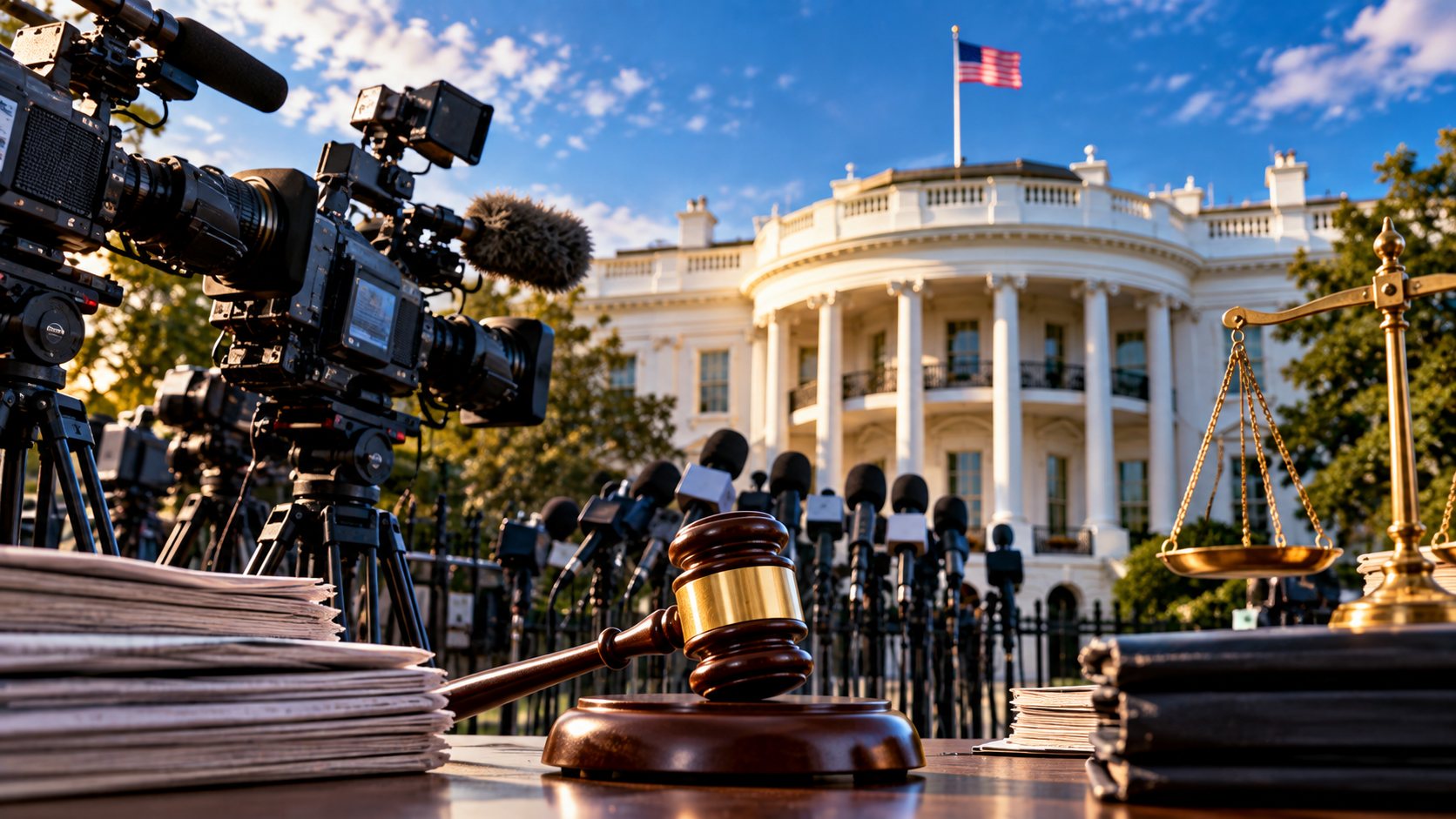
US District Judge Timothy Kelly issues a 14-day temporary restraining order after the three news organisations challenged the Trump administration’s decision to revoke their White House press credentials
A US federal judge has temporarily blocked the Trump administration from excluding CNN, MS NOW and Politico from the White House, ordering that the news organisations’ press credentials be restored while their legal challenge proceeds.
US District Judge Timothy Kelly issued a temporary restraining order requiring the relevant administration officials to immediately return, reinstate and restore the White House hard-pass credentials held by employees of the three organisations. The order is set to remain in effect for 14 days unless the court takes further action.
The ruling follows a legal challenge filed by CNN, MS NOW and Politico after their reporters were denied access to the White House grounds following President Donald Trump's September 18 announcement that the organisations would be barred.
Three News Organisations Challenged the Ban
CNN, MS NOW and Politico argued that the administration's decision violated constitutional protections, including First Amendment protections concerning freedom of the press and due-process rights.
The organisations said they had been singled out because of the content of their reporting and argued that the government cannot selectively restrict press access based on a publication's viewpoint.
The administration has taken a different position, arguing that access to the White House is a privilege rather than an automatic entitlement. Government lawyers have also argued that the president has discretion over access to areas where space and security considerations limit the number of journalists who can be present.
Judge Focuses on Due Process
During Wednesday's hearing, Judge Timothy Kelly questioned whether the White House had followed the procedures required under existing federal appellate precedents before revoking the journalists' press credentials.
Kelly pointed to two decisions from the US Court of Appeals for the District of Columbia Circuit concerning White House press access. He indicated that those precedents require journalists to receive due process before their credentials are revoked.
The judge said it did not appear that the three organisations had been given a meaningful opportunity to contest the decision before their access was withdrawn.
The temporary restraining order now preserves access while the broader legal dispute continues.
What Is the Temporary Order?
The latest decision does not represent a final ruling on the underlying lawsuit.
A temporary restraining order is designed to preserve the existing situation while the court considers the broader legal issues. In this case, the order requires the restoration of the affected press credentials for 14 days unless modified or extended by the court.
The central constitutional questions surrounding the administration's decision therefore remain unresolved.
The court will ultimately have to consider the competing arguments over government control of White House access, press freedom, due process and the authority of the executive branch.
Trump Announced the Ban on September 18
Trump announced on September 18 that CNN, MS NOW and Politico would be barred from the White House, criticising what he described as inaccurate or "fake" reporting.
The three organisations were subsequently denied entry to the White House grounds, and their journalists' credentials were deactivated or confiscated.
The decision represented a further escalation in the administration's disputes with sections of the US news media.
The White House has maintained that the organisations remain free to report on the president from outside the White House and has disputed the characterisation of the policy as an attack on press freedom.
Media Access Becomes a Broader Legal Issue
The case goes beyond the three organisations involved because it raises broader questions about how governments manage access for journalists.
The White House does not provide unlimited access to every journalist. Security requirements, limited physical space and the need for pooled coverage can all affect which reporters are permitted into particular areas.
However, courts have previously examined whether government officials can remove journalists from established press-access arrangements because of the content or viewpoint of their reporting.
That distinction is central to the current case.
White House Press Pool Also Affected
The dispute has had consequences beyond CNN, MS NOW and Politico.
The White House press pool is a longstanding arrangement through which selected media organisations share coverage of presidential events, particularly when physical space or logistical restrictions prevent every journalist from attending.
CNN's exclusion affected its ability to perform an assigned pool role. Other major television networks subsequently suspended pooled coverage in a show of solidarity with the excluded outlets.
The development temporarily disrupted a system that has traditionally allowed television audiences to receive pooled coverage of presidential movements and events.
Administration Cites Access and Security Arguments
The Trump administration has argued that White House access is not an unrestricted right and that the president and his administration retain authority to determine access arrangements.
Government lawyers have also raised arguments concerning security and the nature of White House facilities.
The media organisations, meanwhile, maintain that once the government establishes press-access arrangements, it cannot selectively remove journalists because officials disagree with their reporting.
The court's eventual interpretation of those competing arguments could have implications for how future administrations manage access to the White House press corps.
The Case Follows Earlier Disputes Over Media Access
The latest confrontation is not the first legal dispute involving the Trump administration and White House press access.
During Trump's first presidency, CNN correspondent Jim Acosta's White House access was restored following a court challenge.
More recently, the administration also faced litigation involving the Associated Press after the news organisation was excluded from certain presidential events.
A 2025 federal appeals court decision concerning the Associated Press distinguished between highly restricted spaces, such as the Oval Office, and broader White House press facilities, although litigation surrounding that dispute has continued.
These earlier cases are relevant to the current legal debate because they form part of the body of precedent concerning the government's authority over press access.
What Happens Next?
The temporary order provides CNN, MS NOW and Politico with restored access while the litigation continues, but it does not settle the underlying constitutional dispute.
The court is expected to consider further arguments from both sides as the case develops.
Key questions include whether the administration followed required procedures before revoking the credentials, how much discretion the White House has over press access, and whether the stated reasons for the ban can withstand constitutional scrutiny.
The eventual ruling could also influence how future administrations structure press-access policies and respond to critical coverage.
Global Significance for Media and Government
The dispute has attracted attention because it involves the relationship between executive power and independent journalism in the United States.
For governments, controlling access to secure and highly restricted facilities is an established administrative and security function. For news organisations, access to government officials and institutions is an important part of reporting on public policy and presidential activities.
The legal question is where the boundary lies between legitimate control of restricted spaces and unconstitutional restrictions based on the content or viewpoint of journalism.
The current temporary order does not answer that broader question, but it keeps the existing access arrangement in place while the court examines the case.
World News Outlook
The White House-media dispute is likely to remain a closely watched legal and institutional issue as the case moves forward.
For now, the immediate effect of Judge Kelly's order is clear: the White House must restore the affected hard-pass credentials for CNN, MS NOW and Politico for the duration of the temporary restraining order, subject to further court action.
The broader dispute over press access, due process and executive authority remains unresolved and will depend on subsequent proceedings and judicial rulings.