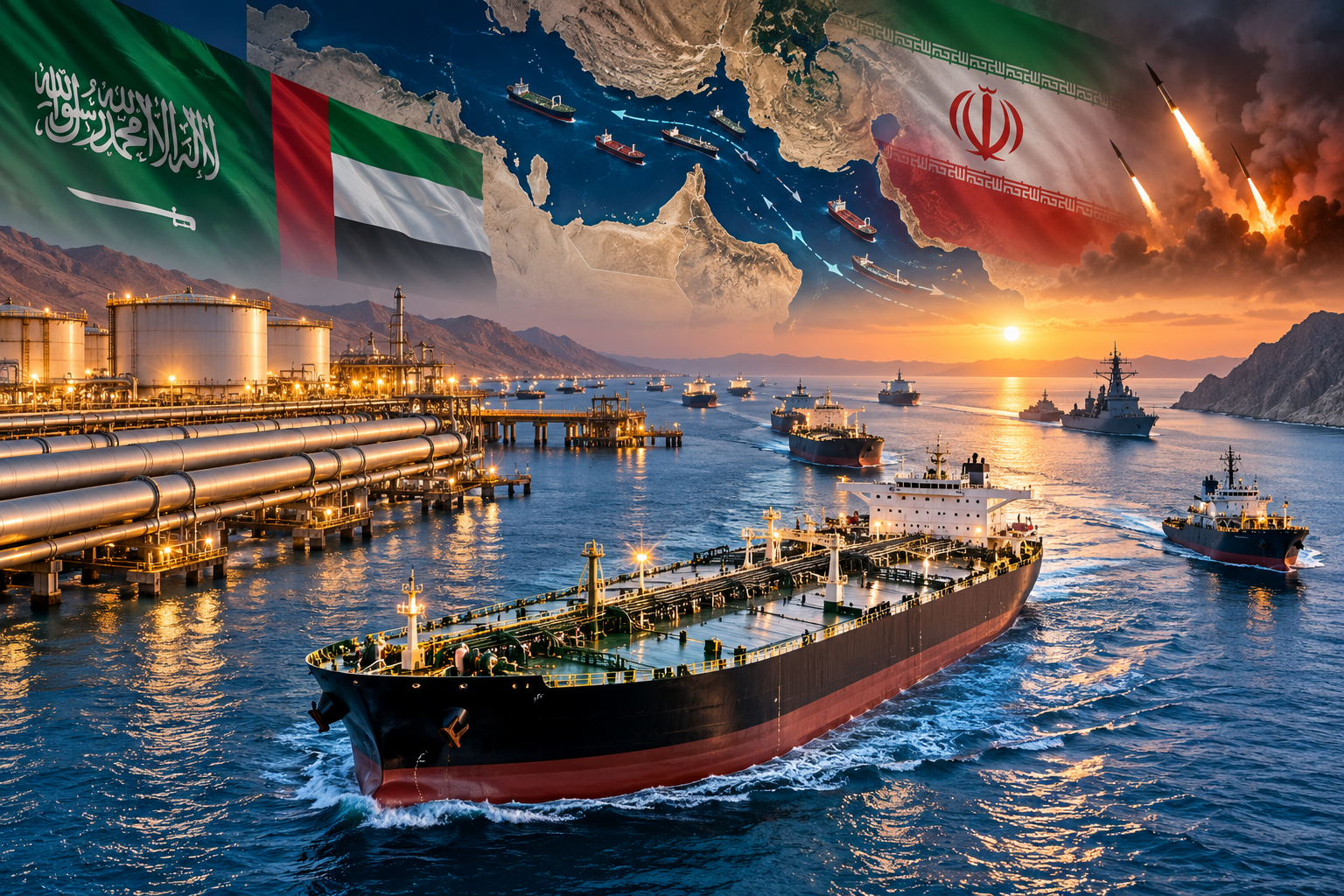
Alternative pipelines, protected shipping corridors and ship-to-ship transfers have prevented a full-scale global oil supply shock, but the increasingly expensive workarounds are exposing fresh risks for producers, refiners and consumers
The disruption of the Strait of Hormuz has created one of the most complicated oil-supply challenges in years, but Gulf producers have so far managed to prevent the conflict from triggering the extreme shortage that markets initially feared. Saudi Arabia, the United Arab Emirates and other regional exporters have combined pipeline alternatives, emergency shipping arrangements and military-protected routes to keep significant volumes of crude moving.
The result has been an unusual situation for global energy markets. Oil remains substantially more expensive than before the conflict, with Brent crude trading around the $100-a-barrel mark, but prices have not reached the $140-$150 levels that some analysts had feared if several million barrels a day were permanently removed from the market.
However, maintaining these alternative supply routes is becoming increasingly expensive. Longer voyages, scarce supertankers, ship-to-ship transfers, higher insurance costs and security requirements are adding substantial costs to every barrel reaching international buyers.
Gulf Producers Turn to Alternative Routes
When attacks disrupted shipping through the Strait of Hormuz, Saudi Arabia relied heavily on its East-West pipeline, which transports crude from the country's eastern oil fields to the Red Sea port of Yanbu. The route allows Saudi exports to bypass the strategic chokepoint.
The UAE also used its pipeline network connecting oil-producing areas to Fujairah on the Gulf of Oman, providing another route that avoids the main Hormuz passage.
These systems had spare capacity and initially helped Gulf producers maintain exports despite the disruption. Saudi Arabia and the UAE therefore entered the crisis with an important advantage over producers whose exports are much more dependent on direct passage through Hormuz.
But the alternative routes themselves subsequently came under pressure, forcing producers to develop additional solutions.
Saudi Arabia Faces Repeated Disruptions
The vulnerability of alternative infrastructure became clear when Saudi Arabia's East-West pipeline was temporarily shut following an attack earlier in September. The disruption forced the kingdom to redirect more crude toward terminals on the Persian Gulf.
Saudi Arabia subsequently increased exports from Ras Tanura and relied on ship-to-ship transfers around Omani waters to move crude toward international buyers.
Reuters reported that Saudi Aramco loaded around 14 million barrels onto seven very large crude carriers at Ras Tanura on September 20, while flows through Hormuz rose sharply from August levels.
The East-West pipeline has since resumed operations, providing some relief to the supply system. The restart also contributed to a decline in Brent prices toward the $97-a-barrel region earlier this week.
Ship-to-Ship Transfers Become a Critical Workaround
One of the most important emergency mechanisms has been the expansion of ship-to-ship transfers near Oman.
Instead of relying entirely on conventional port-to-port journeys, crude can be transferred between large tankers outside the most dangerous sections of the shipping route. This has allowed producers to continue moving barrels even as direct shipping through Hormuz remains heavily restricted.
Saudi Arabia has reportedly planned significant volumes of crude exports from Ras Tanura through ship-to-ship transfers at Oman's Sohar port. Trade sources indicated that around 60 million barrels could be moved through this mechanism during September and October, with buyers including refiners in China, South Korea, India and Japan.
The system, however, comes with substantial logistical and financial costs.
Shipping Costs Surge
The biggest weakness in the workaround strategy is transportation.
Longer routes mean more fuel consumption, longer vessel turnaround times and greater exposure to geopolitical and security risks. Ship-to-ship transfers also require additional vessels and waiting time.
Reuters has reported that the expansion of these emergency operations has pushed tanker freight costs sharply higher, with very large crude carrier rates reaching exceptionally elevated levels.
For oil producers, this means that maintaining exports does not necessarily translate into maintaining the same profitability. A greater share of the value of each barrel can be absorbed by transportation, insurance and security expenses.
For refiners, particularly in Asia, higher freight costs can increase the delivered cost of crude even when the headline benchmark price remains relatively stable.
Why Oil Has Not Surged to Extreme Levels
Despite the severe disruption, the global oil market has so far avoided the type of supply deficit that would normally trigger an explosive price rally.
Several factors are helping balance the market.
First, alternative routes and emergency shipping arrangements have restored a meaningful portion of the barrels affected by the disruption. Second, oil inventories have been drawn down to supplement physical supply. Third, higher prices and weaker economic activity have reduced some demand.
Additional production from suppliers outside the conflict zone has also provided some support.
This combination has helped keep the physical market relatively supplied even though the underlying logistics have become significantly more difficult.
Global Inventories Are Acting as a Buffer
Oil inventories have become another important shock absorber.
Commercial stocks, particularly in major consuming economies, have been used to compensate for barrels that are temporarily unable to reach the market through conventional routes.
That has helped prevent a much larger price spike. But inventory withdrawals cannot continue indefinitely.
If the conflict remains prolonged and alternative supply routes continue to face disruptions, stockpiles could eventually become less capable of absorbing the shortfall.
That would leave prices more directly exposed to any additional supply interruption.
Asia Remains Particularly Exposed
Asian refiners are among the most important buyers of Middle Eastern crude, making the region especially sensitive to developments around Hormuz.
India, China, Japan and South Korea have all had to adjust crude procurement and shipping arrangements as Gulf supply routes have changed.
For India, the issue is particularly important because higher crude prices can increase the country's import bill, put pressure on the rupee and raise operating costs across transportation, manufacturing and other energy-intensive industries.
Indian refiners have also been monitoring alternative sources of crude as Gulf supply uncertainty continues.
Iran's Leverage Is Complicated
The disruption has demonstrated that Iran can create substantial friction in global energy trade, but the emergence of alternative supply routes has also reduced the immediate impact of the disruption.
The ability of Gulf producers to reroute some exports means that shutting down a single shipping corridor does not automatically remove the equivalent volume of oil from the global market.
At the same time, the continued targeting of pipelines, ports and shipping routes could make the workarounds progressively more difficult.
The market is therefore watching not only the status of Hormuz itself but also the security of the alternative infrastructure around the Gulf, Red Sea and Mediterranean.
Oil Prices Remain Highly Sensitive to Diplomatic Developments
Brent crude recently moved back toward the $100 level after falling from its September highs as markets assessed signs of possible diplomatic engagement between Washington and Tehran.
On September 24, Brent crude was around $102 a barrel, while WTI was near $92, with traders weighing Iran's signals on diplomacy alongside continuing supply risks.
Any credible progress toward reopening the Strait of Hormuz could remove a significant geopolitical premium from crude prices. Conversely, renewed attacks on tankers, pipelines or alternative shipping corridors could quickly push prices higher.
The Bigger Risk Is Prolonged Disruption
The most important issue for the oil market is no longer simply whether crude can move, but how long the current emergency logistics can be maintained.
The existing system depends on spare pipeline capacity, available tankers, military protection, favourable weather, insurance availability and functioning transfer points.
A disruption to any one of these components could increase pressure on the others.
The recent expansion of ship-to-ship transfers demonstrates that the global oil trade can adapt quickly, but it also highlights how dependent the system has become on increasingly complicated logistics.
Market Outlook
The global crude market is currently being supported by a combination of alternative Gulf supply routes, inventory withdrawals, softer demand and additional production outside the conflict zone. This has prevented the extreme shortage scenario that initially threatened the market.
However, the underlying physical market remains vulnerable. Brent crude around the $100 level continues to reflect a significant geopolitical risk premium, while tanker and insurance costs are adding to the delivered price of oil.
For India and other major Asian importers, the key variables to monitor will be the stability of Gulf exports, the security of Hormuz and Bab el-Mandeb, tanker freight rates, inventory trends and developments in US-Iran diplomacy.
If Hormuz traffic normalises and alternative pipelines operate without further disruption, the supply premium in crude could gradually ease. If attacks expand to additional infrastructure or shipping corridors, the market could face renewed upward pressure despite the extensive workarounds currently keeping oil supplies moving.