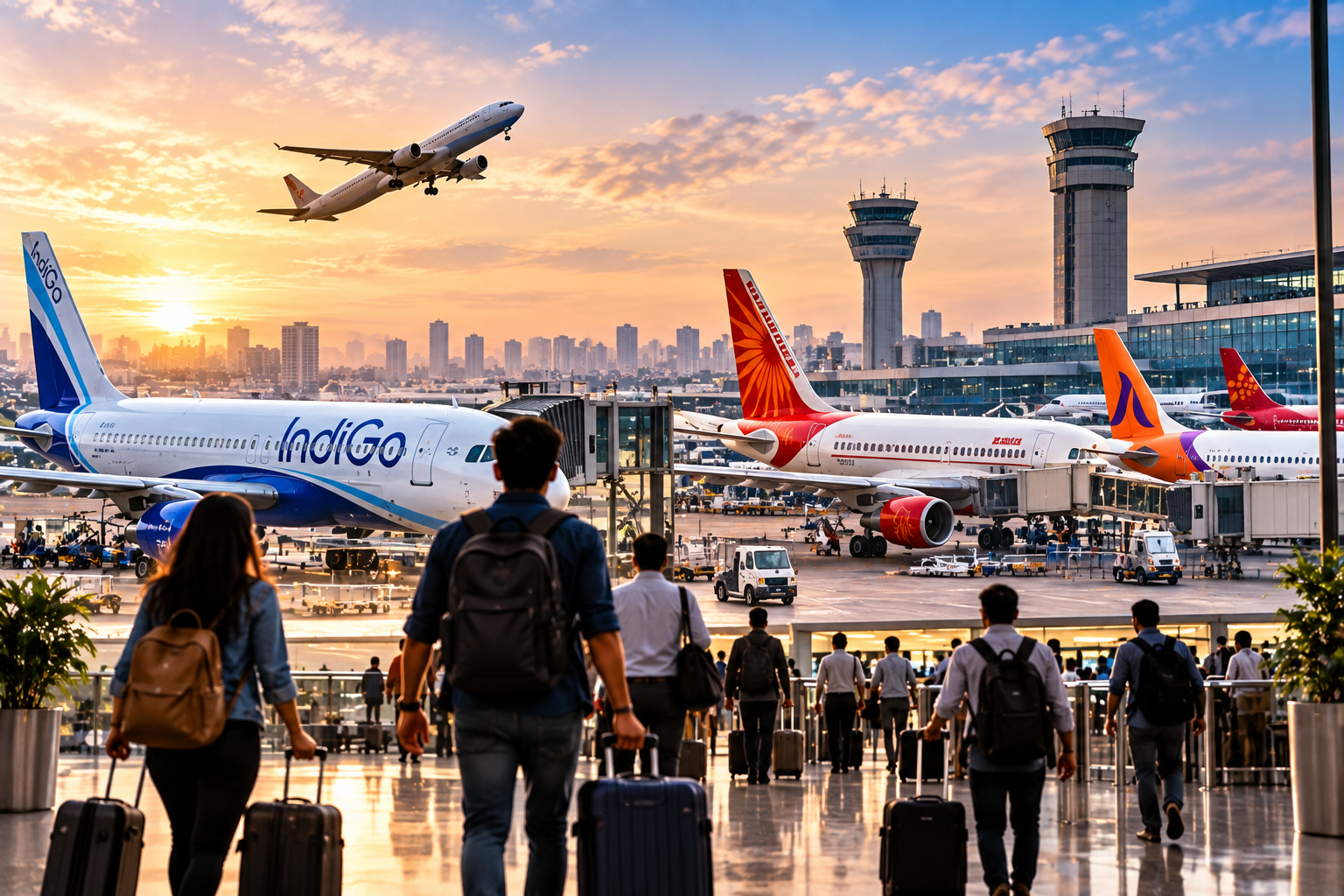
Domestic airlines carried 12.13 million passengers in August, while Air India Group gained market share and IndiGo's share declined; industry traffic remained broadly flat during the first eight months of 2026
India's domestic aviation sector witnessed a year-on-year decline in passenger traffic in August, with airlines carrying 12.126 million passengers during the month, according to data released by the Directorate General of Civil Aviation (DGCA).
Domestic passenger traffic declined 6.34% from 12.947 million passengers recorded in August 2025. The monthly decline comes against a relatively stable traffic trend for the first eight months of 2026, when Indian airlines carried 110.53 million passengers compared with 110.726 million during the corresponding period last year.
The data indicates that while India's aviation market remains at a large scale, passenger growth has faced pressure in recent months.
Domestic Air Traffic Declines in August
According to DGCA data, domestic airlines carried 12.126 million passengers in August 2026, compared with 12.947 million in the same month a year earlier.
On a cumulative basis, passenger traffic during January-August stood at 110.53 million, marginally below the 110.726 million passengers recorded during the same period in 2025.
The cumulative decline of 0.18% suggests that the weakness in August followed a broadly flat traffic trend during the first eight months of the year rather than representing a sharp deterioration in the overall market.
IndiGo Market Share Falls to 65%
IndiGo continued to remain the largest domestic airline by passenger market share in August, but its share declined sequentially.
The airline's market share fell to 65% in August from 67.4% in July, representing a decline of 2.4 percentage points.
Despite the decline, IndiGo continued to account for nearly two-thirds of India's domestic aviation market, highlighting its substantial scale and network presence.
The movement in market share also indicates increasing competition for passengers as other airline groups expand capacity and networks.
Air India Group Gains Ground
Air India Group emerged as the biggest market-share gainer during the month.
Its market share increased to 26.7% in August from 24% in July, a gain of 2.7 percentage points.
The increase comes as the Tata Group-owned aviation businesses continue to consolidate and expand their presence across India's domestic and international aviation markets.
The increase in Air India Group's share, alongside the decline in IndiGo's share, was one of the key developments in the August DGCA data.
SpiceJet Market Share Declines Further
SpiceJet continued to hold a relatively small share of the domestic market.
Its market share declined to 1.2% in August from 1.6% in July.
The airline has been dealing with operational and financial challenges, and its reduced market share reflects the pressure it faces in maintaining capacity and competing with larger carriers.
Akasa Air Holds 5.5% Share
Akasa Air's market share remained unchanged at 5.5% in August compared with July.
The airline has continued to maintain its position among India's newer carriers and has been expanding its network and fleet since beginning commercial operations.
Its stable market share during August suggests that it retained its passenger base despite the broader decline in domestic traffic.
IndiGo Leads in On-Time Performance
While IndiGo's market share declined during August, the airline continued to lead the industry in on-time performance (OTP).
At the 10 major airports tracked by the DGCA, IndiGo recorded an OTP of 91.5% during August.
Akasa Air followed with an OTP of 90.5%, while Air India Group recorded 83.9%.
On-time performance remains an important competitive factor for airlines because delays can influence passenger satisfaction, connecting-flight reliability and overall network efficiency.
Cancellation Rate Stands at 1.39%
The overall cancellation rate of scheduled domestic airlines stood at 1.39% during August.
The cancellation figure provides an indication of operational reliability across the domestic aviation industry.
Airlines face multiple factors that can affect cancellations, including weather conditions, aircraft availability, technical issues, crew constraints and airport-related disruptions.
For passengers, consistent operations and lower cancellation rates remain important factors when choosing an airline, particularly for business travel and time-sensitive journeys.
What the Market Share Shift Means
The movement in market shares during August highlights an evolving competitive landscape.
IndiGo continues to command a dominant position, but the decline in its monthly share coincided with a rise in Air India Group's share.
The development could become more significant if Air India Group continues to increase capacity, expand routes and improve operational performance.
For the industry, greater competition could encourage airlines to focus on aircraft utilisation, network efficiency, fares, customer experience and operational reliability.
Aviation Demand Remains Structurally Important
Despite the August decline, India's domestic aviation market remains strategically important because of the country's large population, expanding middle class, increasing urbanisation and growing demand for business and leisure travel.
The long-term expansion of air connectivity also depends on the development of airports and regional routes.
However, passenger growth does not automatically translate into stronger profitability for airlines. Fuel prices, aircraft leasing costs, foreign-exchange movements, airport charges, maintenance expenses and pricing competition can have a significant impact on airline margins.
Capacity and Fleet Expansion to Remain Important
The ability of airlines to match capacity with demand will remain a key factor in the industry's financial performance.
Excess capacity can place pressure on ticket yields, while insufficient capacity can limit passenger growth and lead to higher fares.
As major airlines expand their fleets and networks, the balance between capacity growth and passenger demand will therefore be closely watched.
For investors tracking aviation companies, fleet deliveries, aircraft utilisation, passenger load factors, average fares and operating costs can provide important signals about the sector's underlying health.
Air India-IndiGo Competition Takes Centre Stage
The expanding presence of Air India Group alongside IndiGo is likely to remain one of the most important competitive developments in India's aviation industry.
IndiGo retains a substantial market-share advantage, while the Air India Group is attempting to build scale through fleet expansion, network development and integration of its aviation businesses.
The competitive dynamics could influence domestic routes, international connectivity, fares and passenger service standards over the coming quarters.
Key Metrics to Watch
Investors and industry participants will be watching several indicators in the coming months, including monthly passenger traffic, market shares, passenger load factors, aircraft utilisation and average ticket yields.
Operational indicators such as on-time performance and cancellations will also remain important.
At the financial level, aviation companies remain sensitive to aviation turbine fuel prices, foreign-exchange movements, aircraft leasing costs and maintenance expenses.
Market Outlook
India's domestic aviation sector recorded a 6.34% year-on-year decline in passenger traffic in August, but the January-August figure remained broadly stable, with traffic down only 0.18% from the corresponding period of 2025.
The most notable development during the month was the shift in airline market shares. IndiGo remained the dominant carrier with a 65% share, while Air India Group increased its share to 26.7%. Akasa Air retained 5.5%, while SpiceJet's share declined to 1.2%.
Operational performance remained an important differentiator, with IndiGo recording the highest on-time performance among the major carriers tracked by DGCA.
Going ahead, passenger demand, capacity additions, fuel costs, aircraft availability and competitive pricing will determine the trajectory of the aviation sector. The evolving market-share battle between IndiGo and Air India Group will also remain a key factor for the industry's competitive and financial outlook.