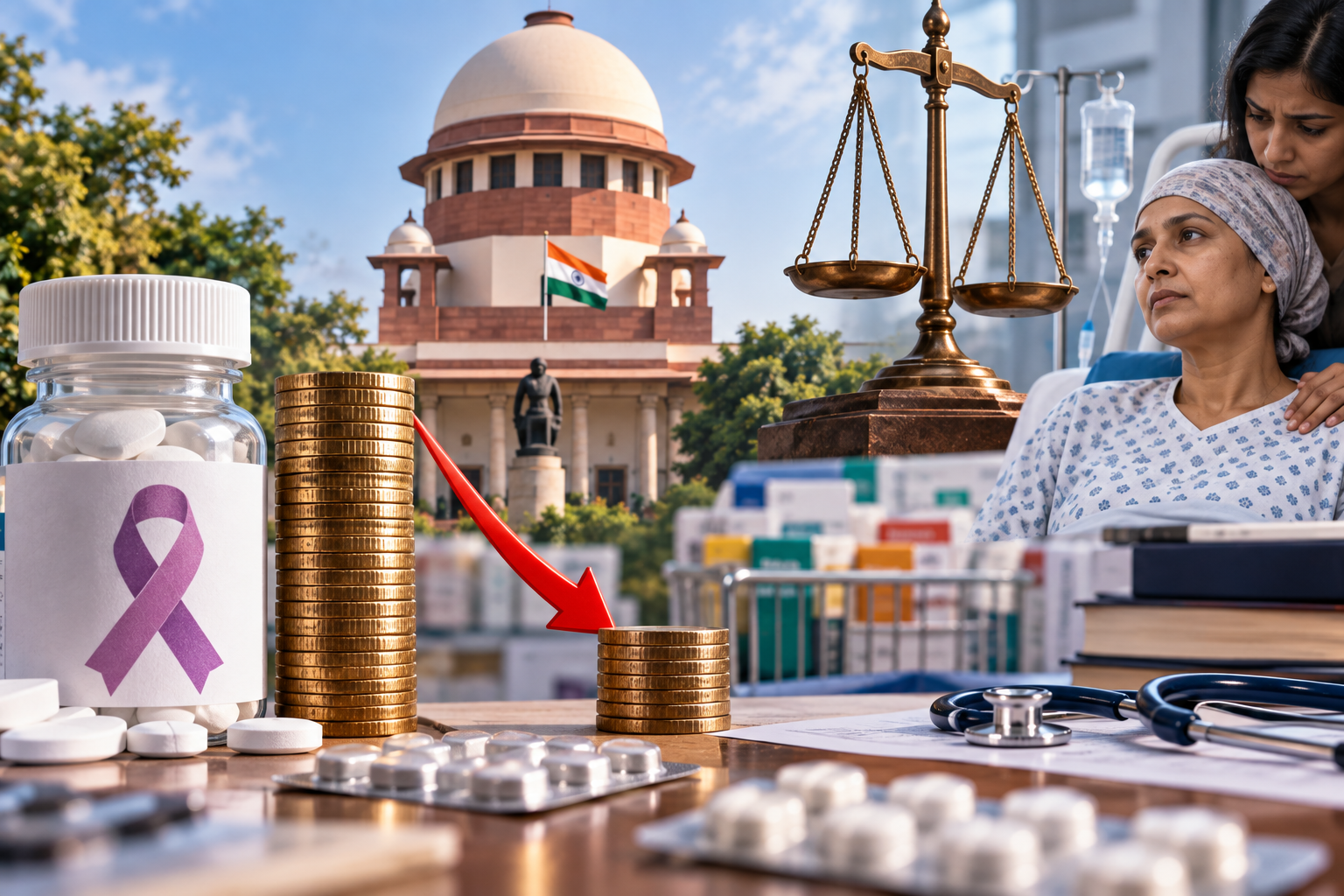
Court raises serious concerns over a cancer medicine carrying an MRP of ₹27,000 despite being supplied to retailers at ₹2,700, highlighting the impact of excessive medicine pricing on patients and public healthcare schemes
The Supreme Court has raised serious questions over the wide gap between the price at which certain essential medicines are supplied to retailers and the maximum retail price (MRP) printed on their packaging, focusing particular attention on cancer drugs.
During a hearing on petitions seeking tighter regulation of medicine prices, a bench comprising Justices Sandeep Mehta and Vikram Nath questioned how such a substantial difference could be permitted. The court was told that an essential cancer medicine had a price to retailer (PTR) of ₹2,700 while its printed MRP was ₹27,000 — a ten-fold difference.
The observations have brought renewed attention to India's drug-pricing framework, trade margins across the pharmaceutical distribution chain and the financial burden faced by patients requiring expensive and prolonged treatment.
Supreme Court Questions 10-Fold Price Difference
The court questioned why an essential medicine could carry an MRP several times higher than the price at which it reaches the retailer.
The bench expressed strong concern about the impact of such pricing structures on patients, particularly those requiring cancer treatment, where treatment costs can run into several lakhs of rupees.
The court also noted that families can be forced to use their savings or sell assets to finance medical treatment, underscoring the broader affordability challenge associated with life-saving medicines.
The matter is scheduled to be heard again on September 29.
PTR and MRP: What Is the Difference?
PTR, or price to retailer, is the price at which a manufacturer or marketer supplies a medicine to a retailer or pharmacy.
MRP, meanwhile, is the maximum price at which the packaged medicine can be sold to the consumer and is printed on its packaging.
The two figures are not necessarily expected to be identical. The difference can include margins for distributors and retailers, logistics and other costs, as well as applicable taxes.
The Supreme Court's concern in the present case relates to the scale of the difference rather than simply the existence of a gap between PTR and MRP.
Examples cited during the proceedings included one medicine with an MRP of ₹73 against a PTR of ₹22.75 and another carrying an MRP of ₹61 against a PTR of ₹9.65.
Why Cancer Drug Pricing Has Become a Major Issue
Cancer treatment frequently involves expensive medicines, repeated treatment cycles, diagnostics, hospitalisation and long-term follow-up care.
For patients without adequate insurance or public financial protection, the medicine component alone can become a substantial part of the overall treatment bill.
The Supreme Court also examined the implications for government-funded healthcare. Where hospitals purchase medicines and subsequently receive reimbursement under public healthcare programmes, questions arise over whether unusually high medicine prices can ultimately increase the financial burden on public funds and taxpayers.
This makes medicine pricing relevant not only to individual patients but also to the economics of publicly funded healthcare.
How India's Drug Price Control System Works
India regulates medicine prices primarily through the Drugs (Prices Control) Order, 2013, under which the National Pharmaceutical Pricing Authority (NPPA) fixes ceiling prices for medicines included in Schedule I.
The Schedule I list is linked to the National List of Essential Medicines (NLEM).
For scheduled medicines, manufacturers, marketers and importers are required to sell products within the applicable ceiling price, subject to permitted taxes.
For non-scheduled formulations, the regulatory framework currently restricts annual MRP increases to no more than 10% over the preceding 12 months. The government has also said that NPPA can intervene in extraordinary circumstances and in the public interest.
NPPA Already Regulates Hundreds of Formulations
Government data shows that the NPPA had effective ceiling prices for 935 scheduled formulations as of July 23, 2026.
The government has also highlighted separate mechanisms for fixing retail prices of certain new drugs.
This means India's drug-pricing system already includes several layers of regulation. However, the Supreme Court proceedings have brought attention to whether the existing framework sufficiently addresses large differences between manufacturer-level prices and consumer-facing MRPs.
131 Anti-Cancer Formulations Under Ceiling Prices
Anti-cancer medicines are already included within India's price-control framework.
According to government data released in March 2026, effective ceiling prices were in place for 131 anti-cancer drugs. The government said the revised ceiling prices had reduced prices by around 21% compared with the earlier NLEM 2015 ceiling prices and were estimated to generate annual savings of about ₹294 crore for patients.
The government has also stated that NPPA fixes retail prices for certain new anti-cancer drugs and monitors non-scheduled formulations under the applicable provisions of the DPCO.
The Trade Margin Question
A major issue emerging from the proceedings is the role of trade margins in determining the final price paid by patients.
A medicine moves through several stages before reaching the consumer. The manufacturer or marketer may supply it to a stockist or distributor, which then supplies it to a retailer. Each stage can involve commercial margins and costs.
The difference between PTR and MRP therefore does not automatically represent a manufacturer's profit.
However, a very large difference can raise questions about how the final price is determined and whether the distribution chain is operating with margins that remain proportionate to the cost and value of the medicine.
Impact on Patients and Healthcare Costs
For patients undergoing cancer treatment, even relatively small differences in the price of individual medicines can accumulate significantly over multiple treatment cycles.
High medicine prices can also affect treatment decisions, adherence and the ability of households to continue treatment over an extended period.
The issue becomes particularly significant in diseases such as cancer, where treatment can involve a combination of medicines, surgery, radiation, diagnostics and hospital care.
Government Schemes Add Another Dimension
The Supreme Court's observations also bring public healthcare financing into the discussion.
When medicines are supplied as part of treatment reimbursed under government healthcare schemes, the cost is ultimately borne through public expenditure. Therefore, pricing efficiency can have implications for both patients and government healthcare budgets.
The broader question is whether public health programmes can achieve greater healthcare coverage while ensuring that procurement and treatment costs remain economically sustainable.
Generic Medicines and Pricing Transparency
The hearing also touched upon broader issues involving generic medicines, prescription practices, medical devices and trade margins.
Greater transparency around medicine pricing could potentially help patients, hospitals and policymakers better understand how the final consumer price is formed.
One issue raised before the court was the availability of pricing information with the regulator, including PTR and price-to-stockist data, and whether greater public disclosure of such information could improve transparency.
What Could Change if Regulation Tightens?
If the ongoing proceedings eventually lead to changes in the regulatory framework, pharmaceutical companies, distributors, hospitals and pharmacies could face greater scrutiny over pricing structures and trade margins.
For pharmaceutical companies, tighter price controls could affect margins on medicines where the gap between supply prices and consumer-facing prices is substantial.
For hospitals and healthcare providers, greater scrutiny could increase transparency around medicine procurement and billing.
For patients, the intended objective would be to improve affordability and reduce the possibility of excessive pricing on essential medicines.
However, any regulatory changes would need to balance affordability with incentives for pharmaceutical companies to develop, manufacture and distribute complex medicines, particularly in specialised therapeutic areas.
Pharmaceutical Industry Implications
The Supreme Court proceedings could increase attention on pricing practices across India's pharmaceutical distribution network.
Companies with significant exposure to regulated medicines could face closer scrutiny if the pricing framework is strengthened. At the same time, manufacturers with efficient production and distribution systems may be better positioned to operate under tighter margin structures.
The impact on pharmaceutical businesses will ultimately depend on the nature of any regulatory changes that may emerge from the proceedings.
Market Outlook
The Supreme Court's questioning of the ten-fold gap between PTR and MRP of an essential cancer medicine has placed medicine pricing and trade margins under renewed scrutiny.
India already has a structured price-control mechanism through the DPCO and NPPA, including ceiling prices for scheduled medicines and specific measures covering anti-cancer drugs. The latest proceedings, however, raise a broader question about whether the existing framework adequately addresses unusually large differences between supply prices and consumer-facing MRPs.
The September 29 hearing could provide further clarity on the court's concerns and the regulatory questions surrounding non-scheduled medicines, trade margins and pricing transparency.
For the pharmaceutical and healthcare sectors, the key issue will be how any future changes balance patient affordability, public healthcare expenditure, distribution economics and the industry's ability to supply essential medicines sustainably.