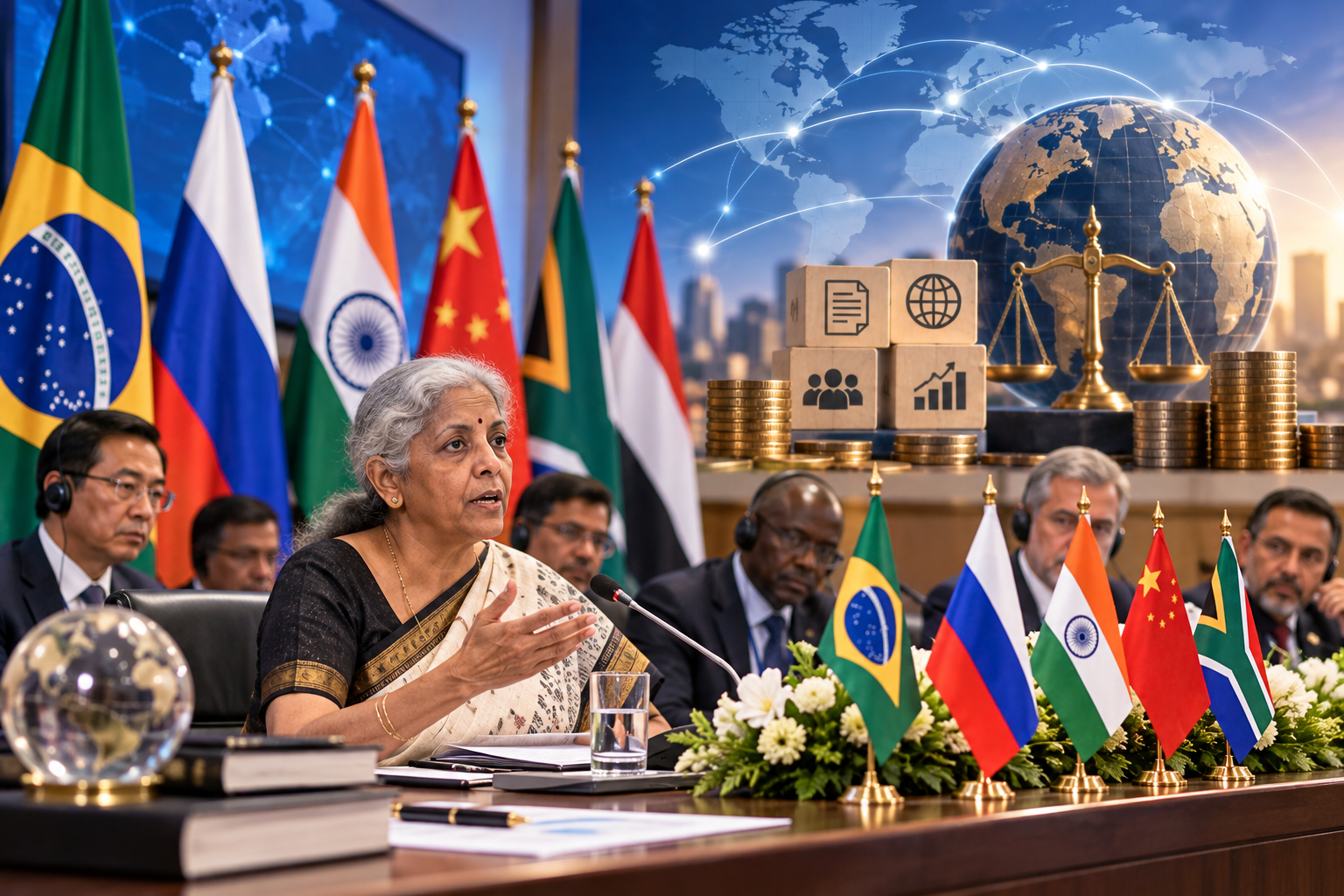
India proposes new BRICS working groups on international taxation, transfer pricing and revenue statistics as global negotiations move towards a new framework for cross-border taxation
Finance Minister Nirmala Sitharaman has called for stronger coordination among BRICS tax administrations as countries negotiate the future architecture of international taxation, arguing that major developing economies should have a meaningful role in shaping rules that will govern cross-border taxation for years to come.
Speaking at a meeting of BRICS tax heads in New Delhi, Sitharaman said international tax rules are undergoing a significant renegotiation, including discussions around the proposed United Nations Framework Convention on International Tax Cooperation (UNFCITC).
The United Nations process is currently moving from broad discussions towards negotiations over draft provisions. The fifth session of the UN Intergovernmental Negotiating Committee, held in August 2026, considered draft texts for the framework convention and two early protocols covering taxation of cross-border services and prevention and resolution of tax disputes.
India seeks stronger BRICS coordination
India has proposed two new BRICS working groups focused on international taxation and transfer pricing, and revenue statistics.
The objective is to create institutional mechanisms that can continue beyond India's 2026 BRICS chairmanship. China is scheduled to assume the BRICS chairmanship in 2027.
The proposed structure could give tax administrations a regular platform to exchange experiences and coordinate on issues that have become increasingly important as companies expand across multiple jurisdictions.
For developing economies, the discussions are particularly relevant because cross-border transactions, digital business models and multinational corporate structures can make the allocation of taxing rights more complex.
Transfer pricing takes centre stage
One of the proposed working groups will focus on international taxation and transfer pricing.
Transfer pricing refers broadly to the pricing of transactions between related entities operating in different jurisdictions. Tax authorities use transfer-pricing rules to determine whether profits are being appropriately allocated between countries.
The proposed BRICS platform is expected to facilitate exchanges on areas such as treaty interpretation, transfer-pricing audits, advance pricing agreements and mutual agreement procedures.
Greater cooperation could also help tax administrations share experiences on complex international transactions and develop greater consistency in handling disputes.
Why international tax rules are changing
The global tax system is undergoing a broader transformation as governments seek to address challenges created by cross-border commerce, digitalisation and multinational business structures.
The UN Framework Convention negotiations are intended to establish a more inclusive framework for international tax cooperation. The UN says the process is designed to help countries mobilise domestic resources for sustainable development while ensuring that all member states can participate in shaping international tax rules.
The negotiations have now entered a more detailed drafting stage. The August 2026 session was the first point at which the committee had draft texts covering the framework convention and both early protocols, providing a concrete basis for negotiations.
Revenue statistics could get a BRICS-specific framework
The second proposed working group will focus on revenue statistics.
According to the report, the initiative is intended to develop a framework for measuring tax-system performance that better reflects the economic structures and circumstances of BRICS economies.
This could become important because tax-to-GDP ratios, revenue mobilisation, compliance and collection efficiency can vary substantially across economies with different levels of formalisation, income structures and institutional capacity.
A common framework for data and measurement could make comparisons between BRICS tax systems more useful while helping administrations identify areas requiring reform.
Developing countries seek greater influence
A key element of India's position is that developing economies should have a stronger voice in shaping international tax rules.
The UN's ongoing negotiations similarly emphasise inclusiveness and participation by all member states. The organisation has said the proposed framework is intended to create a more inclusive and effective system of international tax cooperation.
For BRICS countries, this could mean greater coordination on issues affecting revenue collection, taxation of cross-border activities and the treatment of multinational enterprises.
However, the final outcome will depend on negotiations among a much broader group of UN member states, rather than BRICS countries alone.
Tax disputes remain a major issue
International tax disputes can arise when two jurisdictions claim taxing rights over the same income or interpret tax treaties differently.
The proposed BRICS working group could provide a forum for sharing experiences around mutual agreement procedures and other mechanisms used to resolve cross-border tax disputes.
The UN's draft framework discussions have also addressed the prevention and resolution of tax disputes, underlining the importance of creating mechanisms that provide greater certainty to both governments and taxpayers.
For multinational companies, predictable dispute-resolution procedures can reduce uncertainty around investment decisions and cross-border business structures.
Technology and administrative capacity
India's BRICS tax initiatives also include technology-driven cooperation.
The Tax Collaboration Tool, Tax Knowledge Hub and Cross-Learning Lab are intended to support information sharing and institutional learning among participating tax administrations.
Technology is becoming increasingly important for tax authorities as governments use data analytics, digital records and automated systems to identify compliance gaps and improve tax administration.
The development of common knowledge platforms could allow BRICS administrations to share practical experiences rather than relying solely on formal treaty negotiations.
Young tax professionals programme could become annual
The BRICS tax meeting also considered institutionalising the BRICS Young Tax Professionals Programme as an annual initiative at the National Academy of Direct Taxes in Nagpur.
The first in-person programme was held in April and brought together young tax officials from seven BRICS countries for training and discussions on international taxation.
Institutionalising such programmes could create a longer-term network among tax officials and support the exchange of technical expertise across member administrations.
Tax Support Network aims to improve cooperation
Another initiative under discussion is the BRICS Tax Support Network, for which terms of reference are being finalised.
The proposed network is intended to provide practical support to tax administrations while also contributing to the ease of doing business across BRICS economies.
For businesses operating across multiple BRICS jurisdictions, greater administrative coordination could potentially reduce duplication and improve clarity around tax procedures.
However, the effectiveness of such a network will depend on how much information-sharing and administrative cooperation participating countries ultimately agree to implement.
India’s BRICS chairmanship and the road ahead
India's emphasis on institutionalising these initiatives reflects an attempt to ensure that tax cooperation continues after its 2026 BRICS chairmanship.
The timing is significant because international tax negotiations are entering a more substantive phase. The UN process is scheduled to continue through 2027, with member states working towards final texts for the proposed framework and protocols.
The proposed BRICS working groups could therefore provide participating economies with an additional platform for developing common positions and exchanging technical experience during this period.
Implications for businesses and investors
Changes to international tax rules can have implications beyond government revenue.
Multinational companies may eventually need to reassess their cross-border structures, transfer-pricing policies, tax compliance systems and dispute-resolution strategies as international rules evolve.
For investors, greater clarity in international taxation could reduce some forms of regulatory uncertainty for companies with significant overseas operations. At the same time, changes in the allocation of taxing rights could affect effective tax rates and profitability for certain multinational businesses.
The ultimate impact will depend on the final international agreements and how individual countries incorporate them into domestic legislation and tax treaties.
Market Outlook
The push by India for stronger BRICS cooperation comes at a time when the international tax system is moving into a detailed negotiating phase. The proposed working groups on international taxation, transfer pricing and revenue statistics could give BRICS tax administrations a more permanent mechanism for technical cooperation.
The immediate focus will remain on how these initiatives are institutionalised and how BRICS members coordinate their positions while the broader UN negotiations progress.
For businesses operating across borders, the evolution of transfer-pricing rules, treaty arrangements, tax-dispute mechanisms and the allocation of taxing rights will remain important regulatory developments. The eventual framework could influence international investment structures, compliance costs and government revenue policies across emerging and developed economies.