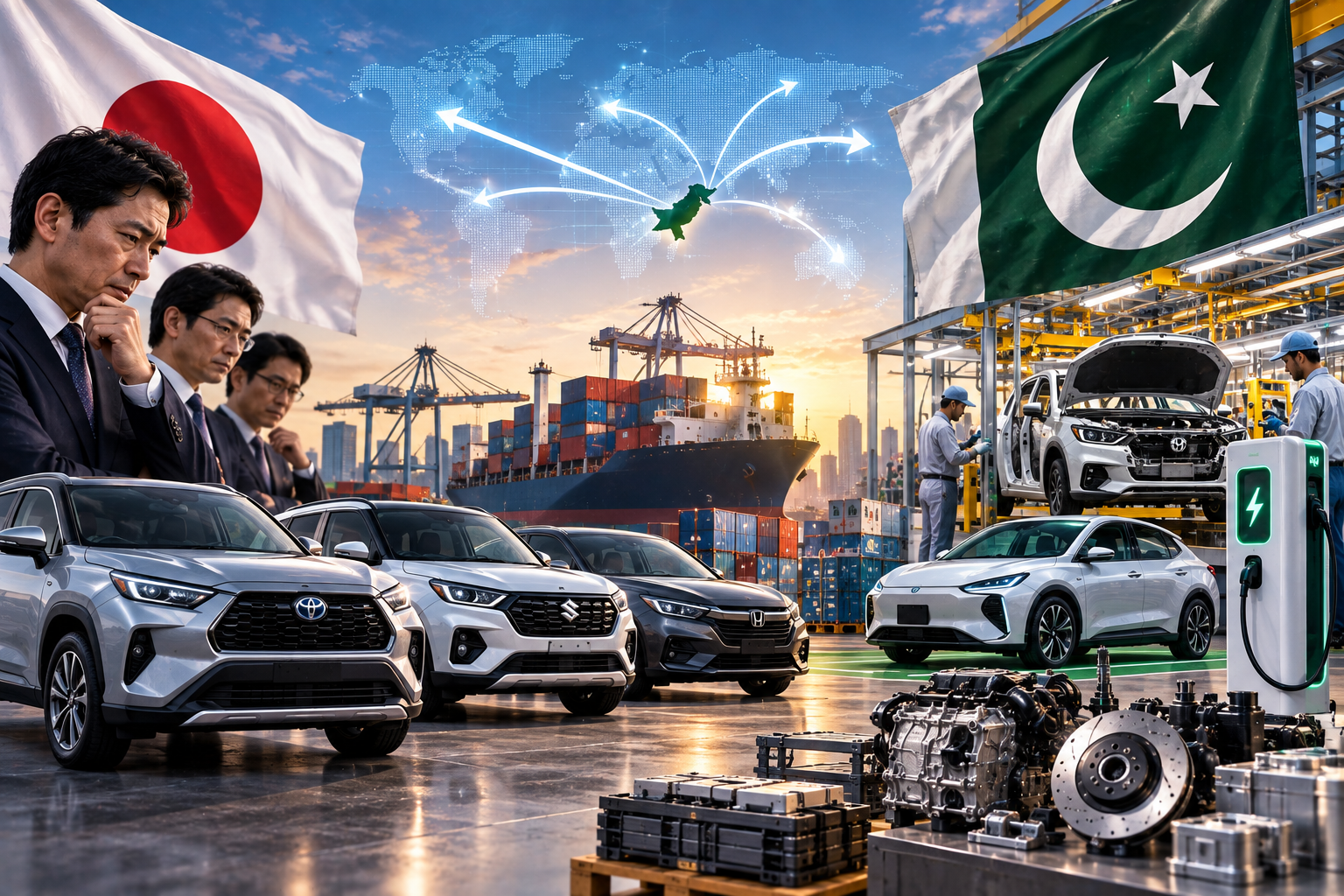
Islamabad’s push to raise vehicle exports, deepen localisation and accelerate new-energy vehicle manufacturing could reshape competition between Japanese incumbents and Chinese EV manufacturers
Pakistan’s automobile industry is facing a potential policy reset as the government seeks to increase vehicle exports, deepen domestic manufacturing and accelerate the transition towards new-energy vehicles. The proposed Automotive Industry Development Policy (AIDP) 2026-31 has, however, raised concerns among Japanese automakers because of provisions that could link industry benefits and market access with export performance.
According to the report cited by Nikkei Asia, the policy was approved by Prime Minister Shehbaz Sharif on September 9 and is expected to take effect after Cabinet approval. The framework is designed to make Pakistan’s automotive sector more competitive while increasing its contribution to exports and local industrial development.
The proposed changes are particularly significant for Japanese manufacturers such as Suzuki, Toyota and Honda, which have established manufacturing and supplier networks in Pakistan.
Export targets at the centre of the policy
One of the most important elements of the proposed framework is an increase in export requirements for vehicle manufacturers. The target is expected to rise from the current 10 per cent of the value of vehicles manufactured in Pakistan to 12 per cent by 2031, with a gradual increase envisaged during the policy period.
Companies that fail to meet the prescribed requirements could face customs-related penalties and, potentially, consequences affecting their manufacturing licences, according to the report.
Pakistan is also targeting combined vehicle and auto-parts exports of around $4.6 billion. The government believes that a stronger export orientation can help the domestic automobile industry move beyond dependence on the local market and generate additional foreign-exchange earnings.
The challenge, however, is whether manufacturers can achieve these targets while remaining internationally competitive.
Why Japanese manufacturers are concerned
Japanese automobile companies have built a significant presence in Pakistan over several decades. Suzuki, Toyota and Honda together account for a substantial share of passenger-vehicle sales, according to the report.
The proposed export-linked framework therefore has direct implications for companies that have traditionally focused heavily on Pakistan's domestic market.
Japan has previously raised concerns at the World Trade Organization regarding Pakistan's automotive policies. Tokyo has questioned measures that link export targets with tariff reductions and import licences and has urged Islamabad to ensure that its revised automobile policy remains consistent with WTO obligations.
Pakistan, for its part, has maintained that its export requirements are compatible with international trade rules.
The issue could therefore become important not only for individual automakers but also for Pakistan's broader trade-policy relationship with Japan.
WTO rules could become an important test
The potential dispute centres on the use of domestic-policy incentives and market-access benefits to encourage exports.
For Pakistan, encouraging manufacturers to export is part of a broader strategy to improve the country's trade balance and increase foreign-exchange earnings. For international manufacturers, however, mandatory export-linked conditions can create additional compliance costs and affect investment decisions.
A renewed WTO discussion would therefore place Pakistan's new automobile framework under greater scrutiny, particularly if manufacturers believe that the policy conditions discriminate against certain business models or conflict with international trade commitments.
The final structure of the policy, including its implementation rules and enforcement mechanisms, will be important in determining whether these concerns translate into a formal trade dispute.
Chinese EV makers could gain strategic importance
Another major dimension of Pakistan's new automobile policy is its focus on new-energy vehicles.
Pakistan wants to encourage domestic assembly and manufacturing of electric and other low-emission vehicles. This could change the competitive landscape because Chinese automobile manufacturers have become increasingly aggressive in electric vehicles and are expanding their presence across international markets.
For Chinese EV companies, incentives for new-energy vehicle production could provide an opportunity to establish manufacturing operations, develop local supplier networks and compete directly with established Japanese brands.
Japanese manufacturers, meanwhile, have traditionally maintained strong positions in Pakistan's conventional passenger-vehicle market. The transition towards electric mobility could therefore alter the balance between established manufacturers and newer entrants.
Local suppliers could benefit from deeper manufacturing
The proposed policy is not limited to vehicle manufacturers. A stronger export-oriented automobile industry would require a deeper domestic component ecosystem.
Pakistan's existing Japanese automotive operations have already contributed to the development of local suppliers. Industry representatives cited in the report estimate that locally produced components account for as much as 65 per cent of the value of Japanese vehicles manufactured in Pakistan.
Japanese automakers are also significant purchasers of locally manufactured components, with annual procurement estimated at around $720 million.
This supplier ecosystem could become an important competitive advantage if Pakistan succeeds in expanding exports. However, increasing localisation alone may not be sufficient if production costs remain significantly higher than those of competing manufacturing hubs.
Cost competitiveness remains a major challenge
Pakistan's automobile industry faces several structural constraints, including high manufacturing costs, expensive financing and relatively limited domestic volumes.
These factors can make it difficult for manufacturers to achieve economies of scale and compete in overseas markets.
An export target can create pressure to expand international sales, but manufacturers also need competitive pricing, reliable supply chains, adequate infrastructure, favourable logistics costs and access to technology.
If these underlying constraints are not addressed, simply increasing the mandatory export ratio may not automatically produce a meaningful rise in exports.
IMF reform agenda adds another layer
Pakistan's automotive reforms are also taking place against the backdrop of broader economic liberalisation efforts.
The International Monetary Fund has advocated tariff reductions and greater liberalisation of automobile imports as part of Pakistan's economic reform programme. Lower trade barriers could increase competition within the domestic automobile market by exposing local manufacturers to a wider range of imported vehicles.
This could create both opportunities and risks.
Greater competition could encourage manufacturers to improve efficiency and product quality, while consumers could gain access to a wider range of vehicles. At the same time, domestic manufacturers with relatively high production costs could face additional pressure.
Energy transition could reshape investment decisions
The new policy's emphasis on new-energy vehicles comes as automobile markets worldwide move towards electrification.
Pakistan's EV market is still developing, but government incentives and manufacturing support could encourage companies to establish local assembly and component production.
The development of an EV ecosystem would require investment in batteries, power electronics, charging infrastructure, software and specialised components. It could also create opportunities for Pakistani suppliers to participate in emerging automotive value chains.
For Japanese manufacturers, the transition could require additional capital expenditure and technology investment if they want to maintain their market positions in Pakistan while meeting the new policy requirements.
Regional competition is another factor
Pakistan is not competing for automobile investment in isolation. Countries across Asia are seeking to attract global manufacturers by offering combinations of market access, production incentives, export infrastructure and supplier ecosystems.
For Pakistan to become an export hub, the proposed policy will need to be supported by improvements in logistics, energy availability, financing conditions, port infrastructure and supply-chain reliability.
The country's geographic position offers access to regional markets, but converting that potential into competitive exports will depend on production economics and trade connectivity.
What the policy could mean for Pakistan’s auto industry
If implemented effectively, the proposed AIDP 2026-31 could encourage a shift from a predominantly domestic-market-oriented automobile industry towards a more export-focused manufacturing ecosystem.
The potential benefits include higher foreign-exchange earnings, greater localisation, development of domestic suppliers, increased technology transfer and additional investment in new-energy vehicles.
However, the policy also creates implementation challenges. Export obligations need to be matched by improvements in competitiveness, while incentive structures must be designed carefully to avoid discouraging existing manufacturers from investing further.
For Japanese automakers, the key question will be whether the final policy provides sufficient flexibility for established manufacturers to adapt while still meeting Pakistan's export and localisation objectives.
Market Outlook
Pakistan's proposed automobile policy could become an important test of how emerging markets balance industrial policy, export promotion and international trade commitments.
For Japanese manufacturers, the combination of higher export requirements, potential compliance penalties and a stronger push towards EVs could require changes to their production and investment strategies. For Chinese automakers, the new-energy vehicle incentives could create an opportunity to expand their presence.
The policy's final Cabinet-approved framework, implementation rules and compatibility with WTO obligations will remain important developments for the industry. Beyond the policy itself, Pakistan's ability to lower manufacturing costs, improve financing conditions, strengthen its component ecosystem and build export competitiveness will determine whether the country's automobile sector can successfully transition from a primarily domestic market into a broader regional manufacturing and export base.