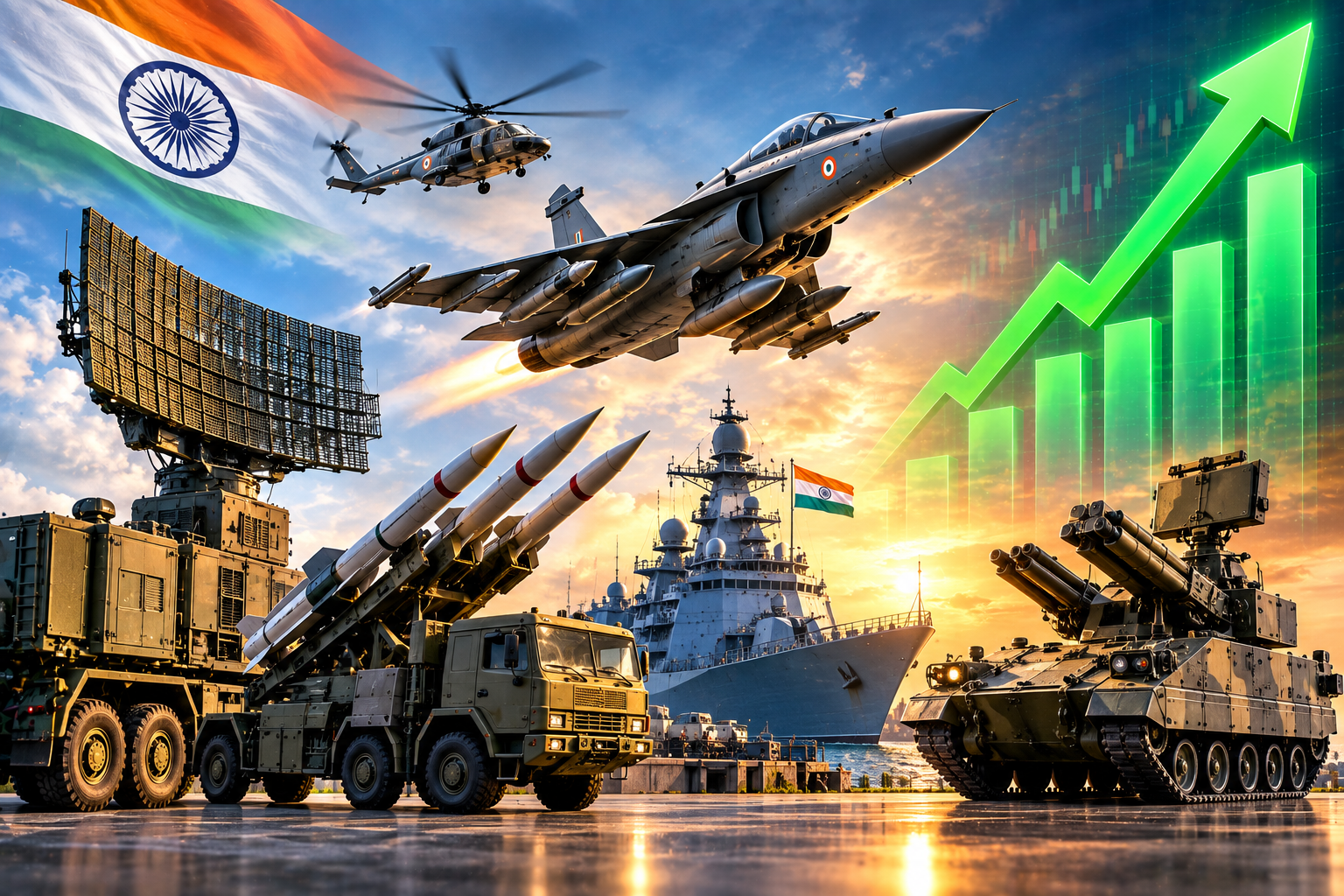
Rising domestic production, expanding exports and policy support are strengthening India’s defence manufacturing ecosystem, while Emkay Global sees further growth opportunities across aerospace, electronics and defence platforms
India’s defence manufacturing story is entering a phase of sustained expansion, supported by higher domestic procurement, greater private-sector participation, rising exports and a continued policy push towards self-reliance. Against this backdrop, domestic brokerage Emkay Global has initiated coverage on the defence sector and identified Hindustan Aeronautics (HAL), Bharat Electronics (BEL), BEML and Bharat Dynamics (BDL) among its preferred companies, in that order.
The brokerage’s assessment comes as defence stocks remain a prominent part of the Indian thematic market. According to NSE data cited in the report, the Nifty India Defence index has gained 23 per cent so far in 2026 and is up 16 per cent over the past year. However, the performance across individual stocks has been uneven, highlighting the importance of company-specific execution, order visibility and valuations.
Defence production reaches record levels
India’s defence production reached an all-time high of around ₹1.8 trillion in FY26, representing growth of 15.6 per cent year-on-year, according to the figures cited by Emkay Global. Production has expanded at an estimated 18 per cent compound annual growth rate since FY21, reflecting the expansion of indigenous manufacturing capabilities and investments in the domestic defence industrial base.
The government's emphasis on domestic procurement and localisation has been a key factor behind this expansion. Recent procurement decisions have also increased the potential addressable market for Indian defence manufacturers. In September, the government approved proposals worth approximately ₹1.1 trillion for the three armed forces, with around 98 per cent of the procurement value earmarked for Indian industry.
This creates opportunities not only for large defence public-sector undertakings but also for private-sector suppliers, specialised component manufacturers and defence-technology companies that form part of the broader supply chain.
Defence exports add another growth avenue
India’s defence export ambitions are providing another structural growth driver. Defence exports rose from just ₹6.9 billion in FY14 to approximately ₹380 billion in FY26, according to figures cited by Emkay Global. Exports in FY26 increased 63 per cent year-on-year.
The government has set an objective of taking defence exports beyond ₹500 billion by 2029 while targeting defence production of around ₹3 trillion. These targets underline the longer-term effort to position India not only as a major domestic buyer but also as a supplier of defence equipment to international markets.
The expansion of exports could also help Indian manufacturers diversify their revenue base and improve capacity utilisation. At the same time, export markets bring additional requirements related to certification, geopolitical relationships, product reliability and after-sales support.
HAL emerges as Emkay’s preferred company
Emkay Global has placed Hindustan Aeronautics at the top of its defence-sector preferences. HAL operates across aircraft, helicopters, engines, avionics and related aerospace systems and remains one of India's largest defence aerospace manufacturers.
The company is positioned to participate in India's ongoing aircraft and helicopter modernisation programmes, as well as maintenance, repair and overhaul opportunities. Its role across multiple stages of the aerospace value chain provides exposure to both new platform production and lifecycle support.
HAL's position also needs to be viewed alongside the execution requirements associated with large defence programmes. Delivery schedules, order conversion, production ramp-up and working-capital requirements can influence the timing of revenue and earnings.
BEL benefits from defence electronics expansion
Bharat Electronics is another major beneficiary of the shift towards indigenous defence electronics. The company operates in areas including radars, electronic warfare systems, communication equipment, avionics and other strategic electronics.
Recent order activity illustrates the scale of the opportunity. BEL secured additional orders worth ₹6,795 crore in April, covering areas such as mountain radars, avionics packages, communication equipment, electronic fuses, strategic components, upgrades and services.
The increasing electronics content of modern military platforms could provide a structural opportunity for companies with established design, manufacturing and system-integration capabilities.
BEML and Bharat Dynamics remain part of the broader opportunity
Emkay has also included BEML and Bharat Dynamics among its preferred defence companies.
BEML operates across defence and aerospace, mining and construction, and rail and metro businesses. Its diversification means that defence is one component of a wider business portfolio. The company also recently secured an order worth more than ₹5,400 crore from the National High Speed Rail Corporation for the Mumbai-Ahmedabad High Speed Rail corridor, demonstrating the contribution of its non-defence businesses as well.
Bharat Dynamics, meanwhile, is focused on missiles and allied defence equipment and supplies primarily to India's armed forces and government. The company recently received orders worth approximately ₹1,347.71 crore from HAL for Helina launchers and line-replaceable units, along with additional countermeasure dispensing-system components.
Defence index performance masks wide stock-level differences
While the broader defence index has delivered strong gains, individual stocks have shown significant divergence. Among the 19 constituents cited in the report, nine have delivered double-digit gains over the past year.
MTAR Technologies has been among the strongest performers, gaining 285 per cent over one year, while Paras Defence has risen 93 per cent over the same period. Conversely, Cochin Shipyard and Bharat Dynamics have both declined 26 per cent over the period cited by Emkay.
The divergence demonstrates that a favourable sector backdrop does not necessarily translate into uniform stock performance. Order execution, valuation, earnings growth, business mix and the timing of large contracts remain important variables for individual companies.
Private-sector participation broadens the defence ecosystem
India’s defence expansion is also increasingly extending beyond traditional defence PSUs. Private companies and specialised technology firms are becoming more important in areas such as electronics, missiles, unmanned systems, aerospace components, communication systems and advanced manufacturing.
This broader ecosystem can potentially improve domestic supply-chain depth while reducing dependence on imported components. It also creates opportunities for smaller companies, although their business models may carry greater concentration, execution and valuation risks.
Order visibility remains a key factor
For investors tracking the sector, the conversion of government approvals into executable contracts remains an important variable. Large procurement announcements can increase the potential market for defence companies, but the eventual impact on financial performance depends on tender finalisation, contract awards, production schedules and execution.
Recent approvals have already strengthened expectations for a sizeable domestic order pipeline. Earlier in September, around ₹1.1 trillion of procurement proposals were approved, with approximately 98 per cent expected to be sourced from Indian industry.
Valuations and execution need close monitoring
The structural defence opportunity has attracted substantial investor attention, but strong historical stock performance can also increase valuation sensitivity. Companies with large order books may still face delays in execution, margin fluctuations, working-capital requirements and project concentration.
Investors may therefore need to distinguish between the long-term growth potential of the Indian defence industry and the near-term valuation of individual stocks. A rising order book is beneficial only when companies can convert contracts into revenue and cash flows while maintaining profitability.
Market Outlook
The defence sector remains supported by several long-term themes, including higher indigenous procurement, modernisation of India's armed forces, expanding exports, increasing private-sector participation and growing demand for sophisticated electronics and aerospace systems.
Emkay Global's coverage places HAL, BEL, BEML and Bharat Dynamics among its preferred names, but these views represent the brokerage's assessment and should not be treated as a universal ranking of defence stocks. Sector performance can remain volatile, particularly after periods of strong gains.
For the broader market, defence companies are likely to remain sensitive to government procurement announcements, order wins, execution updates, export developments and valuation movements. The combination of record production, rising exports and a large domestic procurement pipeline provides a supportive backdrop, while stock-specific earnings delivery and valuations remain important factors for market participants.