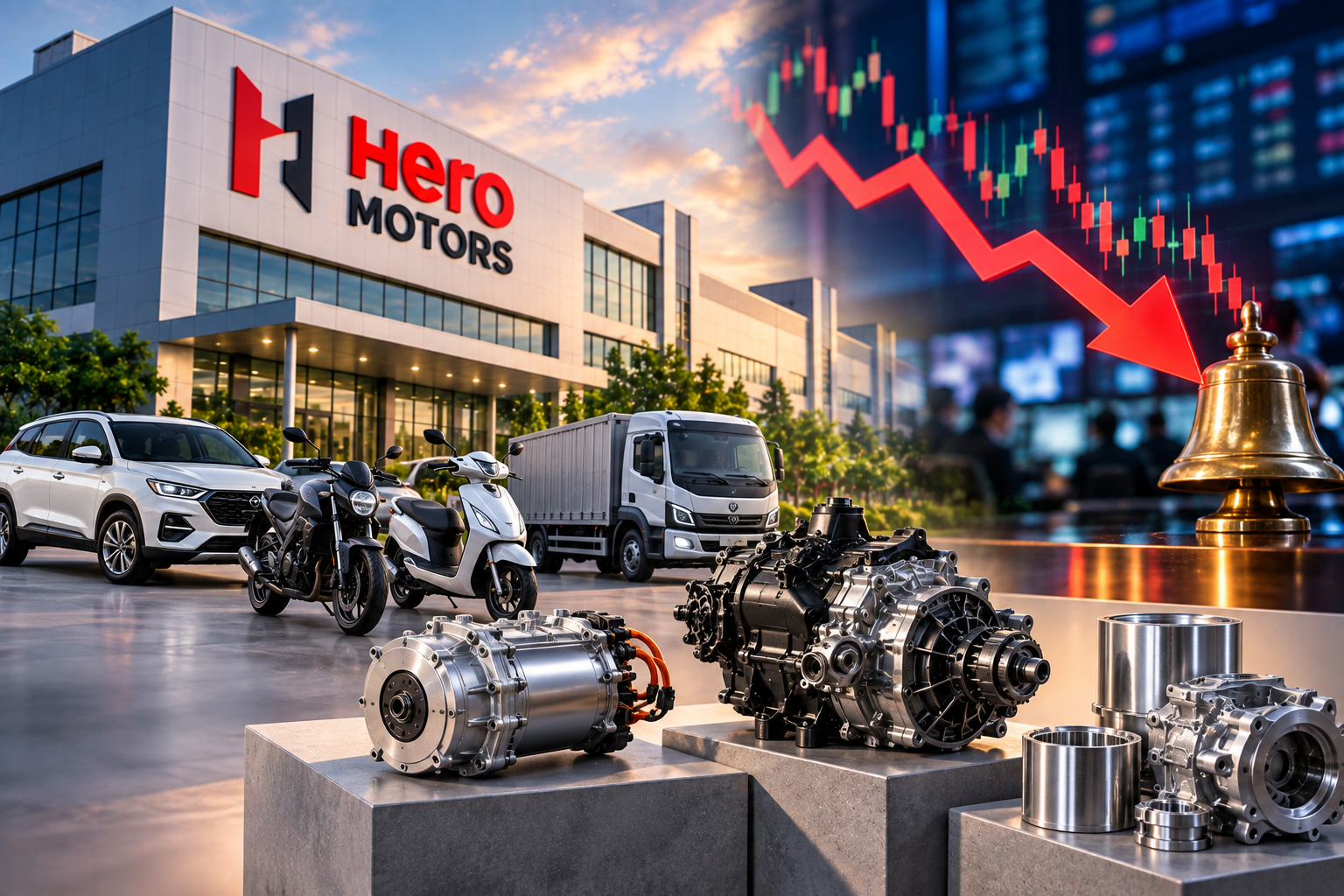
Strong IPO demand fails to translate into a premium debut as Hero Motors shares open below the ₹84 issue price; valuation and earnings execution remain key factors for investors
Hero Motors shares made a subdued debut on the stock exchanges on Wednesday, September 23, opening below the upper end of the company's IPO price band despite the public issue receiving strong overall subscription.
The shares opened at ₹82.10 on the BSE, representing a 2.26 per cent discount to the IPO price of ₹84. On the NSE, the stock opened at ₹82, around 2.38 per cent below the issue price.
The listing was broadly in line with grey-market indications ahead of the debut, which had pointed towards a modest discount rather than a premium listing.
IPO subscribed 6.66 times
Hero Motors' initial public offering received bids for approximately 58.97 crore shares against 8.86 crore shares available for subscription, resulting in an overall subscription of 6.66 times.
The subscription was led by non-institutional investors, whose portion was subscribed 9.86 times. The retail individual investor category received bids for 8.23 times the shares on offer.
The qualified institutional buyers' portion was subscribed 1.49 times.
The subscription figures indicated considerable demand during the three-day issue period, but the stock's initial market performance shows that strong IPO bidding does not necessarily translate into a premium listing.
Market pricing after listing is influenced by prevailing valuations, broader market conditions, investor expectations and the price at which institutional and other investors are willing to transact once trading begins.
Hero Motors IPO details
The IPO opened for subscription on September 16 and closed on September 18, 2026.
The issue comprised a fresh issue of equity shares worth up to ₹600 crore and an offer for sale aggregating up to ₹400 crore by O P Munjal Holdings and Hero Cycles.
The price band was fixed at ₹79-₹84 per share, with a lot size of 178 shares.
At the upper price band, an investor applying for one lot would have required ₹14,952.
Prior to the IPO, Hero Motors raised approximately ₹244.98 crore from anchor investors on August 15. The company allotted around 2.91 crore shares at ₹84 apiece to 16 anchor investors.
What does Hero Motors do?
Hero Motors is an automotive technology company involved in designing, developing, manufacturing and supplying engineered powertrain solutions to original equipment manufacturers (OEMs).
Its product portfolio covers both electric and conventional powertrain applications.
The company supplies solutions for two-wheelers, e-bikes, performance vehicles, off-road vehicles, electric and hybrid passenger vehicles and heavy-duty vehicles.
This positioning gives Hero Motors exposure to multiple segments of the automotive industry rather than dependence on a single vehicle category.
Its customers include global names such as BMW, Ducati, Enviolo, Formula Motorsport, Hummingbird EV and HWA, according to the company information cited in the IPO details.
Two major business segments
Hero Motors operates through two principal segments: Powertrain Solutions and Alloys & Metallics.
In FY26, Powertrain Solutions contributed approximately 53.67 per cent of the company's revenue, making it the larger of the two businesses.
Alloys & Metallics contributed the remaining 46.33 per cent.
The segment mix provides the company with exposure to both engineered powertrain products and the metals/alloys business.
For investors, the performance of both segments will be important because changes in automotive demand, commodity costs, product mix and OEM production schedules can influence overall revenue and profitability.
Global manufacturing footprint
As of March 31, 2026, Hero Motors had six manufacturing facilities spread across India, the United Kingdom and Thailand.
Its international manufacturing presence gives the company access to global automotive supply chains and customers.
The overseas footprint can also diversify revenue geographically, although it introduces exposure to foreign exchange movements, regional economic conditions, regulatory requirements and differences in automotive demand across markets.
The company's ability to expand its relationships with global OEMs will therefore remain an important component of its longer-term growth strategy.
EV transition provides a growth opportunity
One of the major themes surrounding Hero Motors is the transition towards electric mobility.
The company provides powertrain solutions for electric as well as non-electric applications, allowing it to participate in the changing automotive technology landscape.
Demand for electric powertrains, hybrid systems and other advanced automotive technologies is expected to influence the industry's investment priorities as manufacturers work to meet changing consumer preferences and regulatory requirements.
Hero Motors' exposure to both conventional and electric applications could allow it to serve OEMs during the transition period.
However, the pace of EV adoption and the company's ability to win new programmes will determine how much of this opportunity translates into actual financial growth.
Valuation remains a key consideration
Despite the company's technology capabilities and exposure to the EV ecosystem, valuation was one of the issues highlighted following the listing.
Swastika Investmart's Head of Wealth Shivani Nyati noted that the company's valuation was around 69-74 times price-to-earnings, compared with a peer average of approximately 50.2 times, according to the report.
The valuation gap means investors may closely examine whether Hero Motors can deliver sufficient earnings growth to support the premium.
A high valuation can leave a stock more sensitive to quarterly earnings disappointments, changes in growth expectations or broader market corrections.
Why strong subscription did not ensure a premium listing
The 6.66-times subscription may initially appear inconsistent with the discounted listing, but IPO subscription and post-listing performance measure different things.
During the IPO, investors bid within a predetermined price range. Once the shares begin trading, the market continuously reassesses their value based on available information and prevailing market sentiment.
The grey market also suggested a discounted debut before listing, indicating that demand during the subscription period had not necessarily translated into expectations of a substantial listing premium.
The initial listing therefore reflects the market's assessment of the company's valuation at the time trading began.
Fresh issue and offer-for-sale structure
The Hero Motors IPO combined a fresh issue and an offer for sale.
The fresh issue component of up to ₹600 crore provides capital to the company, while the offer-for-sale component of up to ₹400 crore allows existing shareholders to sell shares.
For investors, the distinction is important because proceeds from a fresh issue go to the company for corporate purposes, whereas money raised through an offer for sale goes to the selling shareholders.
The utilisation of the fresh capital and the company's future return on that capital will therefore remain important areas to monitor.
Key risks investors may track
Hero Motors' performance is linked closely to the broader automotive industry, making it sensitive to changes in vehicle production, OEM demand and global economic conditions.
Raw-material prices can also influence manufacturing costs, particularly for the Alloys & Metallics business.
The company also operates across multiple geographies, creating exposure to foreign exchange movements and regional market conditions.
In addition, the transition towards electric vehicles presents both an opportunity and a competitive challenge. The company will need to continuously invest in technology and product development to remain relevant as powertrain architectures evolve.
Valuation is another important consideration following the IPO, particularly if earnings growth does not keep pace with market expectations.
What investors will watch next
Following the listing, investors are likely to focus on quarterly revenue growth, margins, order wins, customer additions and the contribution of electric and advanced powertrain products.
The performance of the Powertrain Solutions segment will remain particularly important because it represents the larger share of FY26 revenue.
The company’s international operations, new OEM relationships, capacity utilisation and the deployment of IPO proceeds will also provide important indicators of its execution.
Investors may additionally track how the stock trades relative to its ₹79-₹84 IPO price band as the market establishes a longer-term valuation.
Market Outlook
Hero Motors' discounted listing despite a 6.66-times subscribed IPO highlights the difference between subscription demand and post-listing market valuation. The company's diversified powertrain portfolio, international manufacturing footprint and exposure to electric mobility provide multiple potential growth avenues.
At the same time, the valuation cited by analysts remains an important factor to monitor. Future share-price performance will be influenced by earnings growth, OEM demand, margins, EV-related business expansion, global operations and the company's ability to convert its technology and customer relationships into sustained financial performance.
The company's upcoming financial results and business updates will therefore be important in determining how the market reassesses the stock after its initial listing.