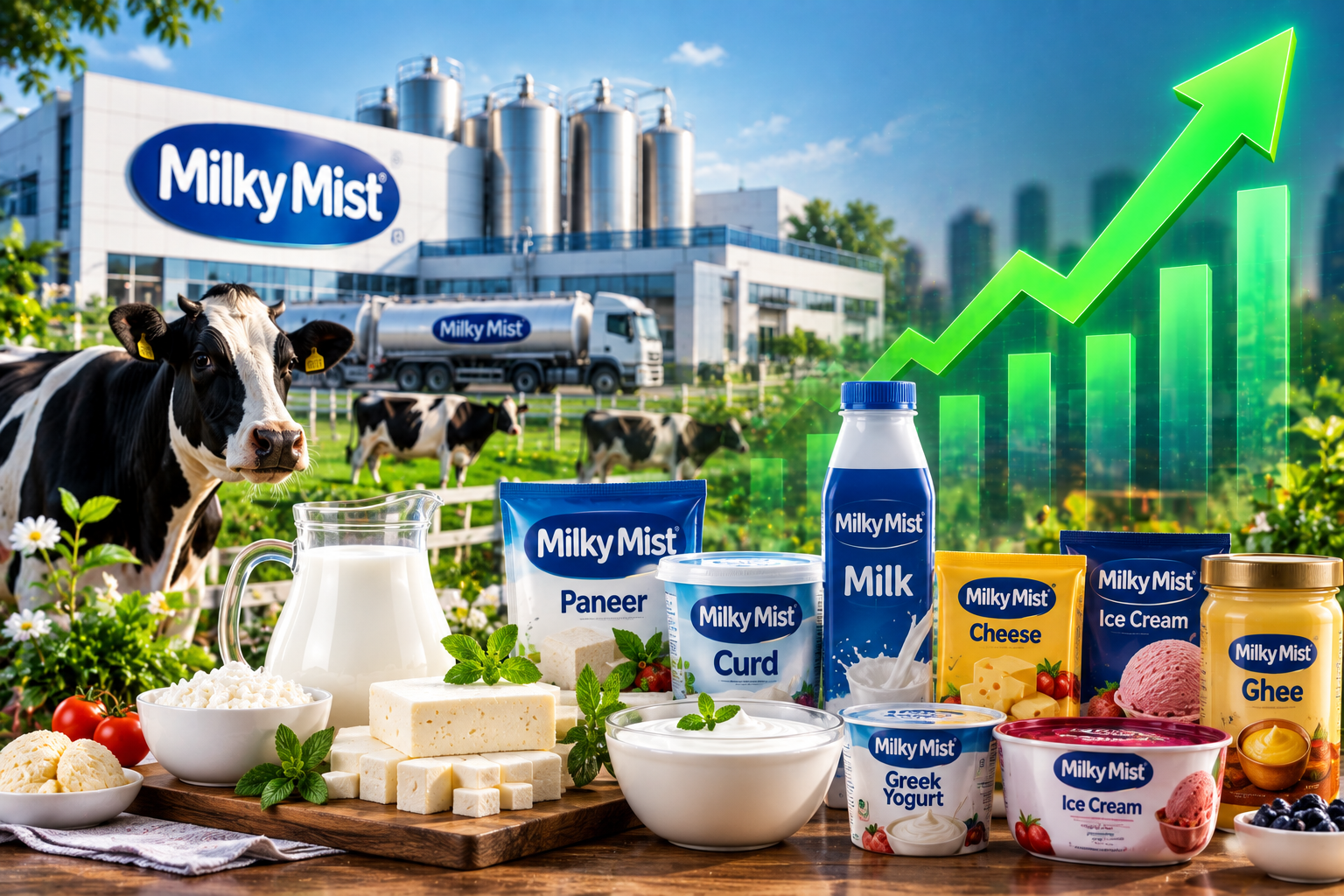
Milky Mist shares touch a fresh high of ₹317.30 as strong investor interest lifts the stock sharply since its August listing; premium dairy products and capacity expansion remain key growth drivers
Shares of Milky Mist Dairy Food continued their strong post-listing run on Wednesday, September 23, hitting the 5 per cent upper circuit amid heavy buying interest. The stock touched a fresh high of ₹317.30 on the BSE, with only buyers visible at the counter during early trading.
The sharp rally has taken the stock well above its IPO issue price of ₹140 per share. At ₹317.30, Milky Mist shares were trading around 127 per cent above the issue price, meaning the stock has more than doubled in just five weeks since its market debut.
The company was listed on the exchanges on August 18, 2026. From its BSE closing price of ₹181.45 on the listing day, the stock has gained around 75 per cent.
Heavy buying pushes stock to fresh high
Milky Mist shares surpassed their previous high of ₹304.70, recorded on September 15, during Wednesday's session.
Trading activity was strong, with around 2.34 million shares changing hands across the BSE and NSE by 9:29 AM. Pending buy orders of approximately eight lakh shares were also reported on the two exchanges.
The combination of a fresh price high, an upper-circuit move and substantial trading activity has kept the recently listed dairy company firmly in focus among market participants.
The stock's sharp post-listing appreciation, however, also means that investors are now likely to closely track the company's earnings growth, valuation and ability to deliver on the expectations embedded in the share price.
From IPO debut to a 127% gain
Milky Mist's market performance has been notable since its listing.
The shares were issued at ₹140 apiece and subsequently listed at a substantially higher level. The stock has continued to appreciate after listing, reaching ₹317.30 on September 23.
The move represents a gain of approximately 127 per cent from the IPO issue price in only around five weeks.
Such a rapid appreciation highlights strong market interest, but it also increases the importance of fundamental performance. Future returns will depend increasingly on earnings growth, margins, category expansion and valuation rather than simply the company's successful transition from private to listed markets.
Diversified value-added dairy portfolio
Milky Mist has developed a diversified portfolio covering several segments of the dairy and packaged-food market.
Its product range includes cheese, paneer, curd, ghee, yogurt, ice cream, chocolates, frozen foods and ready-to-eat and ready-to-cook products.
The company markets products under the Milky Mist brand as well as sub-brands such as SmartChef, Capella and Misty Lite. It has also expanded its portfolio through the acquisition of brands including Briyas and Asal.
This broader product mix gives the company exposure to multiple consumption categories and reduces dependence on a single dairy product.
Premiumisation becomes an important growth lever
Traditional products such as paneer, cheese and curd continue to account for a significant portion of the company's revenue, contributing around 60 per cent according to the information cited in the report.
At the same time, Milky Mist has increasingly focused on higher-value dairy products.
Premiumisation can potentially support both revenue growth and profitability because value-added products generally offer greater scope for differentiated pricing, branding and product innovation than basic liquid-milk products.
The company's growing presence in yogurt, high-protein dairy products, whey and other specialised categories reflects this shift in product mix.
New Skyr and Greek Yogurt facility
Milky Mist recently commissioned a Skyr and Greek Yogurt manufacturing facility using ultrafiltration technology at its integrated manufacturing complex in Perundurai, Tamil Nadu.
The company was an early adopter of ultrafiltration technology in India for Skyr and Greek Yogurt, having introduced these products in 2022.
The new capacity is aimed at increasing the availability of the company's high-protein dairy portfolio and supporting future growth in a segment where consumer interest is rising.
Demand for high-protein foods has been increasing as health awareness grows and consumers increasingly look for products that combine convenience with nutritional benefits.
Revenue growth remains strong
According to the analyst commentary cited in the report, Milky Mist's revenue grew at a compound annual growth rate of approximately 31 per cent between FY24 and FY26.
The company's focus on value-added dairy products has also contributed to an improvement in operating profitability.
Its EBITDA margin increased by around 200 basis points, from 11.9 per cent in FY24 to 13.7 per cent in FY26.
The improvement suggests that the company's changing product mix and increasing contribution from premium categories have supported operating profitability.
Organised paneer and cheese markets offer runway
Milky Mist has established a strong position in India's organised packaged dairy market.
The company is estimated to have around 19 per cent share of the organised paneer market and approximately 12 per cent share of packaged cheese in South India, according to the analyst commentary cited in the report.
Paneer remains an important growth category, while cheese, yogurt and whey represent additional opportunities for expansion.
The organised dairy segment can benefit from changing consumer preferences, increasing branded-product penetration and the shift from loose products towards packaged and quality-assured alternatives.
India's value-added dairy market expands
The Indian traditional value-added dairy products market was estimated at approximately ₹5.6 trillion in FY26 and is projected to reach around ₹10 trillion by FY31, according to the brokerage estimates cited in the report.
This implies a projected CAGR of around 12.1 per cent.
Growth is expected to be supported by rising disposable incomes, health awareness, increasing demand for premium and innovative dairy products and the growing preference for convenient, high-protein food options.
Within the broader market, paneer is expected to remain a major growth driver.
The paneer market is projected to expand from approximately ₹1 trillion in FY26 to around ₹2.1 trillion by FY31. The organised paneer segment is expected to grow at an even faster pace, with a projected CAGR of around 20.2 per cent.
Emerging value-added categories such as cheese, yogurt and whey are estimated to grow at approximately 15.3 per cent during the same period.
Higher milk prices remain a challenge
Despite the favourable demand outlook, the dairy industry continues to face input-cost pressures.
Raw milk procurement prices remained elevated during the June 2026 quarter, as dairy cooperatives increased farmer remuneration in response to higher feed, fodder, fuel and livestock-related costs.
For dairy companies, milk procurement is a critical component of the cost structure. Sustained increases can pressure gross margins if companies are unable to pass higher costs through to consumers.
Milky Mist's increasing exposure to value-added products could provide some protection because these categories generally offer better pricing flexibility and higher gross margins than commoditised liquid milk.
However, sustained raw-material inflation remains a factor investors will need to monitor.
Capacity investments support future growth
Improved operating cash flows over the past two years have allowed the company to increase investments in manufacturing capacity, according to the analyst commentary.
New capacities are focused on premium products, including sweeteners and whey proteins.
Such investments can support category expansion while also increasing the contribution of higher-value products to the overall business.
The success of these investments will ultimately depend on capacity utilisation, consumer demand, distribution expansion and the company's ability to maintain attractive margins.
Why the stock remains in focus
Milky Mist combines several factors that have attracted investor attention: strong historical revenue growth, leadership in selected value-added dairy categories, premiumisation, expanding manufacturing capacity and exposure to India's growing packaged-food market.
Its business model also has characteristics that resemble consumer-facing FMCG companies, including branded products, distribution networks, premium pricing and repeat consumption.
However, the stock's rapid post-IPO appreciation means expectations have also risen sharply.
Investors will therefore be watching whether the company's future earnings growth can keep pace with the valuation implied by the stock's strong market performance.
Key factors to monitor
The company's upcoming financial performance will be important in determining whether the current growth trajectory is sustainable.
Key factors include revenue growth, EBITDA margins, raw milk procurement costs, capacity utilisation, premium-product growth and the pace of expansion in organised dairy markets.
Investors will also monitor the performance of newer categories such as Greek yogurt, Skyr and whey products, as well as the integration and contribution of acquired brands.
Competition from established dairy companies and regional players will remain another factor, particularly as the value-added dairy segment attracts increasing investment.
Market Outlook
Milky Mist Dairy Food's 127 per cent gain over its IPO price in roughly five weeks has placed the stock among the notable recent post-listing performers. The company's strong revenue growth, expanding value-added dairy portfolio and exposure to India's premiumisation trend provide important growth drivers.
The commissioning of additional capacity for Skyr and Greek Yogurt and investments in premium categories could further diversify the business and support future revenue growth.
At the same time, the sharp rise in the share price means valuation and earnings execution become increasingly important. Raw milk costs, competitive intensity, capacity utilisation and the company's ability to sustain margin expansion will remain key factors for investors to track as the stock moves beyond its initial post-IPO phase.