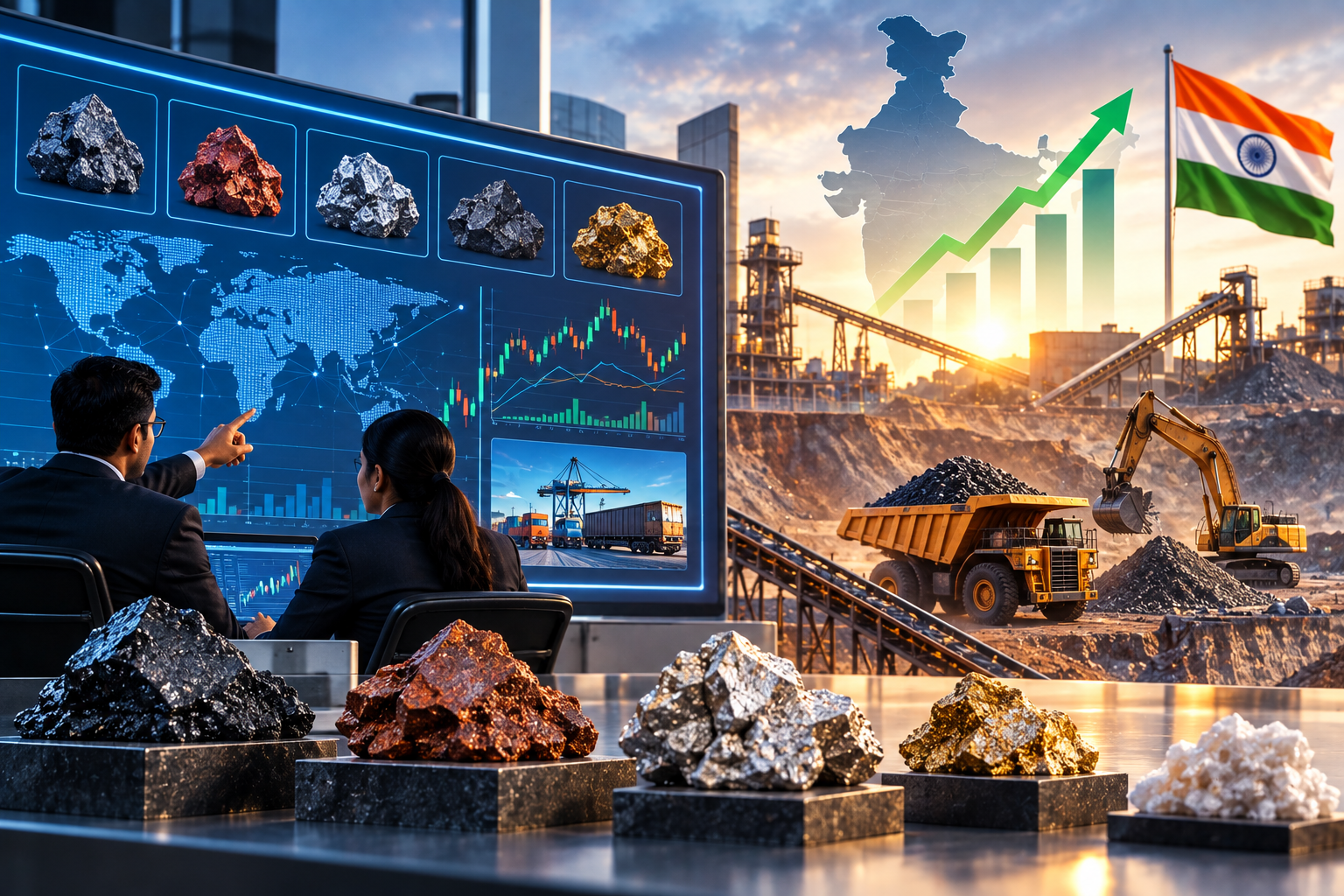
New electronic platform aims to bring greater transparency to mineral trading, improve price discovery and reduce information gaps between producers and buyers
India is moving closer to establishing its first dedicated mineral exchange, with the platform expected to be registered and operationalised by FY28. The proposed exchange is expected to introduce an electronic, delivery-based trading mechanism for minerals, creating a more transparent marketplace for producers, buyers and other participants across the mining value chain.
The development follows the Ministry of Mines’ notification of the Mineral Exchange Rules, 2026, in June. According to Mines Additional Secretary Veena Kumari Dermal, work on registering the exchange is already under way and the government expects the platform to become operational during the next financial year.
A New Market Infrastructure for Minerals
The proposed mineral exchange is designed to address several structural challenges in India’s mineral market, particularly limited price transparency, information asymmetry and differences in quality assessment.
Unlike conventional transactions that may rely heavily on bilateral negotiations, the electronic exchange is expected to provide a standardised marketplace where mineral producers and buyers can participate through a transparent trading mechanism.
The delivery-based structure is particularly significant because it could connect quoted prices more closely with actual physical mineral transactions. Standardised quality assessment could also help participants compare material more efficiently and reduce disputes related to grades and specifications.
For an economy that is increasingly dependent on minerals for infrastructure, manufacturing, construction and energy transition, the creation of a dedicated market mechanism could become an important piece of financial and industrial infrastructure.
Price Discovery Could Become More Transparent
One of the central objectives of the exchange will be market-based price discovery.
Mineral prices can vary depending on quality, location, transportation costs, supply availability and demand from individual industries. A transparent electronic marketplace could provide participants with more consistent reference prices and improve visibility into prevailing market conditions.
Better price discovery could also help producers make more informed decisions regarding production and inventory, while industrial consumers could potentially gain greater clarity when planning raw-material procurement.
The impact could extend beyond individual transactions if exchange-generated prices gradually become useful benchmarks for the wider mineral industry.
Risk Management to Be a Key Component
The government has indicated that the proposed exchange will include risk-management mechanisms aimed at preventing market manipulation and protecting participants.
This will be particularly important as the platform develops liquidity. A credible commodity marketplace requires robust surveillance, standardised contracts, transparent settlement mechanisms and safeguards against excessive speculation or manipulation.
The success of the exchange will therefore depend not only on launching the electronic platform but also on establishing confidence among producers, traders, processors and industrial buyers.
India’s Large Mineral Import Requirement
The proposed exchange comes at a time when India is seeking to strengthen domestic mineral availability and reduce dependence on overseas supplies.
According to the government official cited in the report, India imported minerals worth around ₹10.12 lakh crore in FY26. The scale of imports highlights the importance of expanding domestic exploration, mining, processing and resource utilisation.
Minerals are increasingly important not only for traditional industries but also for sectors linked to infrastructure development, renewable energy, electric mobility, electronics and advanced manufacturing.
Reducing import dependence will therefore require more than increasing mining output. India will need a broader ecosystem covering exploration, extraction, beneficiation, processing, recycling, logistics and efficient domestic markets.
Mineral Production Has Expanded Sharply
India’s domestic mineral production has grown substantially over the past decade.
The value of mineral production increased from around ₹50,000 crore in FY14 to ₹1.86 trillion in FY26, representing a cumulative annual growth rate of approximately 11.6 per cent, according to the government.
Production volumes have also increased across several important minerals.
Iron ore production rose from around 152 million tonnes in FY14 to 312 million tonnes in FY26. Limestone production increased from approximately 280 million tonnes to 483 million tonnes, while bauxite production rose from around 22 million tonnes to 26 million tonnes over the same period.
The numbers indicate that India has significantly expanded its domestic mineral output, although the government believes production still needs to increase further to meet the country's long-term requirements.
Critical Minerals Add Strategic Importance
The importance of the proposed exchange goes beyond traditional commodities such as iron ore, limestone and bauxite.
India is increasingly focused on securing critical minerals required for batteries, electric vehicles, renewable-energy equipment, electronics and other advanced industries. Building domestic capabilities in these areas has become an important component of the country's broader industrial and energy-security strategy.
A transparent mineral marketplace could eventually support better visibility into supply and demand for a wider range of minerals as the domestic ecosystem develops.
However, the effectiveness of such a platform will depend on the depth of participation, availability of standardised grades, reliable delivery infrastructure and the development of sufficient trading liquidity.
Potential Impact on Mining Companies
For mining companies, a functioning mineral exchange could create a more structured mechanism for selling output and discovering market prices.
Large producers could potentially benefit from improved market transparency, while smaller producers may gain access to a broader pool of buyers if participation barriers remain manageable.
The exchange could also encourage greater standardisation in mineral quality and documentation. Over time, this could improve the efficiency of transactions between mines, processors and industrial consumers.
For companies operating across mining, metals, infrastructure and mineral processing, developments surrounding the exchange could therefore become an important policy and industry theme.
Benefits for Industrial Consumers
The proposed platform could also be relevant for industries that consume large quantities of minerals.
Steelmakers, cement manufacturers, aluminium producers, construction companies and other industrial users require reliable supplies of raw materials. A transparent trading platform could provide additional market information while helping buyers assess prevailing prices and availability.
More transparent price signals may also improve procurement planning and inventory management, particularly for businesses exposed to significant fluctuations in raw-material costs.
Technology and Standardisation Will Matter
The success of the mineral exchange will ultimately depend on the quality of its market infrastructure.
An electronic marketplace will require reliable trading systems, quality certification, warehousing or delivery mechanisms, settlement infrastructure, participant verification and effective regulatory surveillance.
Standardised grading will be particularly important. Minerals can differ significantly in quality and composition, and a credible exchange will need clear specifications so that buyers know precisely what they are purchasing.
The development of recognised benchmarks could become one of the longer-term outcomes if sufficient volumes are eventually traded through the platform.
A Step Towards a More Organised Mineral Market
India's mining sector has expanded rapidly, but the country's mineral ecosystem remains closely linked to physical supply chains and bilateral transactions.
The proposed exchange represents an effort to build a more organised market structure around those physical commodities.
If successfully implemented, the platform could improve transparency, strengthen price discovery and provide market participants with a common trading mechanism. Its broader success, however, will depend on participation from both producers and consumers and on the credibility of its settlement, quality and risk-management systems.
Market Outlook
The proposed mineral exchange could become an important development for India’s mining and metals ecosystem as the country seeks to expand domestic mineral production and reduce import dependence.
For investors, the development is relevant across the broader mining, metals, mineral processing, infrastructure and critical-mineral supply-chain landscape. However, the immediate impact on individual companies will depend on the commodities they produce or consume, their cost structures, domestic exposure and the eventual design and liquidity of the exchange.
The key milestones to track will be the formal registration of the exchange, regulatory and operational framework, participation by major mineral producers and industrial buyers, standardisation of mineral grades, trading volumes and the emergence of reliable benchmark prices.
As India targets higher domestic manufacturing capacity and greater resource security, the creation of a dedicated mineral marketplace could become an important part of the country's evolving commodity-market infrastructure.