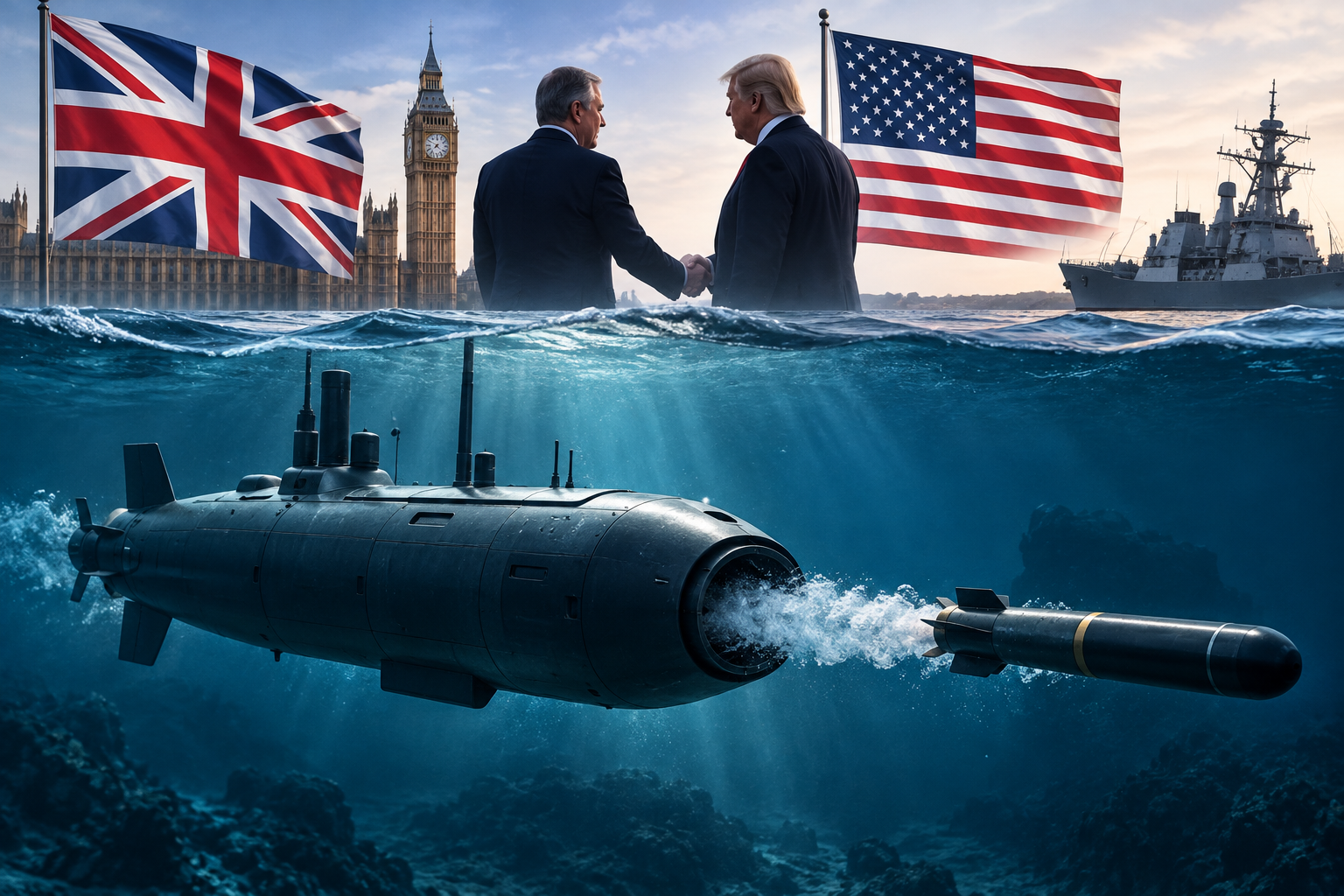
First torpedo launch from an uncrewed undersea vessel marks a new phase in UK-US-Australia defence cooperation as London expands work on autonomous systems and AI
The United Kingdom has successfully test-fired a US torpedo from a British-made uncrewed undersea drone, marking a significant step forward in autonomous maritime warfare and highlighting the growing technological cooperation between the UK, the United States and Australia under the AUKUS security partnership.
The test involved the Plymouth-made XV Excalibur, a 12-metre extra-large uncrewed underwater vehicle, which launched a heavyweight torpedo jointly developed by the US and Australia. The test was conducted in UK waters last week, according to the UK government. It was the first time either the UK or US had launched a torpedo from an uncrewed undersea vessel rather than a crewed submarine.
The development comes as UK Prime Minister Andy Burnham travels to New York for the United Nations General Assembly and prepares for his first meeting with US President Donald Trump. The timing places the defence breakthrough alongside broader discussions between the two countries on artificial intelligence, security and emerging technologies.
Excalibur takes autonomous underwater warfare to a new level
The Excalibur is designed as a test platform for large-scale autonomous underwater operations. At 12 metres long and with a displacement of about 19 tonnes, it is the largest uncrewed underwater vessel to have been trialled by the Royal Navy.
The latest trial demonstrates that an autonomous underwater platform can carry and deploy a heavyweight weapon traditionally associated with crewed submarines.
The UK government described the firing as a major advance in submarine technology and a breakthrough for Euro-Atlantic security and NATO's undersea capabilities.
The significance extends beyond the individual weapons test. Autonomous underwater vehicles can potentially perform surveillance, reconnaissance, logistics and other missions while reducing the need to place personnel directly inside the platform operating in contested waters.
AUKUS cooperation expands beyond nuclear submarines
AUKUS was initially associated prominently with Australia's plans to acquire conventionally armed, nuclear-powered submarines, but its second pillar focuses on advanced military technologies.
Under AUKUS Pillar II, Australia, the UK and US are developing capabilities including artificial intelligence, autonomy, quantum technologies and advanced undersea systems.
In May 2026, the three countries announced the first AUKUS Pillar II signature project focused on payloads and enabling systems for uncrewed underwater vehicles. The programme is designed to allow compatible technologies to operate across AUKUS partners' underwater platforms, with delivery beginning in 2027.
The areas covered include underwater surveillance and reconnaissance, protection of critical seabed infrastructure, anti-submarine and anti-surface warfare, mine countermeasures and electronic warfare.
UK and US deepen AI and autonomy cooperation
Alongside the torpedo test, London is also announcing expanded cooperation with Washington on artificial intelligence and autonomous systems.
The UK's Ministry of Defence Rapid AI Delivery Taskforce and the US Department of War's Chief Digital and Artificial Intelligence Office are expected to work together on AI and autonomy. The objective is to accelerate the development of trusted and interoperable technologies for defence and critical infrastructure protection.
The cooperation reflects a wider shift in military technology, with governments increasingly exploring how AI, autonomous platforms and advanced sensors can work alongside conventional military systems.
For the UK, autonomous underwater technology is becoming an important part of its longer-term maritime capability. Excalibur has already been used in trials involving remote operation and advanced navigation technologies, including a quantum optical atomic clock intended to improve underwater timing and navigation.
Defence technology becomes central to AUKUS strategy
The latest test also demonstrates the practical direction of AUKUS cooperation. Instead of limiting collaboration to major platforms such as nuclear-powered submarines, the partnership is increasingly focused on technologies that can be integrated across the armed forces of all three countries.
The three governments have been working to reduce barriers to defence technology transfers and improve industrial cooperation. AUKUS-related arrangements have also sought to streamline defence trade between the partner countries, particularly for advanced technologies covered by the partnership.
This could allow companies and defence laboratories in the three countries to collaborate more quickly on emerging technologies, although the development and deployment of autonomous weapons systems will remain subject to national regulations and military requirements.
Implications for future naval operations
The use of an uncrewed underwater vehicle to deploy a heavyweight torpedo points towards a future in which autonomous systems could operate alongside conventional submarines and surface ships.
Such platforms could potentially undertake missions in environments where deploying a crewed vessel would involve greater operational risk. They could also provide additional surveillance or strike capacity and extend the geographic reach of naval forces.
However, the latest test represents a technology demonstration rather than evidence that fully autonomous underwater combat operations have already become routine. Further trials will be required to evaluate reliability, communications, navigation, weapons integration and operational control.
The ability to operate underwater also presents unique technological challenges because conventional satellite-based navigation systems such as GPS cannot be used continuously beneath the surface.
Broader UK-US security agenda
The torpedo test comes at a time when London and Washington are seeking deeper cooperation across several areas of security and technology.
During the UN General Assembly, discussions are expected to cover artificial intelligence, the war in Ukraine, security in the Middle East and other global challenges. The UK government has also highlighted the importance of international cooperation in ensuring that rapidly developing AI technologies are used responsibly while supporting national security.
The two countries' expanding work on AI, autonomy and maritime technology therefore forms part of a broader effort to maintain technological interoperability between their defence forces.
G20 presidency adds another dimension to UK-US engagement
The UK government has also confirmed that Manchester will host the G20 Leaders' Summit during Britain's forthcoming G20 presidency.
The United States is scheduled to hand the G20 presidency to the UK following the summit in Miami in December. London has said the British presidency will focus on bringing major economies together to address global economic and geopolitical challenges.
The combination of defence, AI, economic diplomacy and international security is therefore giving the UK-US relationship a broader strategic dimension.
Market Outlook
The latest AUKUS development highlights the increasing importance of autonomous systems, artificial intelligence and advanced maritime technologies in global defence spending.
For defence and technology companies, the expansion of programmes involving uncrewed underwater vehicles, AI, sensors, navigation systems and secure communications could create new areas of long-term demand. The UK government's AUKUS Pillar II programme specifically identifies uncrewed underwater technologies as an area for deeper industrial and technological cooperation.
For markets, the broader trend to watch is the growing allocation of defence resources towards autonomous and digitally enabled platforms rather than traditional weapons systems alone. The successful Excalibur trial provides an early demonstration of how these technologies could become integrated into future naval operations, although commercial and investment implications will depend on subsequent procurement decisions, programme scale and technology maturity.