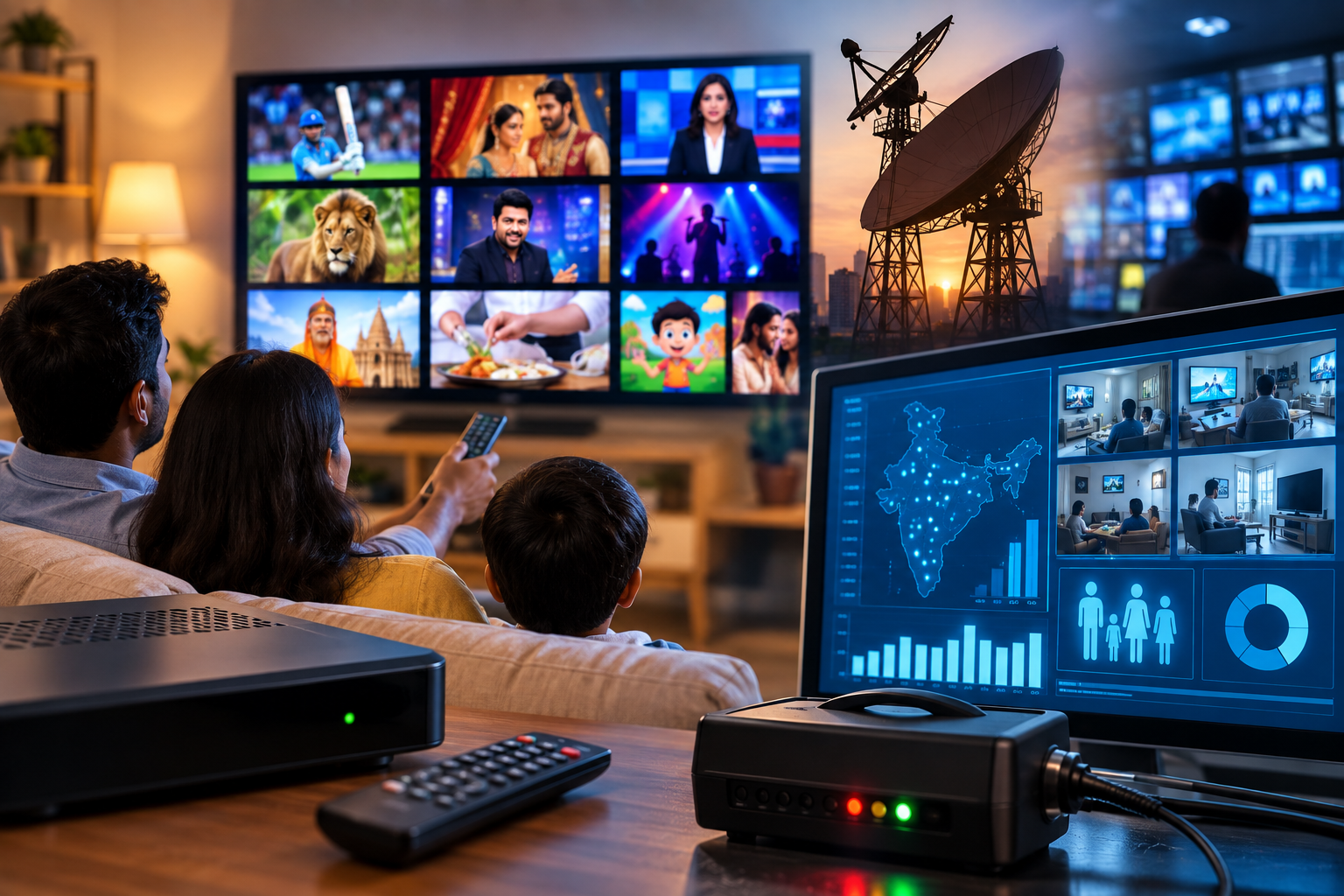
Prolonged suspension of television ratings has created uncertainty for broadcasters, advertisers and media agencies, while the new TV Ratings Policy 2026 seeks a larger, more technology-neutral and transparent measurement framework
The prolonged suspension of television ratings has once again put India's TV audience measurement system under the spotlight. Broadcasters have called for the restoration of Broadcast Audience Research Council (BARC) ratings, arguing that the absence of regular viewership data is affecting revenue visibility, programming decisions and advertising planning, particularly ahead of the festive season.
BARC ratings have traditionally served as an important reference point for India's television ecosystem. Broadcasters use the data to assess the performance of channels and programmes, while advertisers and media agencies use audience measurements to determine where advertising budgets should be deployed.
The issue has gained additional significance following the introduction of the TV Ratings Policy 2026, which replaces the earlier 2014 framework and introduces changes aimed at making television audience measurement more transparent, independent and technology-neutral. The Ministry of Information & Broadcasting formally notified the new policy on March 27, 2026.
What is BARC India?
The Broadcast Audience Research Council, or BARC India, is an industry-led television audience measurement organisation. Its primary role is not to regulate television content but to measure viewing behaviour and provide audience estimates based on data collected from selected households.
The resulting data helps broadcasters understand which channels and programmes are attracting viewers. For advertisers, the ratings provide a common reference for evaluating audience reach and deciding advertising placements.
In a television-driven advertising ecosystem, the difference between a programme attracting a large audience and one attracting a relatively small audience can have a significant impact on advertising demand and commercial negotiations.
BARC therefore operates as an important measurement layer between television audiences, broadcasters, advertisers and media agencies.
How Does BARC Measure TV Viewership?
BARC's traditional measurement model relies on a representative panel of television-owning households. Metering equipment installed in selected homes captures viewing activity, allowing the organisation to estimate viewing patterns across a much larger television universe.
The basic process begins with the identification of the channel or programme being watched. Television content can carry an inaudible audio watermark that contains information allowing the measurement system to identify the broadcast. Measurement equipment installed in panel homes detects this information and records the viewing event.
Panel households also provide information about who is watching through the designated viewing interface. This helps distinguish household television usage from individual audience behaviour.
The collected information is subsequently processed, cleaned and aggregated. The data is combined with information about channels, programmes, languages and broadcast schedules before statistical techniques are applied to estimate viewing across the broader television universe.
What Do TV Ratings Actually Tell Us?
Television ratings are designed to convert individual viewing behaviour into measurable audience indicators.
One commonly used measure is Impressions, which broadly represents the average number of viewers or viewing instances recorded during each minute of a programme, expressed according to the relevant audience universe.
Another important concept is the television audience universe — the population of television households and viewers that the measurement system seeks to represent.
This means a rating should not simply be interpreted as a direct count of every person watching television across India. It is a statistical estimate derived from a defined measurement universe and a representative sample.
That distinction is important because changes in panel composition, methodology, technology and audience behaviour can influence how ratings are calculated and interpreted.
Why Do Broadcasters Need Ratings?
For television companies, ratings influence several commercial decisions.
A channel with strong audience numbers can use that data while negotiating advertising rates and sponsorships. Programme ratings can also influence decisions regarding programme continuation, scheduling, content investment and prime-time strategy.
Advertisers, meanwhile, use audience measurement to compare channels and programmes before allocating budgets. Media agencies can use the data to estimate the potential reach of an advertising campaign and evaluate whether spending is reaching the intended audience.
The absence of regular ratings therefore creates a gap in the information available to the industry.
This becomes particularly important during periods when advertising demand traditionally increases, including major festivals and high-consumption seasons.
Why Were BARC Ratings Suspended?
The current disruption is linked to India's transition to the new TV Ratings Policy 2026.
The government introduced the revised framework after reviewing the earlier television-rating guidelines. The new policy came into effect in March 2026 and was subsequently amended in May. The framework applies to television rating agencies and sets requirements covering governance, audience measurement, panel size, establishment surveys and technology-neutral measurement.
The Ministry's July 2026 communication on the revised television-rating framework emphasised greater transparency, independence and accountability in India's TV audience measurement system.
According to the industry account, BARC's ratings were subsequently withheld while the organisation's registration under the revised framework was being processed. The resulting gap has left broadcasters and advertisers without the regular weekly benchmark that has traditionally been used for television audience analysis.
New Policy Raises Metered Homes to 80,000
One of the most significant changes under the revised framework is the expansion of the measurement panel.
The May 2026 amendment requires an existing television rating agency to increase its panel to 80,000 metered homes within nine months of notification. For a new rating agency, the policy provides for deployment of at least 80,000 metered homes within 18 months of registration.
The larger sample is intended to strengthen the statistical foundation of television measurement and improve representation across different markets and demographic groups.
The policy also allows rating agencies to deploy more than 80,000 metered homes depending on their business requirements.
Greater Focus on Independent Governance
The revised framework also places greater emphasis on governance and independence.
Under the May amendment, at least 33 per cent of the board of directors must comprise independent directors who have no direct or indirect association with broadcasters, advertisers or advertising agencies.
The policy also contains provisions concerning cross-holdings and the relationship between rating agencies and participants in the broadcasting and advertising ecosystem.
These provisions are designed to address potential conflicts of interest and strengthen confidence in the measurement process.
TV Ratings Are Moving Beyond Traditional Television
The television industry is changing rapidly. Smart TVs, connected devices, streaming platforms and internet-enabled set-top boxes have created new sources of viewing data.
The revised policy therefore moves towards a more technology-neutral measurement approach. The framework provides for audience measurement across multiple viewing platforms, including connected TVs.
This is increasingly important because audiences no longer consume video exclusively through conventional linear television.
A viewer may watch a television channel through a traditional set-top box, a connected television, an OTT application or another internet-connected device. A modern measurement system therefore has to account for these different consumption environments.
What Are the Alternatives to BARC?
BARC remains the central reference point for India's television ratings, but technological alternatives are becoming increasingly important.
Automatic Content Recognition (ACR) systems can identify content by analysing audio or visual signals on connected devices. Streaming platforms can also generate first-party data from server logs, including information about viewing duration, unique viewers and concurrent users.
Connected set-top boxes operated by DTH companies and other distributors can similarly provide usage information.
These systems can potentially offer extremely detailed viewing data because they are based on direct digital records rather than solely on a traditional sample-panel model.
However, the two approaches are not identical. Large-scale platform data may provide highly detailed information about a particular service or device ecosystem, while an industry-wide rating system is intended to provide a standardised measurement that can be used across broadcasters and advertisers.
Why a Common Measurement Currency Matters
One of the biggest challenges for the media industry is comparability.
Advertisers need to compare different channels, programmes and platforms using consistent metrics. Broadcasters also need a common benchmark to understand their competitive position.
Without an accepted industry measurement currency, negotiations can become more complicated because different participants may rely on different data sets.
This is particularly relevant as television increasingly overlaps with digital video and OTT platforms.
The future measurement framework will therefore need to balance the statistical advantages of traditional panels with the scale and precision of digital measurement technologies.
BARC Has Faced Disruptions Before
The current interruption is not the first disruption involving BARC ratings.
Television ratings have previously been withheld or modified following concerns about the reliability and integrity of audience measurement.
The most significant episode occurred in 2020 following allegations of television rating manipulation. The controversy resulted in BARC temporarily suspending weekly ratings for the news genre while its systems and processes underwent review.
The episode highlighted a central challenge for the ratings industry: the commercial importance of audience numbers means that the measurement system itself must be protected against attempts to influence or manipulate the underlying data.
What Does the New Framework Mean for the Industry?
The 2026 policy represents a broader attempt to modernise India's television audience measurement system.
The expansion to 80,000 metered homes, establishment surveys, independent governance requirements and greater emphasis on technology-neutral measurement could change how television audiences are measured over the coming years.
For broadcasters, the immediate priority remains the restoration of a reliable and regularly published ratings system.
For advertisers and agencies, the priority is the availability of credible and comparable data for media planning.
For the government and regulators, the challenge is to ensure that the measurement framework remains independent, transparent and adaptable as viewing habits evolve.
The Road Ahead for TV Measurement
India's television industry is moving into an environment where traditional broadcasting and digital consumption increasingly overlap. As connected TVs and streaming platforms gain importance, measuring only conventional television viewing will provide an increasingly incomplete picture of audience behaviour.
The return of BARC ratings, therefore, is not simply about restarting a weekly ratings chart. The larger issue is how India builds a measurement system capable of capturing fragmented viewing while maintaining consistency, transparency and industry-wide credibility.
The success of the new framework will ultimately depend on how effectively it combines a sufficiently large and representative panel with newer forms of technology-driven measurement.
For broadcasters, advertisers and media agencies, the restoration of reliable ratings could bring greater visibility to programming and advertising decisions. At the same time, the transition to the 2026 framework could mark a significant shift in how India's television audience is measured in an increasingly connected media market.