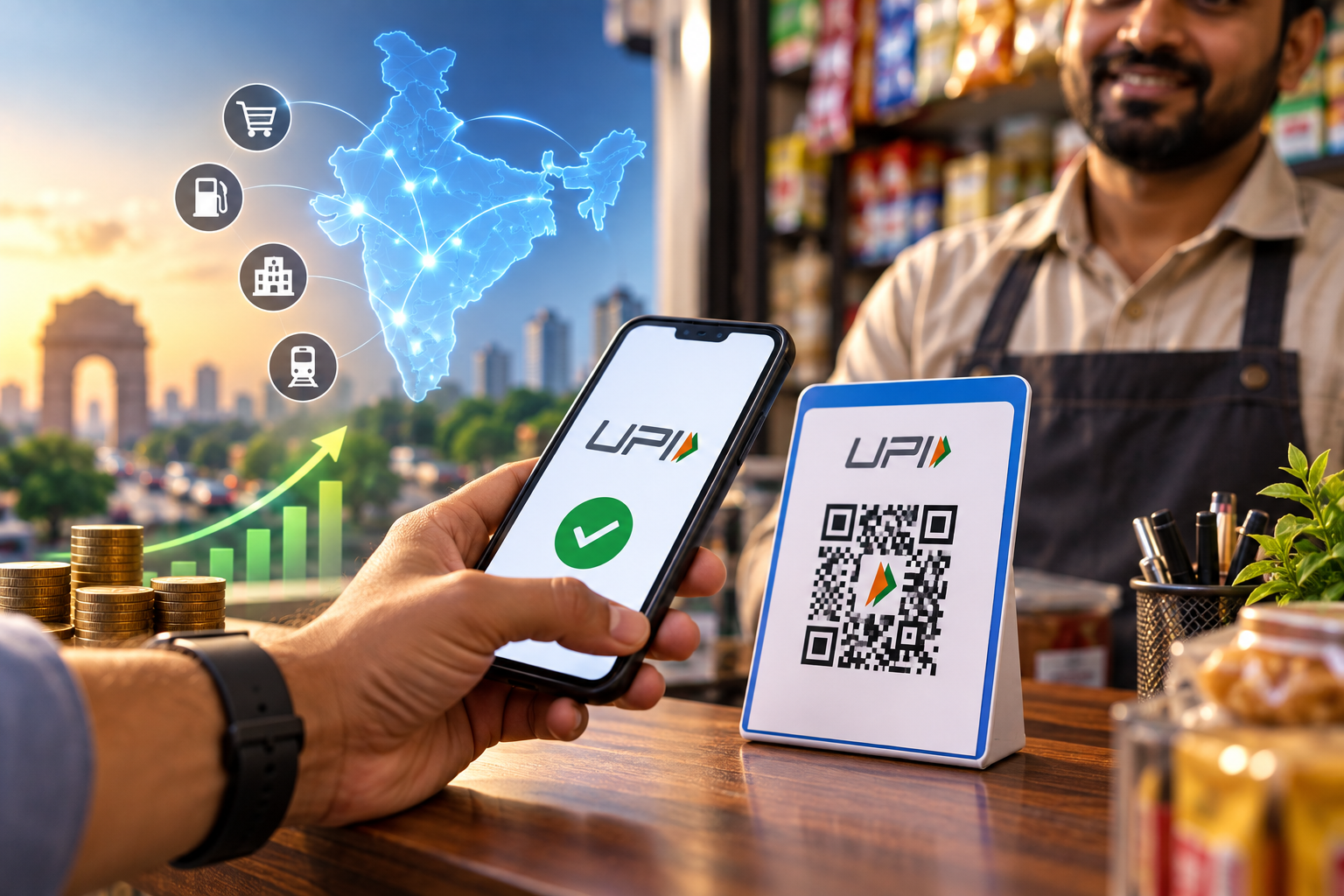
Rajiv Kumar argues that keeping UPI free could help sustain digital-payment adoption, while the new MDR framework seeks to create a revenue stream for the payments ecosystem
Former NITI Aayog vice-chairman Rajiv Kumar has urged the government to retain zero-fee Unified Payments Interface (UPI) transactions for at least a few more years, arguing that the broader economic benefits of the digital payments network outweigh the cost of supporting it.
His comments come shortly after the government introduced a new Merchant Discount Rate (MDR) framework under which certain high-value person-to-merchant UPI transactions will attract a fee from October 15, 2026.
Kumar told PTI that UPI should continue to be treated as a public good because of its wider economic benefits. He suggested reviewing the zero-fee model only after the currency-to-GDP ratio shows a tendency to decline.
New UPI MDR Framework From October 15
Under the new framework, eligible person-to-merchant (P2M) UPI transactions above ₹2,000 will attract an MDR of 0.4 per cent, subject to a maximum charge of ₹300 for transactions of ₹75,000 or more.
Importantly, the charge is levied within the merchant payment ecosystem and is not a transaction fee payable directly by consumers.
UPI payments between individuals will remain free, while P2M transactions up to ₹2,000 will also remain outside the MDR framework. Small merchants classified under the P2PM category and meeting the applicable threshold will also remain exempt.
Why Rajiv Kumar Wants the Zero-Fee Model Extended
Kumar's argument is centred on the wider economic effects of UPI.
According to his assessment, the benefits generated by a large-scale digital payments network extend beyond the immediate payment transaction. UPI can reduce reliance on cash, improve transaction convenience and support formalisation of economic activity.
He has argued that the government should therefore continue bearing the cost of maintaining the system for several more years rather than introducing merchant charges at this stage.
Kumar estimates the public expenditure required to maintain UPI infrastructure at around ₹20,000 crore, while arguing that the overall benefits of the network exceed this cost.
High-Value Transactions Are Becoming More Important
The debate is partly driven by the changing composition of UPI payments.
While around 96 per cent of UPI transactions by number are below ₹2,000, transactions above that threshold account for a much larger share of payment value, according to the figures cited by Kumar.
Business Standard has separately reported that around 67 per cent of P2M transaction value comes from payments above ₹2,000.
This means the new MDR framework is aimed primarily at the higher-value merchant-payment segment rather than routine low-value digital transactions.
Consumers Will Continue to Pay No UPI Transaction Fee
The government and NPCI have emphasised that the new MDR should not be confused with a consumer transaction fee.
Consumers will continue to be able to use UPI without a direct payment charge. NPCI has also said that UPI application providers will not be permitted to impose platform or transaction fees on customers for UPI payments under the new framework.
For example, under the standard 0.4 per cent MDR, a merchant receiving a ₹5,000 eligible payment would incur ₹20, while a ₹50,000 transaction would generate ₹200. At ₹75,000, the charge reaches the ₹300 ceiling.
Special Treatment for Essential Services
The MDR structure does not apply uniformly across all merchant categories.
Transactions above ₹2,000 involving sectors such as railways, telecom, insurance, fuel and certain agricultural inputs will attract a flat MDR of ₹5 rather than the standard 0.4 per cent rate.
Capital-market transactions, including certain payments involving mutual funds, securities and stockbroking, will have a lower MDR of 0.02 per cent, subject to a ₹300 ceiling. UPI AutoPay transactions are also outside the prescribed MDR framework.
The differentiated structure is intended to limit the impact of percentage-based charges on sectors where margins or transaction economics may make higher fees more significant.
Government Seeks to Fund UPI Ecosystem More Sustainably
The introduction of MDR represents a change in the financial model supporting UPI.
Since UPI was made free for users and merchants in 2020, the ecosystem has relied substantially on government incentives and support to participating institutions. The new framework creates an additional revenue stream from selected commercial transactions.
Industry participants have argued that a sustainable revenue model could support investments in technology, cybersecurity and payment infrastructure as transaction volumes continue to expand.
The government has also proposed a dedicated mechanism to support digital-payment infrastructure for small merchants in smaller towns and specific regions. Business Standard reported that the proposed fund could receive around ₹700 crore annually, with details to be finalised in consultation with the Reserve Bank of India.
Concern Over Possible Shift Towards Cash
Kumar has warned that even a relatively small merchant charge could encourage some businesses and consumers to reconsider digital payments, particularly for higher-value purchases.
The concern is that merchants operating on thin margins could seek alternative payment methods if the additional cost becomes material.
A LocalCircles survey cited by Business Standard found that only 17 per cent of surveyed merchants and businesses were willing to bear a 0.4 per cent MDR on UPI payments above ₹2,000, while 41 per cent said they would not bear any MDR. The survey received more than 32,000 responses from merchants across 242 districts.
However, these survey responses reflect stated preferences and do not necessarily establish that merchants will actually shift away from UPI once the framework becomes operational.
Risk of Passing Costs to Consumers
The new framework explicitly keeps the consumer side of UPI free, but the treatment of merchant costs remains an important issue.
The government has been considering a mechanism to monitor whether merchants attempt to pass the MDR on to customers through higher prices or separate charges.
This will be particularly relevant for businesses where margins are narrow and UPI forms a substantial share of payment receipts.
If merchants absorb the cost, their margins could be affected. If businesses respond through broader price adjustments, consumers could experience an indirect impact even though no UPI transaction fee appears on the payment itself.
UPI’s Scale Makes the Policy Significant
UPI has become a central component of India's digital-payment infrastructure. Business Standard reported that UPI processed 24.51 billion transactions worth ₹29.82 trillion in August 2026.
At such a scale, even a small change in the economics of payment processing can have implications for banks, payment service providers, fintech companies, merchants and consumers.
The new MDR framework therefore represents more than a change in transaction pricing. It also raises questions about how India's digital public infrastructure should be financed as usage expands.
Payment Companies and Banks Could Gain a New Revenue Stream
The MDR collected on eligible transactions is distributed across participants in the payments ecosystem rather than being treated as a direct government tax.
Banks, payment service providers, acquiring institutions and other participants can receive portions of the payment-processing economics depending on their role in the transaction.
For payment companies, the new framework could therefore provide an additional source of revenue to support technology, compliance and infrastructure investments.
However, the actual financial impact will depend on transaction volumes, merchant behaviour, the distribution mechanism and operating costs.
Legal Challenge Adds Another Layer of Uncertainty
The new MDR regime is also facing a legal challenge.
A public interest litigation has been filed in the Supreme Court questioning the framework for imposing MDR on UPI transactions above ₹2,000. The petition challenges aspects of the legal framework and raises questions concerning the distinction between UPI and other electronic payment systems.
The legal proceedings could therefore become another factor to monitor as the new system moves towards implementation.
What the New Regime Means for Different Users
For ordinary consumers, the immediate impact is limited because P2P payments and eligible payments up to ₹2,000 remain free.
For small merchants, the P2PM exemption can protect businesses meeting the applicable monthly-receipt criteria.
For larger merchants, the introduction of MDR means that high-value UPI payments will become a direct payment-processing cost.
For banks and fintech companies, the framework potentially creates a new source of revenue for maintaining the payments ecosystem.
For investors, the policy could influence the economics of banks, payment companies and fintech businesses, although the ultimate financial impact will depend on how merchants and consumers respond.
Market Outlook
The UPI MDR debate highlights a fundamental policy question: how should India's rapidly expanding digital-payment infrastructure be financed without weakening adoption?
Rajiv Kumar's argument is that UPI's broader economic benefits justify maintaining the zero-fee model for several more years. The government's new framework, meanwhile, seeks to introduce a limited merchant-side charge while protecting consumers, small merchants and selected essential sectors from significant additional costs.
The key indicators after October 15 will be merchant acceptance, payment volumes, transaction values, any evidence of consumers shifting towards cash or other payment instruments, and the ability of the MDR framework to generate sustainable funding for payment infrastructure.
The outcome will help determine whether India's next phase of digital-payment growth can balance affordability, adoption and long-term financial sustainability.