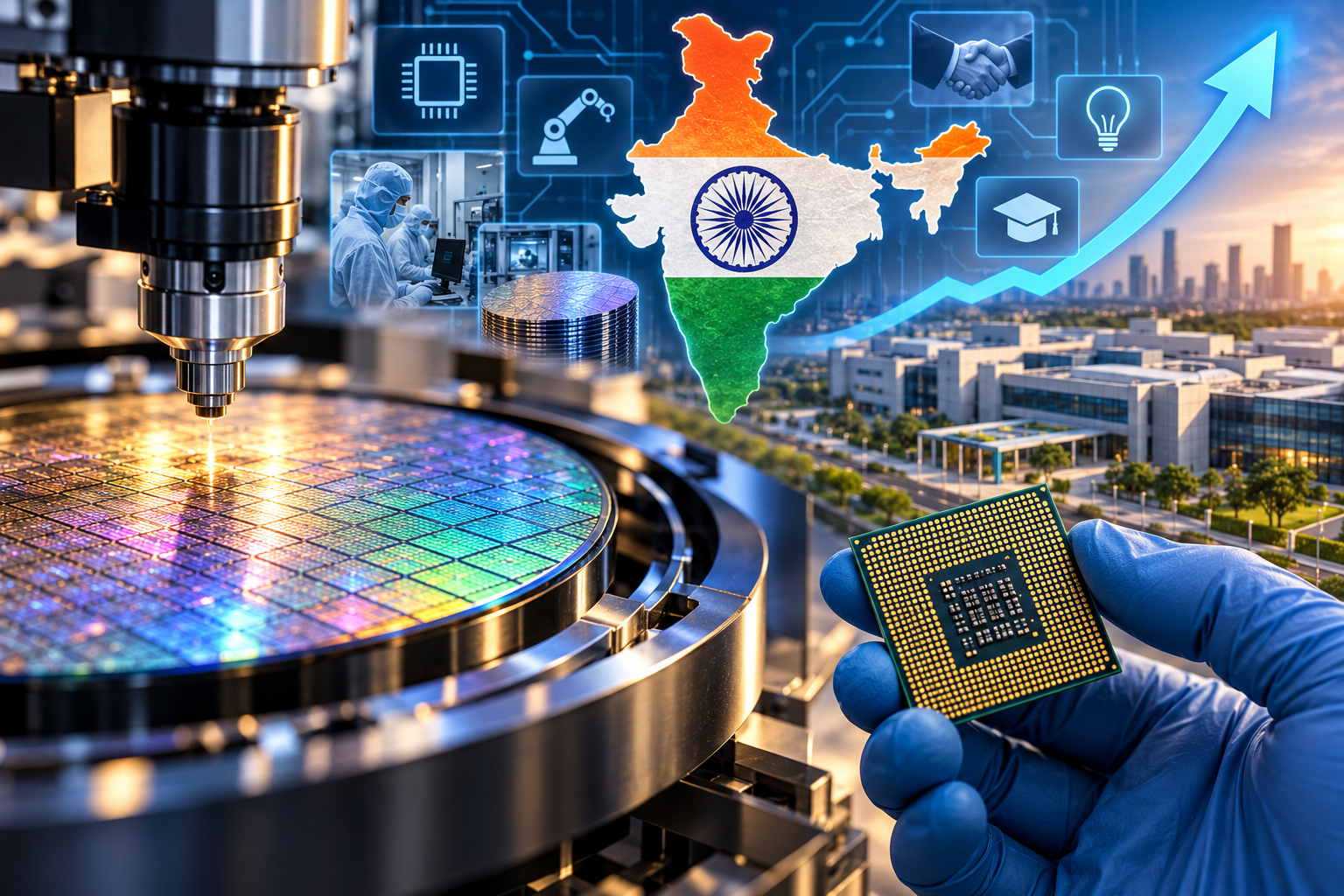
India’s semiconductor market is projected to more than triple to $200 billion by 2035, but EY-IESA says the next phase will depend on suppliers, advanced packaging, R&D, specialised talent and domestic demand rather than fabs alone
India’s semiconductor ambitions are entering a new phase as the country moves from building manufacturing capacity towards developing a deeper and more integrated chip ecosystem. According to an EY-IESA report, India’s semiconductor market is projected to expand from nearly $64 billion in 2026 to $200 billion by 2035.
The report, titled Semicon India 2.0: From Capacity Creation to Ecosystem Leadership, argues that the next stage of India's semiconductor strategy will depend less on the number of factories announced and more on the capabilities built around them — including equipment, materials, advanced packaging, research, design, specialised workforce and commercialisation.
From capacity creation to ecosystem building
India's first semiconductor push was centred largely on attracting manufacturing projects and establishing foundational capabilities. Under Semicon 1.0, 12 semiconductor projects have been approved across six states, with investment commitments of more than ₹1.64 lakh crore, according to government data.
The next phase broadens that approach.
Semicon 2.0, approved with an outlay of ₹1.275 lakh crore, focuses on six interconnected pillars: chip design, semiconductor equipment and materials, fabrication, advanced packaging, research and development, and talent development.
The shift is significant because a semiconductor fab cannot operate as an isolated manufacturing facility. It requires reliable suppliers of specialised materials, machinery, spare parts, chemicals, gases, technical services and other critical inputs.
The market opportunity is expanding rapidly
The projected $200 billion market provides a large domestic demand base for India's semiconductor ambitions.
Consumer electronics currently accounts for about 30 per cent of India's semiconductor market, followed by automobiles at 16 per cent and industrial applications at 15 per cent. Emerging areas such as artificial intelligence, data centres, telecommunications, electric mobility and advanced manufacturing are expected to create additional demand.
This diversification could become increasingly important as electronics content rises across automobiles, industrial equipment, telecommunications infrastructure and connected devices.
Semiconductor imports highlight the opportunity
India's growing semiconductor demand is also reflected in its import bill.
According to the EY-IESA findings, semiconductor imports increased more than fivefold from $5.7 billion in FY17 to $30.3 billion in FY25, representing a compound annual growth rate of around 23 per cent.
The increase demonstrates both the scale of domestic demand and the opportunity to develop greater local manufacturing and value addition.
However, simply replacing imports with domestic production will not be enough to establish a globally competitive ecosystem. The report emphasises the need to build capabilities across multiple stages of the semiconductor value chain.
Supplier ecosystem could determine long-term competitiveness
One of the major challenges for India is developing a strong domestic supplier base.
Semiconductor manufacturing depends on highly specialised equipment, materials and services. If fabs continue to rely heavily on imported inputs, domestic semiconductor production could increase without a comparable increase in local value addition.
The EY report therefore highlights the importance of developing suppliers around semiconductor manufacturing clusters.
This could create opportunities for companies involved in industrial equipment, specialty chemicals, precision engineering, cleanroom systems, electronic materials and other supporting industries.
Advanced packaging emerges as a strategic opportunity
Advanced packaging is another area expected to become increasingly important.
Modern semiconductor performance is no longer determined solely by transistor technology. Packaging techniques such as chiplets, heterogeneous integration and other advanced approaches are becoming increasingly relevant as chip architectures become more complex.
EY notes that advanced packaging, compound semiconductors, photonics and chip-to-system integration could offer high-potential opportunities for India.
Building expertise in these areas could allow India to participate in higher-value segments of the semiconductor chain rather than focusing only on conventional assembly and testing.
India has a major design-talent advantage
India enters this phase with an established strength in semiconductor design.
The country accounts for nearly 20 per cent of the world's semiconductor design engineers, according to the EY-IESA report.
However, the skill requirements of manufacturing are different from those of design and engineering services.
As fabs and advanced packaging facilities scale up, India will require process engineers, equipment engineers, technicians, cleanroom specialists, packaging professionals and quality and reliability experts.
The challenge will therefore be to convert India's existing engineering base into a workforce equipped for large-scale semiconductor manufacturing.
R&D and commercialisation remain critical gaps
Research and development will also play a larger role in determining the industry's long-term competitiveness.
The report recommends strengthening semiconductor research infrastructure and creating mechanisms that can move technologies from laboratories into commercial applications.
A national semiconductor research and commercialisation platform, modelled on institutions such as Taiwan's Industrial Technology Research Institute and Belgium's IMEC, could help connect universities, research organisations, startups and industry.
The objective would be to reduce the gap between research and commercial deployment while creating intellectual property and technologies that can be scaled globally.
State-level policy alignment becomes important
Semiconductor investments require infrastructure that extends beyond traditional industrial facilities.
Reliable electricity, ultra-pure water, logistics, waste management and specialised industrial infrastructure are critical for manufacturing operations.
The EY-IESA report highlights uneven state-level policy support and recommends closer alignment between central and state incentives.
Integrated semiconductor clusters with common infrastructure could help reduce project-development costs and improve operational efficiency.
Domestic demand can support ecosystem development
India's large electronics and technology market could become one of the industry's biggest advantages.
Electronics production increased nearly sixfold between FY15 and FY25, while electronics exports expanded substantially during the same period, according to the EY-IESA findings.
Growing demand from smartphones, automobiles, telecommunications equipment, data centres, industrial electronics and AI infrastructure can provide semiconductor manufacturers with a sizeable domestic customer base.
The challenge will be ensuring that this demand translates into greater domestic value addition rather than simply increasing the country's dependence on imported chips and components.
Recent industry partnerships point to ecosystem expansion
Developments around India's semiconductor projects indicate that ecosystem building is already moving beyond policy announcements.
At Semicon India 2026, Tata Electronics announced partnerships spanning wafer fabrication, advanced packaging, materials, design and R&D, vendor infrastructure and skill development. The initiatives were aimed at supporting its semiconductor projects in Dholera and Assam.
Such partnerships illustrate how semiconductor projects require an ecosystem of suppliers, technology partners, research institutions and skilled workers rather than a standalone manufacturing facility.
Policy support will need to evolve with the industry
The EY-IESA report recommends semiconductor-specific fiscal measures, simplified customs and export procedures, stronger coordination between central and state policies and specialised certification programmes for design, fabrication and advanced packaging.
It also highlights the importance of financing mechanisms for startups and design companies.
For investors and industry participants, the policy transition could therefore broaden the semiconductor opportunity beyond traditional fab investments to include equipment, materials, packaging, design, R&D and workforce development.
What could determine India's semiconductor trajectory
The next decade will test whether India can convert its large domestic market and design talent into a globally integrated semiconductor ecosystem.
Several factors will be particularly important: execution of approved projects, availability of critical infrastructure, development of domestic suppliers, access to technology, specialised talent, research commercialisation and consistency of government policy.
Global semiconductor cycles will also matter. The industry is highly capital-intensive and exposed to fluctuations in electronics demand, technology transitions and global supply-chain conditions.
Market Outlook
India's projected rise from a nearly $64 billion semiconductor market in 2026 to $200 billion by 2035 represents a substantial opportunity, but the EY-IESA report makes clear that manufacturing capacity alone will not determine the outcome.
The next phase will depend on how effectively India develops the ecosystem surrounding semiconductor fabs — from equipment and materials to advanced packaging, R&D, design and specialised talent.
For the broader economy, deeper semiconductor capabilities could support electronics manufacturing, automotive technology, AI infrastructure, telecommunications, electric mobility and industrial automation.
For investors, the opportunity may therefore extend well beyond semiconductor manufacturers. Companies participating in the supporting ecosystem — including specialised materials, engineering, equipment, packaging, electronics and technology — could become increasingly relevant as India's semiconductor infrastructure expands.
The central challenge remains execution. If India can connect domestic demand, manufacturing capacity, supplier networks, research and talent into a commercially viable ecosystem, the projected $200 billion market could represent not just a larger chip market, but a broader industrial opportunity across the technology value chain.