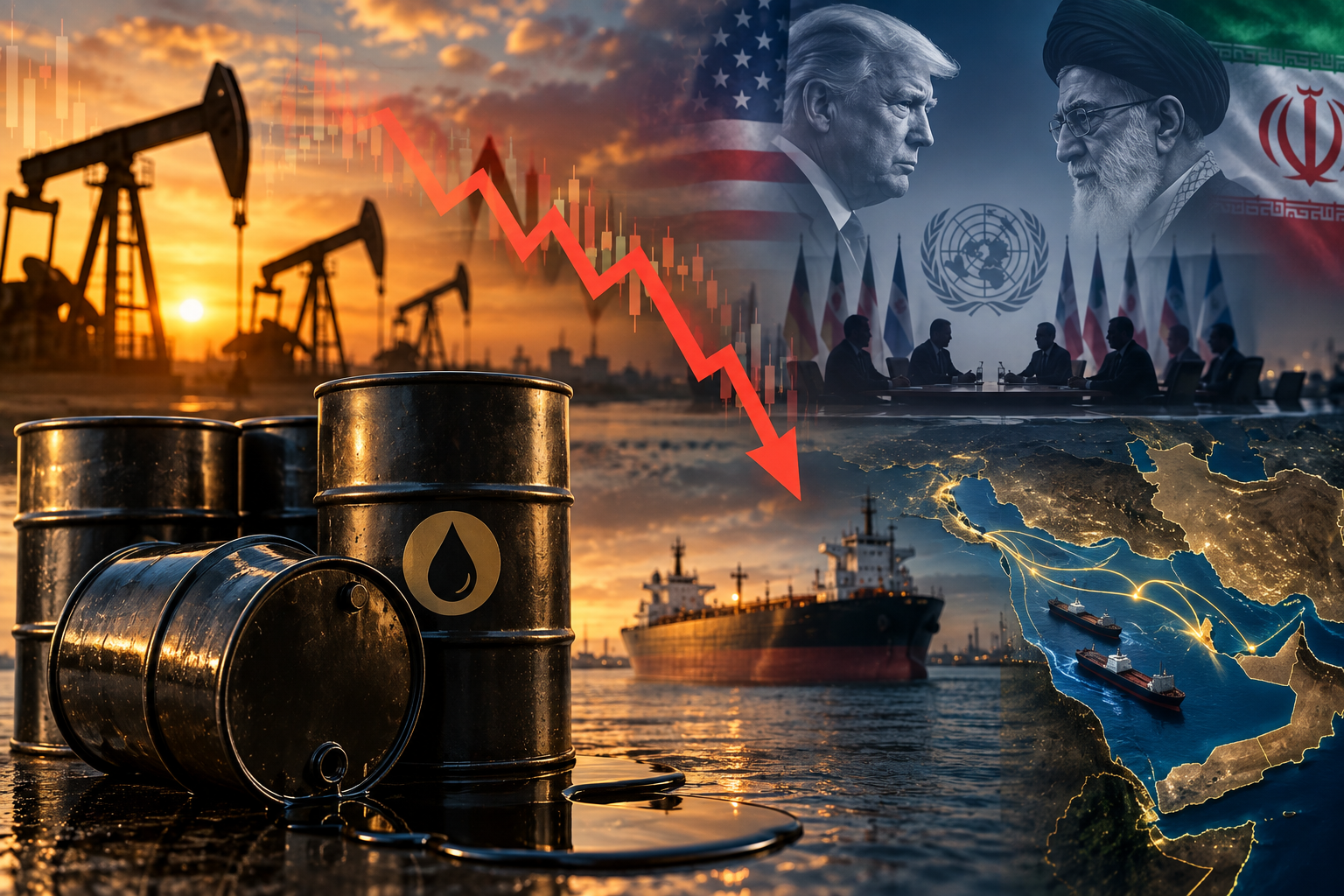
Brent slips to $101.71 and WTI falls below $100 as markets weigh possible diplomatic engagement, recovering Saudi shipments and continuing Middle East supply risks
Oil prices fell to their lowest level in more than a week on Monday as investors assessed the possibility of renewed diplomatic efforts involving the United States and Iran, while also monitoring signs of a recovery in Saudi Arabian crude shipments.
Brent crude futures touched $101.71 a barrel, down $2.16, or 2.08 per cent, by 0213 GMT. US West Texas Intermediate (WTI) crude declined $2.15, or 2.14 per cent, to $98.15 a barrel. Both benchmarks touched their lowest levels since September 10.
The decline indicates that part of the geopolitical risk premium built into crude prices is being reduced as traders assess the possibility of diplomatic developments during the United Nations General Assembly.
Diplomacy becomes a key factor for oil markets
Market participants are closely watching potential diplomatic activity involving Washington and Tehran.
US President Donald Trump has indicated that he would be open to meeting Iranian President Masoud Pezeshkian, who is expected to be in New York for the UN General Assembly. Iran has also communicated conditions for potentially re-engaging in negotiations through mediators, according to reports.
For oil markets, any credible progress toward de-escalation could reduce concerns over further supply disruptions and encourage traders to price in a lower geopolitical premium.
However, the situation remains fluid, with continued military tensions in the region creating uncertainty over the durability of any diplomatic progress.
WTI slips below the $100 mark
The decline pushed WTI below the psychologically important $100-a-barrel level.
WTI had already fallen 1.58 per cent in the previous session before dropping another 2.14 per cent on Monday. Market participants were also assessing the impact of futures positioning ahead of the October contract's expiry, with some traders potentially rolling positions into the November contract.
The move below $100 is significant for market sentiment because crude had remained elevated amid concerns about disruptions to Middle East production and transportation routes.
Saudi oil exports show signs of recovery
Another factor weighing on prices is the improvement in Saudi Arabia's crude shipments.
Saudi oil exports have recovered to more than 4 million barrels per day in September, compared with around 2.4 million bpd in August, according to provisional Kpler data cited by Reuters. The August level was the lowest since at least 2013.
The increase in exports is particularly important because attacks on Saudi infrastructure had raised concerns about the country's ability to move crude through alternative routes.
Saudi Arabia has increased shipments through the Strait of Hormuz after disruptions affected some exports through Yanbu, helping restore a portion of the country's international oil flows.
Houthi attacks keep supply risks elevated
Despite the decline in crude prices, supply risks across the Middle East have not disappeared.
Yemen's Houthis claimed missile and drone attacks on targets in Riyadh and an Aramco facility in Yanbu, a major Saudi oil-export location. The attacks have added another layer of uncertainty to regional energy flows.
The attacks are particularly significant because the region's major oil transportation routes are already operating under heightened security and logistical risks.
Saudi Arabia's response has included increasing shipments through the Strait of Hormuz to compensate for disruptions elsewhere.
Strait of Hormuz remains a critical risk
The Strait of Hormuz continues to be a major focus for global energy markets.
Reuters reported that vessel traffic through the strategic waterway has fallen sharply from normal levels since the conflict began. Over one recent weekend, only 12 commodity vessels passed through the strait, compared with around 125 vessels per day before the conflict.
Despite the lower vessel traffic, oil flows have remained stronger than some earlier expectations.
Kpler data showed that 13 tankers carrying around 34 million barrels exited the strait during the week of September 13, with Saudi Arabia accounting for approximately half of the volume.
The continuing flow of crude has helped prevent the supply disruption from translating into an even larger price shock.
Global oil flows remain relatively resilient
JPMorgan analysts said Middle East oil flows averaged around 17.1 million barrels per day over the previous 10 days, according to Reuters.
That level was about 6.1 million bpd below the 2025 average, indicating that supply has been disrupted but has not completely collapsed. Saudi Arabia's increased shipments through the Strait of Hormuz have been an important part of the adjustment.
This resilience in physical oil flows is one reason crude prices have been able to retreat from recent highs despite continuing geopolitical tensions.
Oil prices remain sensitive to geopolitical developments
The current market environment leaves crude prices particularly sensitive to headlines from the Middle East.
A credible diplomatic breakthrough could lead to further removal of the geopolitical risk premium if traders become more confident that supply disruptions will ease.
Conversely, renewed attacks on energy infrastructure, further restrictions on shipping or a deterioration in US-Iran relations could quickly restore risk premiums.
The competing forces of improving shipments and persistent security risks are therefore likely to keep crude markets volatile.
Implications for India
For India, movements in international crude prices remain particularly important because the country imports a large proportion of its crude oil requirements.
A sustained decline in global oil prices can reduce pressure on India's import bill and current account while also easing input-cost pressures for several industries.
Lower crude prices can be relevant for sectors such as aviation, transportation, paints, chemicals and logistics, although the actual impact depends on refining margins, currency movements and domestic pricing decisions.
The rupee is also sensitive to oil prices because higher crude import costs can increase demand for dollars. Reuters reported that Indian currency markets were closely watching oil prices and foreign investment flows on Monday, with Brent still above $100 despite the decline.
Inflation remains an important transmission channel
Crude oil is an important input into the broader inflation equation because energy costs can influence transportation, manufacturing and logistics expenses.
If oil prices remain elevated for an extended period, companies with high fuel or petrochemical exposure could face margin pressure. On the other hand, a sustained moderation in crude could provide some relief to energy-intensive businesses.
For consumers, the transmission of international oil prices into domestic fuel prices can vary depending on taxation, currency movements and government pricing decisions.
Markets respond to easing oil prices
The decline in crude prices also influenced broader market sentiment in Asia.
Reuters reported that Asian equities moved higher on Monday as lower oil prices and signs of stronger Middle East supply supported risk sentiment. South Korea's technology index rose while Chinese blue-chip stocks also gained.
Indian equities also opened higher, although investors remained cautious because Brent crude was still above $100 and geopolitical uncertainty continued.
The reaction demonstrates how oil has become an important transmission channel between geopolitical developments and financial markets.
What investors will watch next
The immediate focus for crude traders will remain on developments involving the United States and Iran, the movement of oil tankers through the Strait of Hormuz, Saudi export volumes and any further attacks on energy infrastructure.
Physical supply data will be particularly important because a continued recovery in Saudi shipments could reduce the supply premium embedded in crude prices.
At the same time, any deterioration in regional security could quickly reverse the recent decline.
Market Outlook
Oil markets are currently balancing two opposing forces: expectations of improved diplomacy and recovering Saudi shipments on one side, and continuing attacks and shipping risks across the Middle East on the other.
The move below $100 for WTI and the decline in Brent toward $102 indicate that traders are reducing part of the risk premium associated with an escalation scenario. However, the continued disruption to regional shipping routes means the supply-risk component has not disappeared.
For India, the direction of crude prices will remain important for the import bill, currency, inflation-sensitive sectors and broader market sentiment. The next major moves in oil are therefore likely to depend as much on diplomatic and security developments as on conventional supply-and-demand fundamentals.