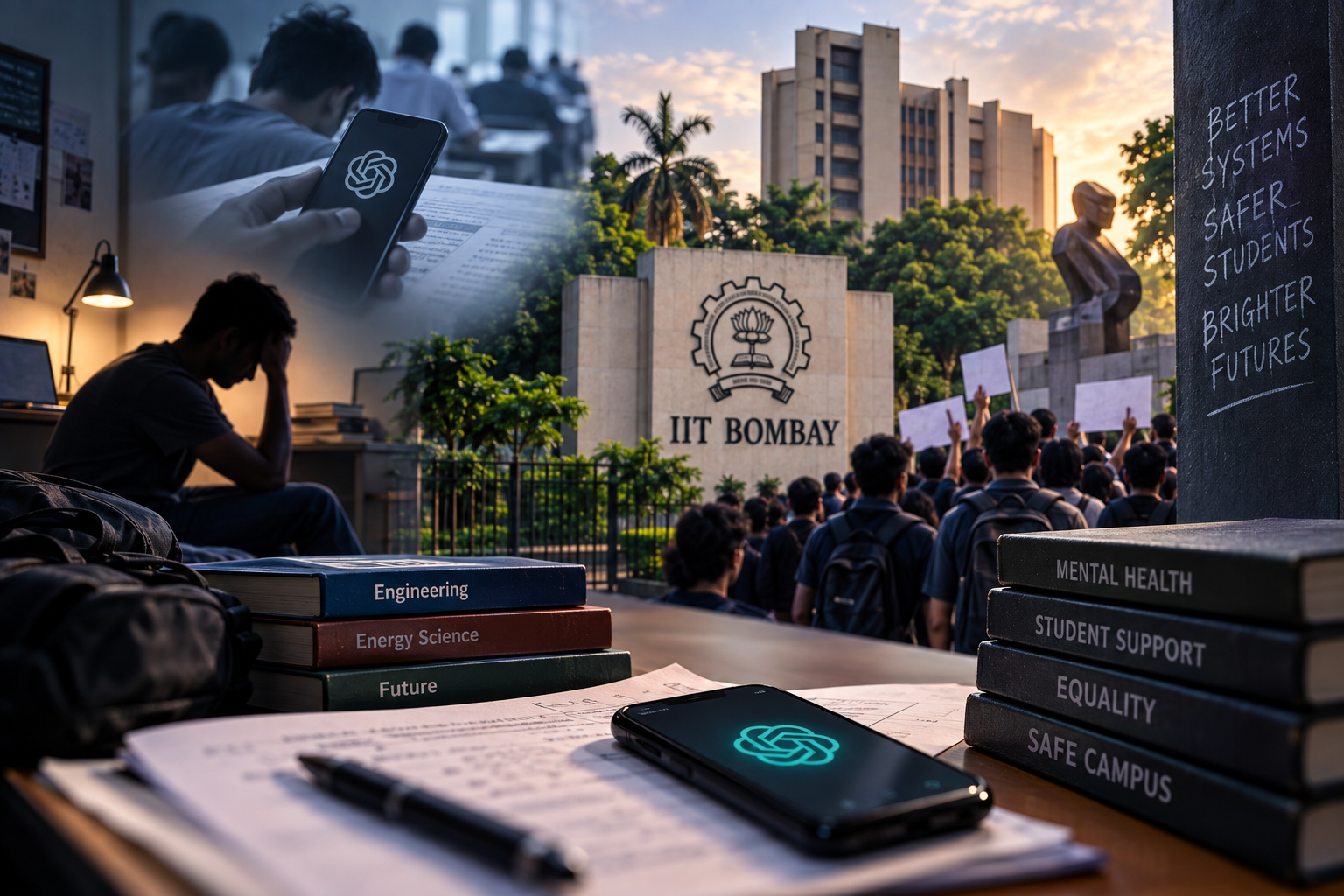
Second-year BTech student Sahil Ravindra Wakode died on September 18 after an examination-related incident; police are probing allegations of abetment and caste discrimination as students demand institutional reforms
The death of Sahil Ravindra Wakode, a second-year BTech student at the Indian Institute of Technology Bombay (IIT Bombay), has triggered a major controversy on the campus, bringing together questions around examination procedures, student welfare, academic pressure and allegations of caste-based discrimination.
Wakode, who was from Yavatmal in Maharashtra and studied in the Energy Science and Engineering department, died in his hostel on September 18, hours after he was allegedly found using a mobile phone during a mid-semester examination.
The incident has since led to student protests, an FIR based on allegations made by Wakode's family and the transfer of the investigation to the Mumbai Crime Branch. IIT Bombay, meanwhile, has denied allegations of caste discrimination and said no disciplinary action had been initiated against Wakode following the examination incident.
What happened during the examination
According to IIT Bombay's statement, Wakode was found using a mobile phone during a mid-semester examination. The institute said he had allegedly uploaded the examination question paper to ChatGPT to seek answers.
The IIT Bombay Faculty Forum said the examination was being invigilated by Professor Suryanarayana Doolla, who reported the matter to the institute authorities after allegedly finding Wakode with the phone. The faculty body described the incident as academic malpractice and said the professor was following the prescribed institutional procedure.
The institute, however, said the matter did not immediately result in disciplinary proceedings. According to IIT Bombay, the course instructor and the Head of the Department discussed the matter with Wakode and counselled him. The institute said he was assured that the incident would not adversely affect his academic career.
Later the same day, Wakode was found dead in his hostel room.
Police initially registered an accidental death report and began an investigation. No suicide note was reported to have been recovered, according to police information cited by media reports. The investigation was subsequently transferred to the Mumbai Crime Branch.
Family alleges caste-based discrimination
The case took a new turn after Wakode's parents approached the police and alleged that their son had faced caste-based discrimination and institutional harassment.
Based on the family's complaint, Mumbai Police registered an FIR under Section 108 of the Bharatiya Nyaya Sanhita, concerning abetment of suicide, along with relevant provisions of the Scheduled Castes and Scheduled Tribes (Prevention of Atrocities) Act.
Professor Doolla has been named in the case. No arrests had been reported as of September 21, and the investigation remains ongoing.
The allegations made by the family have not been established by the investigation. IIT Bombay has denied the caste-discrimination allegations and said Wakode had not submitted a complaint concerning caste discrimination to the institute's SC/ST cell or administration. The institute has said it will cooperate with the authorities and urged people to avoid speculation while the investigation continues.
Faculty body backs the invigilator
The IIT Bombay Faculty Forum has publicly supported Professor Doolla, maintaining that he was carrying out his academic responsibilities when the alleged examination malpractice was detected.
The faculty body's position is that identifying and reporting the use of an unauthorised device during an examination was part of the invigilator's prescribed duties.
This has become one of the central points of contention on campus, with students and the administration presenting different perspectives on how the examination incident was handled and whether sufficient sensitivity was exercised in dealing with the student.
The competing accounts are now part of the broader investigation into the circumstances surrounding Wakode's death.
Student protests expand beyond the examination incident
Wakode's death sparked protests involving students on the IIT Bombay campus. Demonstrations initially focused on the circumstances surrounding the examination incident but subsequently broadened into demands concerning student welfare, transparency, accountability and institutional procedures.
Students questioned whether existing academic and disciplinary mechanisms adequately account for the emotional and psychological pressures faced by students.
Reports said hundreds of students participated in protests on campus, while the ongoing mid-semester examinations were also affected following the incident.
The protests also highlighted concerns about student representation and the manner in which complaints involving discrimination, academic pressure and faculty-student interactions are addressed.
IIT Bombay agrees to take forward an 18-point charter
After three days of student protests, IIT Bombay agreed to take forward an 18-point charter submitted by the protesting students.
Director Professor Shireesh Kedare signed the document after discussions with representatives of the students. The charter includes demands relating to accountability, an independent examination of the circumstances surrounding Wakode's death and changes to aspects of the institute's academic and student-welfare systems.
Students have also sought timelines for the investigation, including an interim report and a final report, according to reports on the protest negotiations.
The development indicates that the controversy has moved beyond the immediate examination incident and into a wider discussion about institutional governance and student support.
Questions around academic pressure and student welfare
The incident has also revived concerns about the pressures associated with highly competitive academic environments.
Wakode's family has said they did not observe signs that suggested he was facing an immediate crisis. According to reports, his parents said he was academically capable, had no backlogs from his first year and was active in sports at the institute. They also said he had plans to prepare for the Civil Services after completing his engineering degree.
These accounts underscore why the circumstances surrounding student distress can be difficult for families and institutions to identify in advance.
For educational institutions, the episode raises questions about the balance between maintaining examination integrity and ensuring that students have access to effective counselling, grievance mechanisms and timely support when facing academic or personal difficulties.
AI and academic integrity add another dimension
The reported use of ChatGPT during the examination also places the incident within a rapidly changing education environment.
Generative AI tools have become increasingly accessible to students, creating new challenges for educational institutions attempting to maintain examination integrity. Institutions are now required to establish clear rules on when AI tools are prohibited, how suspected violations are investigated and what safeguards are available to students during disciplinary processes.
In Wakode's case, IIT Bombay has described the alleged use of the phone and ChatGPT as examination malpractice, while the subsequent circumstances have prompted students to question the handling of the episode.
The investigation will be important in establishing the sequence of events and determining whether any institutional or individual responsibility arose.
Investigation now central to the case
With the Mumbai Crime Branch handling the investigation, the focus will now be on establishing the circumstances surrounding Wakode's death and examining the allegations made by his family.
Key questions include the sequence of events following the examination incident, the interactions between Wakode and faculty members, the nature of any communication concerning academic consequences, and the allegations of caste-based discrimination.
The police investigation will also have to establish whether there is evidence supporting the allegations contained in the FIR.
Until the investigation and any subsequent legal proceedings are completed, allegations against individuals or the institution remain allegations and should not be treated as established facts.
A broader institutional challenge
The IIT Bombay controversy has brought together several issues that extend beyond a single examination: academic integrity, student mental health, grievance redressal, caste-related concerns, faculty-student interactions and the growing role of artificial intelligence in education.
For premier educational institutions, maintaining rigorous academic standards remains essential. At the same time, the episode has highlighted the importance of transparent procedures and accessible support mechanisms for students who face disciplinary or personal difficulties.
The 18-point charter agreed upon by the institute and students could therefore become an important part of the campus response, depending on how the commitments are implemented and monitored.
What happens next
The immediate focus remains on the Mumbai Crime Branch investigation and the implementation of the commitments made following the student protests.
The findings of the investigation could help establish the sequence of events leading up to Wakode's death and determine whether the allegations made by his family are supported by evidence.
For IIT Bombay, the episode is also likely to prompt closer scrutiny of examination procedures, student counselling systems, grievance mechanisms and institutional responses to allegations of discrimination.
The case remains under investigation, and the final findings will be critical in separating established facts from allegations and competing accounts surrounding the tragedy.