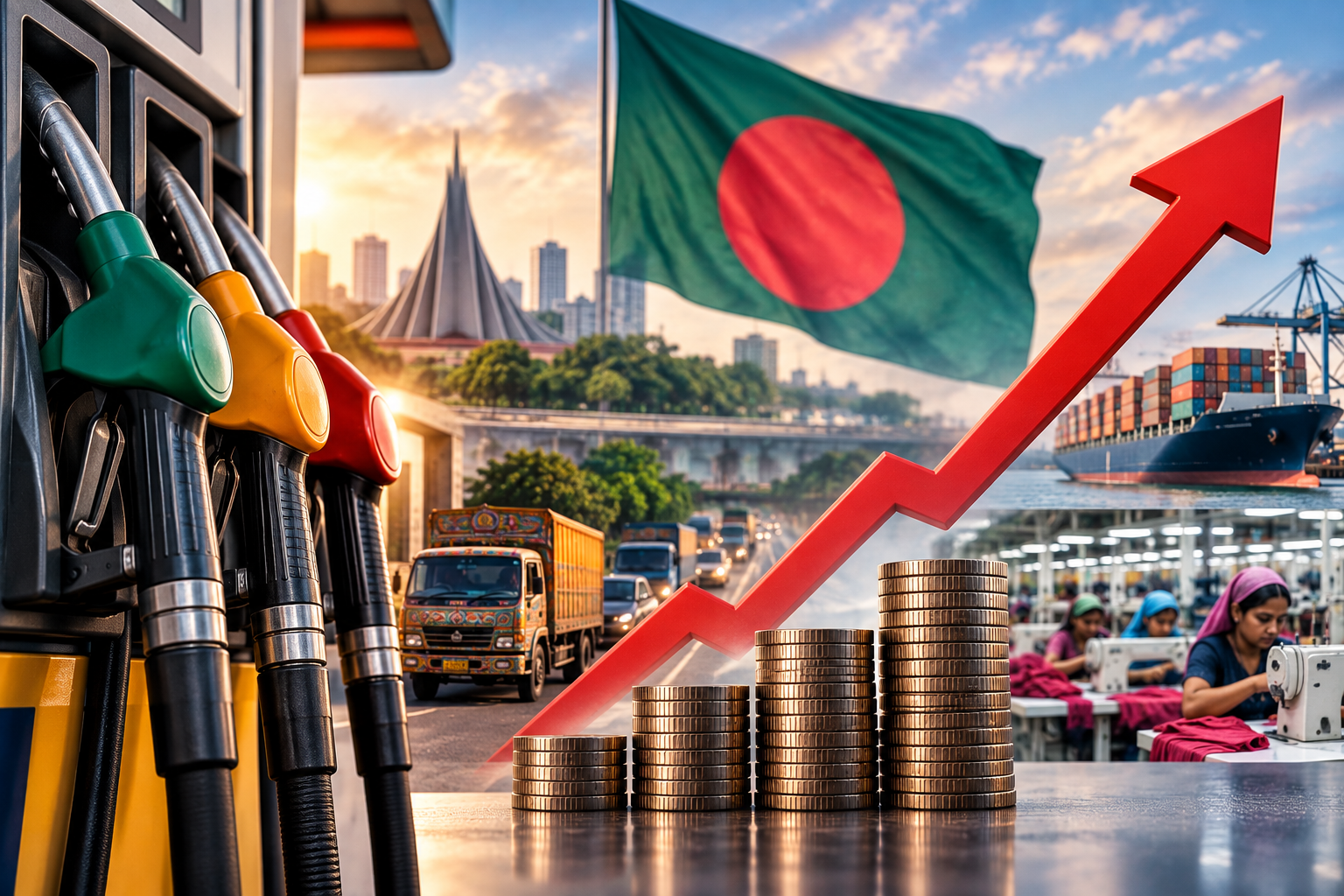
Diesel, petrol and octane prices rise sharply as Dhaka seeks to contain state fuel losses, protect foreign exchange reserves and manage rising import and freight costs
Bangladesh has raised domestic fuel prices by as much as 17.4 per cent, adding to cost pressures on households and businesses as the import-dependent economy faces a sharp increase in global oil prices and higher shipping expenses linked to regional instability.
The revised prices came into effect on Monday and are expected to increase transportation and production costs across the economy. The move comes at a time when Bangladesh is already dealing with power and gas shortages, while its important garment-export industry faces elevated energy-related operating costs.
The government said the latest adjustment was necessary as international fuel prices have more than doubled since March 2026 and freight costs have also increased substantially.
Diesel Price Rises 17.4%
Diesel recorded the steepest increase under the latest pricing revision.
The price of diesel has increased to 135 taka per litre from 115 taka, representing a rise of 20 taka or around 17.4 per cent.
Other petroleum products have also become more expensive. Octane prices have increased to 165 taka per litre from 145 taka, while petrol has risen to 160 taka from 140 taka.
Kerosene prices have been raised to 155 taka per litre from 135 taka.
The increases are expected to have a broad impact because diesel is widely used in transportation, agriculture, industrial equipment and backup power generation.
Fuel Prices Have Been Raised Multiple Times
The latest increase follows earlier fuel-price revisions in April and June.
The government has been adjusting domestic prices as international crude and refined-product prices have increased, raising the cost of importing fuel into Bangladesh.
The repeated price increases underline the difficulty faced by the government in maintaining subsidised fuel prices while simultaneously managing pressure on the country's finances and foreign-exchange reserves.
Bangladesh Petroleum Corporation Reports Heavy Losses
Bangladesh Petroleum Corporation (BPC), the state-owned fuel importer and distributor, has incurred substantial losses as international fuel costs have increased.
According to the Energy Ministry, BPC recorded losses of 228.76 billion taka, equivalent to around $1.9 billion, between March and August.
The government estimates that the latest fuel-price increase could reduce annual BPC losses by approximately 100 billion taka.
Reducing these losses is one of the key reasons behind the latest adjustment.
Government Seeks to Protect Foreign Exchange Reserves
Higher fuel import costs also place pressure on Bangladesh's foreign-exchange position.
Because the country depends heavily on imported energy, an increase in global oil prices means more foreign currency is required to purchase the same volume of fuel.
The government said the latest price adjustment would help conserve foreign exchange reserves by reducing the financial burden associated with fuel imports.
The move also reflects the broader challenge faced by import-dependent economies when international energy prices rise sharply.
Transportation Costs Likely to Increase
The immediate impact of higher diesel and petrol prices is expected to be felt in transportation.
Diesel is a major fuel for commercial vehicles, buses, trucks and other forms of freight transportation. Higher diesel costs can therefore increase the cost of moving goods between factories, ports, warehouses and retail markets.
Higher transportation costs can eventually feed into consumer prices as businesses attempt to pass a portion of their increased operating expenses to customers.
For an economy already facing inflationary pressure, the fuel-price increase could therefore create additional cost pressures across multiple sectors.
Manufacturing Sector Faces Higher Input Costs
Industries are also likely to face higher production costs.
Factories that use diesel-powered equipment or generators will see their fuel expenses rise. Businesses also face indirect costs through higher transportation and logistics expenses.
The impact could be particularly significant for energy-intensive industries and businesses operating in areas affected by power shortages.
Companies may therefore need to reassess production costs, pricing strategies and operating margins following the latest fuel-price adjustment.
Garment Industry Faces Additional Pressure
Bangladesh's garment sector is particularly important to the country's export economy and is already facing an energy crunch.
Higher diesel prices could increase the cost of transportation and backup power generation for factories.
The sector also operates within a highly competitive international market, which can make it difficult for manufacturers to immediately pass all additional costs on to overseas buyers.
Higher energy and logistics expenses could therefore put additional pressure on the margins of garment exporters.
Regional Energy Crisis Adds to the Challenge
The latest price increase comes against a backdrop of heightened regional energy-market uncertainty.
The government has cited higher shipping costs linked to instability in the West Asia region as another factor contributing to increased fuel-import expenses.
Higher freight costs can raise the delivered cost of petroleum products even when the underlying crude price is unchanged.
For an import-dependent economy, the combination of higher commodity prices and more expensive transportation can significantly increase the overall energy-import bill.
Government Also Highlights Fuel Smuggling
The government said the pricing adjustment could help reduce fuel smuggling to neighbouring countries where petroleum products are more expensive.
Large differences between domestic and neighbouring-country fuel prices can create incentives for illegal cross-border movement of petroleum products.
By bringing domestic prices closer to prevailing regional economics, authorities expect the incentive for such activity to decline.
Reducing smuggling could also help ensure that subsidised or lower-priced fuel remains available for domestic consumption.
LPG Subsidies Add to Energy-Sector Pressure
The government has also pointed to substantial subsidies for liquefied natural gas as part of the broader energy challenge.
Bangladesh has continued supporting electricity and gas supplies despite higher import costs resulting from the regional energy crisis.
Maintaining energy subsidies can protect consumers and industries from the full impact of global price movements, but it can also increase pressure on government finances when international prices remain elevated.
The latest fuel-price revision reflects an attempt to reduce part of this financial burden.
Inflation Risks Increase
Higher fuel prices can have a multiplier effect on an economy.
The direct impact comes through more expensive petrol, diesel and kerosene. The indirect impact can spread through transportation, logistics, manufacturing, agriculture and retail prices.
Businesses that face higher fuel costs may attempt to pass those expenses on to consumers, potentially increasing inflation.
The magnitude of the eventual inflationary impact will depend on global oil prices, the duration of the energy shock, domestic demand and the extent to which businesses absorb or pass through higher costs.
Foreign Exchange and Energy Security Remain Key Concerns
Bangladesh's dependence on imported energy makes global commodity prices an important macroeconomic variable.
When crude and refined-product prices rise, the country's import bill increases, putting pressure on foreign-exchange reserves and the domestic currency.
Higher import costs can also affect the government's ability to maintain subsidies and finance other public expenditure.
The latest fuel-price increase therefore has implications beyond the energy sector and forms part of a broader effort to manage external-sector pressures.
Impact on Businesses Could Vary
The effect of the fuel-price increase will not be uniform across the economy.
Transport operators, logistics companies and energy-intensive manufacturers are likely to face a more direct impact. Businesses with lower fuel intensity or stronger pricing power may be better positioned to absorb the increase.
Export-oriented industries face an additional challenge because they operate in global markets where raising prices may reduce competitiveness.
The garment sector, one of Bangladesh's major export industries, will therefore remain an important area to monitor.
Global Oil Prices Remain the Biggest Variable
The sustainability of the government's latest pricing decision will ultimately depend partly on the direction of international energy prices.
If global oil prices remain elevated, Bangladesh could face continued pressure on fuel-import costs even after the latest domestic adjustment.
A sustained decline in crude prices, on the other hand, could reduce the government's import burden and potentially ease pressure on domestic fuel pricing and inflation.
Freight costs and regional shipping conditions will also remain important variables.
What Investors and Businesses Should Watch
The latest fuel-price increase creates several areas that businesses and investors will need to monitor:
-
Global crude-oil prices
-
International refined-fuel prices
-
Bangladesh's foreign-exchange reserves
-
BPC's financial position
-
Domestic inflation
-
Freight and shipping costs
-
Electricity and gas availability
-
Garment-sector operating costs
-
Currency movements
-
Government subsidy expenditure
The interaction between these factors will determine how long the current cost pressures persist.
Market Outlook
Bangladesh's decision to raise fuel prices by up to 17.4 per cent highlights the growing economic impact of higher global energy and shipping costs. Diesel, the most widely used fuel for transportation and several industrial activities, has risen to 135 taka per litre from 115 taka.
The government expects the move to reduce Bangladesh Petroleum Corporation's losses by around 100 billion taka annually while helping conserve foreign exchange and curb fuel smuggling.
For the broader economy, however, higher fuel prices could increase transportation, manufacturing and logistics costs and add to inflationary pressure. The impact on exporters, particularly energy-intensive industries such as garments, will depend on their ability to manage higher operating expenses without losing competitiveness.
The next phase of the energy situation will therefore depend heavily on global crude prices, regional shipping conditions, domestic energy supply and Bangladesh's foreign-exchange position. A prolonged period of elevated oil prices could keep pressure on both businesses and consumers, while a meaningful easing in global energy prices could provide some relief to the import-dependent economy.