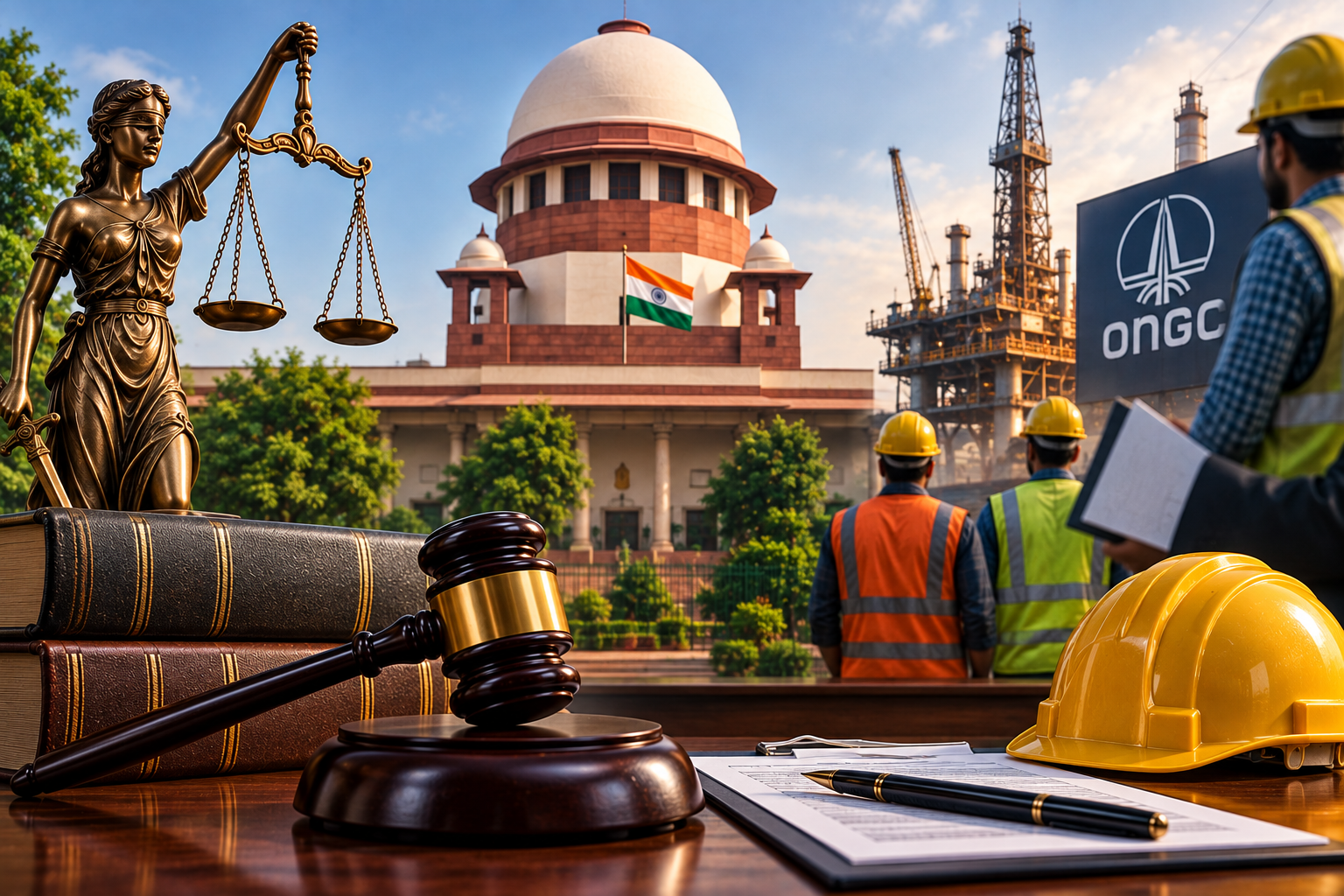
SC sets aside Bombay High Court order against ONGC, says Controlling Authority cannot determine gratuity liability where no employer-employee relationship exists
The Supreme Court has ruled that a principal employer cannot automatically be held responsible for paying gratuity to workers engaged through a contractor when there is no direct employer-employee relationship between the principal employer and those workers.
A bench of Justices Ahsanuddin Amanullah and Manmohan set aside a Bombay High Court order that had held Oil and Natural Gas Corporation (ONGC) liable for gratuity payable to workers engaged through a contractor. The Supreme Court restored the order of the Appellate Authority, which had earlier ruled in favour of ONGC.
The judgment clarifies the limits of the Controlling Authority's powers under the Payment of Gratuity Act and distinguishes between a principal employer and the actual employer of contractual workers.
Dispute Involved Contract Workers Engaged by ONGC
The case arose from a gratuity dispute involving workers who had been engaged through a contractor for work connected with ONGC.
The Controlling Authority under the Payment of Gratuity Act had initially held ONGC liable for the gratuity claimed by the workers.
ONGC challenged the decision before the Appellate Authority, which reversed the Controlling Authority's order and ruled in favour of the public sector energy company.
The workers subsequently approached the Bombay High Court. The High Court restored the Controlling Authority's decision and held ONGC liable for the gratuity.
ONGC then challenged the Bombay High Court's decision before the Supreme Court.
Supreme Court Examines Powers of Controlling Authority
A central issue before the Supreme Court was whether the Controlling Authority under the Payment of Gratuity Act had the jurisdiction to determine who was legally responsible for paying gratuity.
The Supreme Court held that the authority's statutory role was limited to determining and computing the amount of gratuity payable to an employee.
According to the court, determining liability and fastening that liability on a particular entity went beyond the authority's jurisdiction in the circumstances of the case.
The proceedings before the Controlling Authority were therefore held to be unsustainable to the extent that they sought to establish ONGC's liability.
Employer-Employee Relationship Was Central
The Supreme Court's decision turned significantly on the absence of an employer-employee relationship between ONGC and the contractual workers.
The workers were engaged through a contractor rather than directly by ONGC. Therefore, the court examined whether ONGC could nevertheless be treated as their employer for the purpose of gratuity.
The court accepted ONGC's position that Section 4 of the Payment of Gratuity Act deals with gratuity payable to an eligible employee and that the workers in question were not employees of ONGC.
The distinction between direct employees and contract labour was therefore critical to the outcome.
ONGC Relied on Contractual Arrangement
Solicitor General Tushar Mehta, appearing for ONGC, argued that the contractual arrangement between ONGC and the contractor did not establish an employer-employee relationship between the public sector company and the workers.
ONGC also relied on the terms of its agreement with the contractor, which described the arrangement as a job contract.
According to ONGC's submissions, the contractor was responsible for engaging the workers and the contractual arrangement did not transfer the workers into the direct employment of ONGC.
The Supreme Court accepted these submissions in deciding the appeals.
Contract Labour Law Also Considered
ONGC also relied on Section 21(4) of the Contract Labour (Regulation and Abolition) Act, 1970.
The provision was cited in the context of the principal employer's responsibilities towards contract labour.
ONGC argued that the statutory obligations of a principal employer in relation to contract labour, including obligations concerning payment of wages in specified circumstances, should not automatically be interpreted as creating gratuity liability for workers who are not its employees.
The Supreme Court accepted the distinction between the obligations of a principal employer under contract-labour legislation and the liability to pay gratuity as an employer under the Payment of Gratuity Act.
Contractor's Position Also Examined
The contractor, on the other hand, argued that the gratuity liability did not rest with it and that the amount would ultimately have to be borne by the principal employer.
This created a dispute over which entity was legally responsible for the gratuity.
However, the Supreme Court focused on the statutory jurisdiction of the Controlling Authority and the actual employment relationship between the workers and ONGC.
The court held that the authority could not use gratuity proceedings to determine and impose liability on ONGC where the necessary employer-employee relationship had not been established.
Supreme Court Refers to Earlier Judgment
The Supreme Court also considered an earlier judgment in Municipal Council, Nandyal Municipality, Kurnool District, AP v K Jayaram & Ors (2025).
That judgment was cited for the proposition that a person engaged through a contractor cannot automatically claim an employer-employee relationship with the principal employer.
The latest ruling reinforces the importance of determining the actual legal employment relationship before fixing statutory employment-related liabilities.
Bombay High Court Order Set Aside
After considering the arguments, the Supreme Court concluded that the Appellate Authority had correctly interfered with the Controlling Authority's decision.
The court held that the Bombay High Court was not justified in reversing the Appellate Authority's order.
The Supreme Court consequently set aside the Bombay High Court's judgment and restored the order that had ruled in favour of ONGC.
The case was M/s Oil and Natural Gas Corporation Ltd v Suryakand D Lad & Ors, along with connected appeals.
Gratuity Had Already Been Paid
An important practical aspect of the case was that ONGC had already paid the gratuity amount claimed by the workers.
The Supreme Court took note of this fact and directed that no recovery should be made from the workers.
Therefore, while the court clarified the legal question concerning ONGC's liability, the workers were not required to return the gratuity amount that had already been paid to them.
What the Judgment Means for Principal Employers
The ruling provides clarity on the distinction between engaging workers through a contractor and directly employing those workers.
The judgment does not mean that principal employers have no responsibilities towards contract workers. Rather, it establishes that gratuity liability under the Payment of Gratuity Act cannot simply be imposed on a principal employer without establishing the statutory basis and relevant employment relationship.
For companies that regularly use contract labour, the ruling highlights the importance of clearly structured contracts and proper documentation identifying the respective responsibilities of the principal employer and contractor.
Implications for Contract Labour Arrangements
Large companies across sectors such as infrastructure, manufacturing, energy, logistics and construction frequently rely on contractors for specific services.
In such arrangements, the legal distinction between a company's own employees and workers engaged through an external contractor can become important when disputes arise over wages, gratuity and other employment benefits.
The Supreme Court's ruling could therefore become a relevant reference point in future disputes where a contractual worker seeks to impose gratuity liability directly on the principal employer.
At the same time, the specific facts and contractual arrangements of each case would remain important in determining the applicable legal obligations.
Compliance and Documentation Remain Important
For principal employers, the judgment highlights the importance of maintaining clear records relating to contractor arrangements.
Companies may need to ensure that agreements clearly define the scope of work, responsibilities of the contractor, deployment of workers and statutory obligations.
Contractors, meanwhile, remain responsible for complying with applicable labour laws in respect of workers employed by them.
The ruling underscores that the legal identity of the employer can become particularly important when statutory benefits are claimed.
Impact on ONGC
For ONGC, the Supreme Court ruling removes the gratuity liability that had been imposed on the company by the Bombay High Court in this particular dispute.
The decision also restores the earlier Appellate Authority finding in favour of ONGC.
The company's existing payment of gratuity to the workers, however, means the judgment's immediate financial impact is different from a situation where the company had not yet made any payment.
The larger significance for ONGC lies in the legal clarification surrounding its relationship with contractual workers.
Broader Corporate Relevance
The judgment is relevant beyond the specific ONGC dispute because contract labour is widely used by companies across India's industrial and services sectors.
Businesses often outsource specialised, support or project-based activities to contractors. Such arrangements can create complex questions about responsibility for statutory benefits when workers have a long association with the principal employer's premises or operations.
The Supreme Court's ruling reinforces the need to distinguish between operational supervision and the existence of a legally recognised employer-employee relationship.
Key Takeaways
The Supreme Court's ruling establishes several important points:
-
A principal employer cannot automatically be made liable for gratuity payable to contractual workers.
-
The existence of an employer-employee relationship is critical when determining gratuity liability.
-
The Controlling Authority's statutory role is to determine and compute gratuity payable to an employee; it cannot, in the circumstances of this case, independently fasten liability on a principal employer.
-
Contractual arrangements between a company and contractor can be relevant in determining the employment relationship.
-
The Supreme Court restored the Appellate Authority's decision in favour of ONGC.
-
ONGC had already paid the gratuity claimed, and the court directed that no recovery be made from the workers.
Market Outlook
The Supreme Court's ruling is primarily a legal and corporate-governance development rather than a direct earnings catalyst for ONGC. The immediate market impact is therefore likely to depend more on broader developments affecting the company, including crude-oil prices, production levels, refining and exploration activity, government policy and the overall energy-market environment.
For companies that rely extensively on contract labour, however, the judgment is an important legal reference. It reinforces the need to clearly establish contractual relationships and understand the statutory responsibilities of principal employers and contractors.
For investors, the key takeaway is that the ruling removes the specific gratuity liability imposed on ONGC in this dispute while also providing greater clarity on the jurisdiction of the Controlling Authority and the importance of the employer-employee relationship under gratuity law.