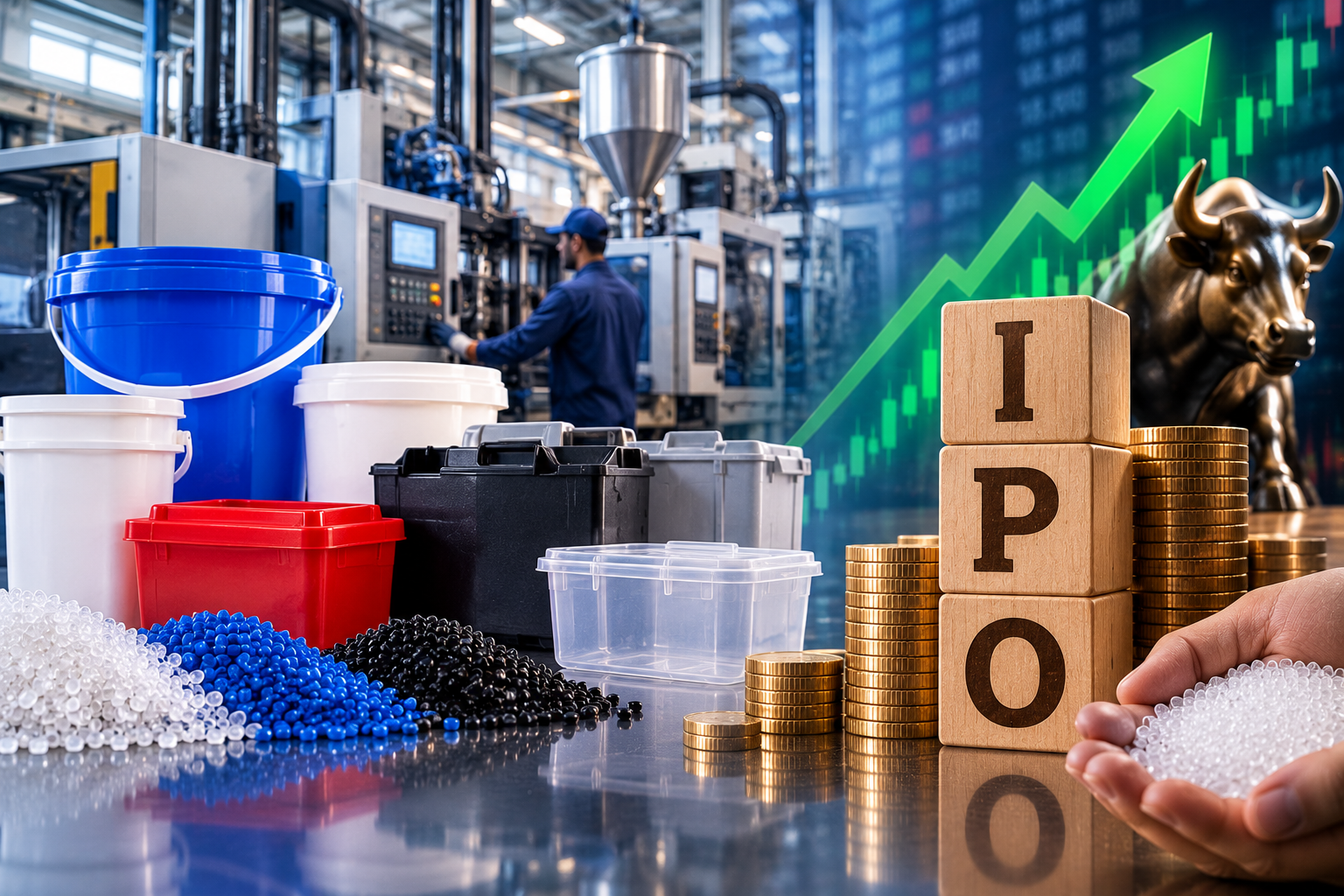
Packaging company makes a muted stock-market debut despite strong IPO subscription and improving operating performance
Shares of ManikaPlastech made a flat debut on the Indian stock exchanges on Monday, listing at ₹43 per share on both the BSE and NSE, in line with its issue price. The subdued debut came despite strong investor participation during the initial public offering, which was subscribed 28.14 times.
The company's IPO had attracted significant demand across investor categories, but the strong subscription did not translate into a premium listing. Ahead of the listing, the grey market premium (GMP) was reported at around ₹1, implying an indicative listing price of approximately ₹44 per share.
The stock's debut therefore remained largely in line with expectations reflected in the grey market.
IPO Receives Strong Investor Response
ManikaPlastech's initial public offering received bids for 60.18 crore shares against 2.14 crore shares on offer, resulting in an overall subscription of 28.14 times.
The IPO opened for subscription on September 11 and closed on September 16, 2026.
The strong subscription indicates substantial investor interest in the company's business and expansion plans, although the flat listing suggests that much of the near-term demand had already been reflected in the IPO pricing.
₹125.50 Crore IPO Structure
ManikaPlastech raised ₹125.50 crore through the IPO.
The issue comprised a fresh issue of 2.15 crore shares aggregating to ₹92.50 crore and an offer for sale of 76.74 lakh shares worth ₹33 crore.
The company had fixed the IPO price band at ₹40-43 per share, with ₹43 being the upper end of the price band and the final issue price.
The lot size was fixed at 348 shares, meaning investors applying at the upper price band required ₹14,964 for one lot.
Majority of Fresh Issue to Fund Capacity Expansion
A significant portion of the fresh issue proceeds will be used to expand the company's manufacturing capacity.
ManikaPlastech plans to invest ₹54.93 crore towards the purchase of plant and machinery.
The proposed expansion is expected to increase installed capacity to 38,000 tonnes per annum from the existing capacity of approximately 29,200 tonnes per annum.
The additional capacity could allow the company to cater to rising demand from industries that use rigid polymer packaging products.
Debt Repayment Also Part of IPO Utilisation
The company plans to allocate another ₹15 crore towards repayment or pre-payment, either partially or fully, of certain borrowings.
Reducing debt can help lower interest costs and strengthen the company's balance sheet, although the eventual impact will depend on the company's overall borrowing profile and future capital expenditure requirements.
The remaining IPO proceeds will be used for general corporate purposes.
What Does ManikaPlastech Manufacture?
ManikaPlastech operates in the rigid polymer packaging segment and manufactures products such as battery casings, pails and thinwall containers.
Its products are supplied to customers across several industries, including:
-
Automotive
-
Energy storage
-
Telecommunications
-
Paints
-
Lubricants
-
Agrochemicals
-
Construction chemicals
-
Food
-
Dairy
The diversified end-user base provides exposure to multiple industrial and consumer-linked markets rather than dependence on a single sector.
Seven Manufacturing Facilities
The company operates seven facilities, including six manufacturing units and one paint facility.
Its manufacturing facilities are located across Dehradun, Hosur, Panipat, Una and Dadra, while the paint facility is situated in Hosur.
Together, the facilities cover more than 51,000 square metres and have an installed production capacity of approximately 29,200 tonnes per annum.
The planned expansion to 38,000 tonnes per annum would represent a meaningful increase over the company's existing capacity.
Operating Performance Shows Improvement
One of the positives highlighted by market analysts is the improvement in ManikaPlastech's operating margins.
According to Shivani Nyati, Head of Wealth at Swastika Investmart, the company's EBITDA margin increased from 8.37 per cent in FY24 to 13.30 per cent in FY26.
The improvement indicates stronger operating profitability over the period, although investors will need to monitor whether the higher margin level can be sustained as the company expands capacity.
Margin performance will remain particularly important because polymer packaging businesses can be affected by fluctuations in raw-material prices, product mix and competitive pricing.
Long-Term Customer Relationships
Another factor highlighted by the brokerage is the company's relationship with its key customers.
The company's top 20 customers have an average relationship of more than 10 years, according to the analyst commentary provided in the report.
Long-standing customer relationships can provide greater revenue visibility and may indicate customer retention and established supplier relationships.
However, investors will still need to monitor customer concentration and the company's ability to diversify its revenue base as capacity expands.
Packaging Demand Linked to Multiple Industries
Rigid polymer packaging plays an important role across several industrial sectors.
Battery casings are relevant to the energy-storage ecosystem, while pails and containers are used by companies operating in paints, chemicals, lubricants, agriculture and other industries.
The company's exposure to multiple end-use segments could provide opportunities for volume growth as industrial production and consumption increase.
The expansion of India's manufacturing ecosystem could also create additional demand for specialised packaging products.
Capacity Expansion Could Drive Future Growth
The proposed increase in capacity from 29,200 tonnes to 38,000 tonnes per annum is one of the key factors investors will track following the listing.
For the expansion to translate into stronger financial performance, the company will need to achieve sufficient capacity utilisation and secure additional customer orders.
Higher production volumes can potentially improve operating leverage, but the benefits depend on demand, pricing and input costs.
The pace at which the new capacity is commissioned and utilised will therefore be an important post-listing milestone.
Raw Material Costs Remain an Important Variable
Like other polymer-product manufacturers, ManikaPlastech's profitability can be influenced by movements in raw-material prices.
Changes in polymer and petrochemical prices can affect production costs. The company's ability to pass higher costs through to customers can therefore have a direct impact on margins.
Investors will need to monitor gross margins, EBITDA margins and working-capital requirements as the company moves into its next phase of expansion.
Strong Subscription Does Not Guarantee Listing Gains
The flat debut also highlights an important feature of IPO investing: strong subscription numbers do not necessarily translate into listing gains.
The issue attracted bids equivalent to more than 28 times the shares offered, but the stock nevertheless listed at ₹43, exactly at its issue price.
Subscription data reflects demand during the IPO period, while the listing price is determined by actual market trading once the shares begin trading on the exchange.
The difference between the two can be influenced by market conditions, valuations, institutional demand, broader sentiment and the expectations already embedded in the issue price.
Analyst View on Post-Listing Trading
Shivani Nyati of Swastika Investmart said the flat debut was in line with the issue price and highlighted the company's improving operating performance and long-standing customer relationships.
She indicated that investors could monitor the stock after listing, while fresh investors could wait for greater price stability before taking a view.
Such comments represent the cited analyst's assessment and should be considered alongside the company's financial performance, valuation and broader market conditions.
Key IPO Details at a Glance
| Particular | Details |
|---|---|
| IPO size | ₹125.50 crore |
| Fresh issue | ₹92.50 crore |
| Offer for sale | ₹33 crore |
| Price band | ₹40-43 per share |
| Listing price | ₹43 |
| IPO subscription | 28.14 times |
| IPO opening date | September 11, 2026 |
| IPO closing date | September 16, 2026 |
| Lot size | 348 shares |
| Existing capacity | 29,200 tonnes per annum |
| Proposed capacity | 38,000 tonnes per annum |
| Fresh issue for machinery | ₹54.93 crore |
| Debt repayment | ₹15 crore |
| Business | Rigid polymer packaging |
What Investors Should Track After Listing
Following the flat debut, the focus will shift from IPO subscription data to the company's actual operating performance.
Key factors to monitor include capacity expansion, utilisation of the new manufacturing facilities, revenue growth, EBITDA margins, raw-material costs, working-capital requirements and debt levels.
The company's ability to convert the IPO-funded expansion into higher volumes and stronger cash generation will be particularly important for its post-listing performance.
Investors should also compare the company's valuation with listed peers in the packaging and polymer-products segment rather than assessing the stock solely on the basis of its IPO subscription multiple.
Market Outlook
ManikaPlastech's flat debut at ₹43 reflects a muted opening despite the IPO receiving bids for more than 28 times the shares offered. The listing was also broadly consistent with the limited premium indicated by the grey market before the debut.
The company's key growth opportunity lies in expanding production capacity from 29,200 tonnes to 38,000 tonnes per annum, supported by ₹54.93 crore of IPO proceeds earmarked for plant and machinery. Debt repayment of ₹15 crore could also help strengthen the balance sheet.
Going forward, investors will focus on whether the company can successfully commission the additional capacity, maintain the improvement in EBITDA margins and convert its long-standing customer relationships into sustained revenue growth.
The flat listing means the next phase of price discovery will depend more heavily on the company's earnings execution, valuation, capacity utilisation and broader market conditions rather than the IPO subscription figure alone.