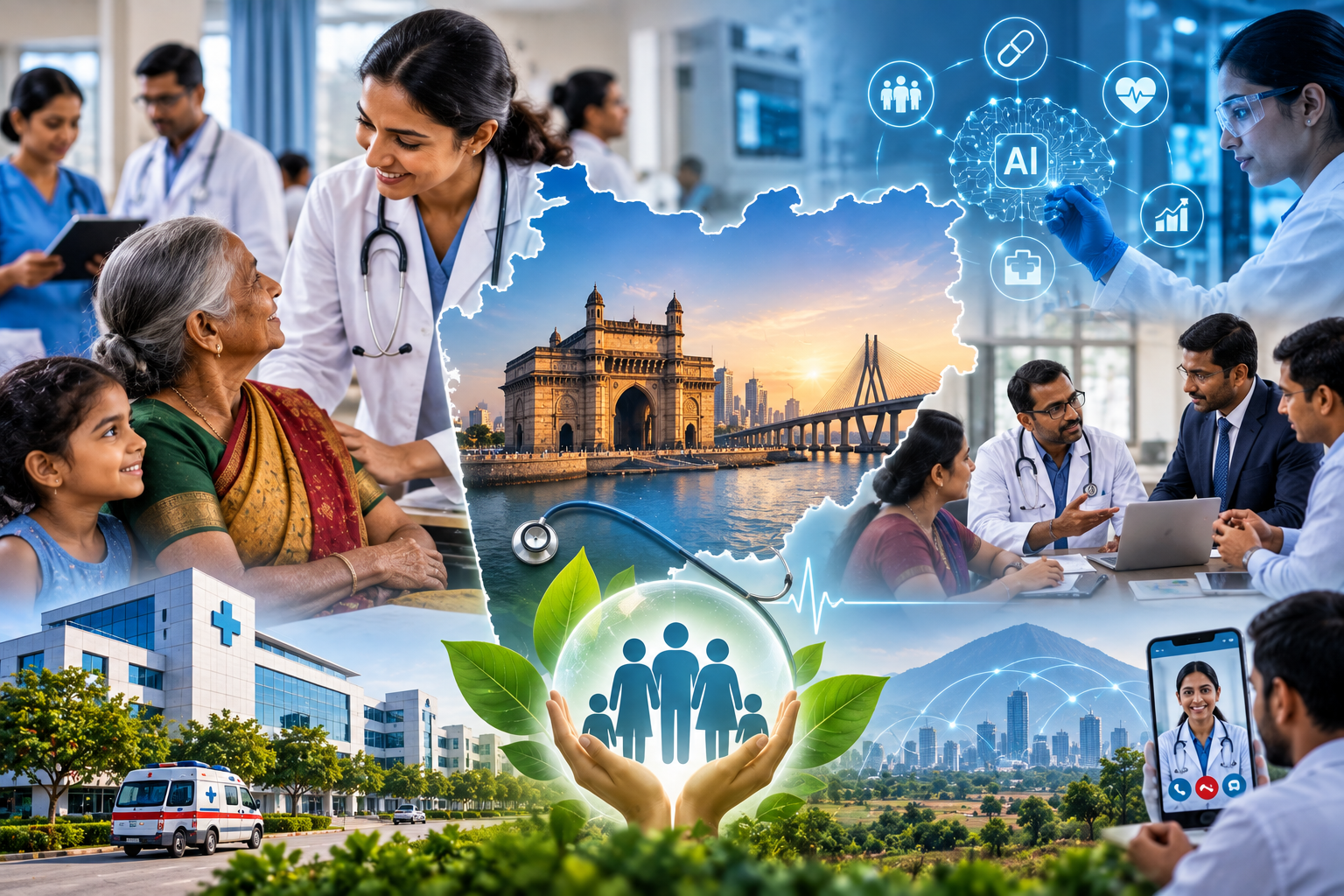
New Platform to Connect Government, Healthcare Providers, Innovators and Communities
Maharashtra is set to develop a new model for identifying, testing and scaling healthcare innovations through the Maharashtra Impact and Innovation Hub. The state-scale platform is being designed to bring together government agencies, healthcare providers, private-sector organisations, academic institutions, innovators and development partners around common public health priorities.
The initiative aims to strengthen the Government of Maharashtra’s “Health for All” mission by focusing on practical solutions that respond to the needs of local communities. Rather than developing innovations in isolation, the Hub will seek to connect community-level requirements with the capabilities of the wider healthcare ecosystem.
Focus on Local Health Priorities
The Maharashtra Impact and Innovation Hub will work towards identifying key health challenges faced by communities across the state. These priorities could include access to healthcare, affordability, quality of treatment, preventive care, early diagnosis and continuity of services.
By engaging communities in the development process, the platform is expected to encourage solutions that are more relevant to local conditions. The approach will also help stakeholders understand how new technologies and care models perform in real-world healthcare settings.
The Hub is expected to support the co-creation of solutions with communities, healthcare professionals and public health authorities. These solutions can then be tested within existing health systems before being considered for wider adoption.
Innovation and Technology at the Centre
The platform will explore the potential of emerging technologies such as Artificial Intelligence, digital health, data analytics and precision health. These technologies could support early disease detection, improved clinical decision-making, better patient monitoring and more efficient healthcare delivery.
Digital health tools may also help improve access to medical advice and services in areas where healthcare infrastructure or specialist availability remains limited. Data-driven systems could assist authorities in identifying gaps in healthcare delivery and allocating resources more effectively.
However, the adoption of technology will need to be supported by reliable infrastructure, data protection, trained personnel and clear standards for quality and accountability. The focus will remain on solutions that can be integrated into existing care pathways rather than creating parallel systems.
Connecting Public and Private Healthcare
One of the key opportunities for the Hub will be to connect the reach of the public healthcare system with the capabilities of private healthcare providers. Maharashtra has a diverse healthcare ecosystem that includes government hospitals, private hospitals, diagnostic centres, medical colleges, technology companies and community-based organisations.
Bringing these stakeholders onto a common platform could help improve coordination and encourage the development of solutions that are affordable, accessible and scalable. Private-sector participation may provide access to technology, specialised expertise, operational experience and investment, while government institutions can offer public health priorities, implementation networks and community reach.
The initiative is expected to complement existing government programmes by strengthening current systems and care pathways instead of replacing them.
Testing Solutions in Real-World Conditions
A major focus of the Hub will be to test new approaches within actual healthcare environments. Pilot projects can help stakeholders assess whether a solution is effective, affordable and practical before it is expanded across a larger population.
Testing in real-world conditions may also identify challenges related to patient behaviour, staff training, technology adoption, infrastructure and service delivery. Such evidence can help improve the design of health innovations and reduce the risks associated with large-scale implementation.
The model could provide a structured pathway for promising ideas to move from early development to pilot testing and, eventually, wider deployment.
Opportunities for Skills and Employment
As the initiative develops, it may create opportunities for local skilling, employment and enterprise development linked to community health needs. Demand could emerge for healthcare technology professionals, data specialists, community health workers, medical equipment technicians, digital health coordinators and trained support staff.
Local startups and small enterprises may also find opportunities to develop products and services related to diagnostics, telemedicine, healthcare logistics, patient management and preventive health.
Such opportunities could support the development of a broader health innovation ecosystem within Maharashtra while creating economic benefits alongside improvements in healthcare delivery.
Potential for Replication Across Maharashtra and Beyond
The Hub’s community-focused approach could provide a framework for addressing different healthcare challenges across urban, semi-urban and rural areas. Solutions developed for one region may be adapted for other districts if they demonstrate measurable benefits and can be implemented within available resources.
The model may also offer lessons for other states seeking to combine public health priorities with private-sector innovation and technology-led solutions. Replication, however, would depend on local infrastructure, funding, institutional coordination and the ability to maintain quality standards.
Implementation and Accountability Will Be Important
The success of the Maharashtra Impact and Innovation Hub will depend on clear governance, measurable outcomes and sustained collaboration among participating stakeholders. Projects will need to be evaluated not only for technological performance but also for affordability, accessibility, patient safety and long-term sustainability.
Transparent data practices and safeguards for patient privacy will be essential, particularly where AI and digital health systems are involved. Continuous monitoring can help ensure that innovations improve healthcare access and quality without increasing inequality or excluding communities with limited digital connectivity.
Market and Industry Implications
The initiative could create long-term opportunities for healthcare technology companies, diagnostic providers, medical device manufacturers, digital health platforms, research institutions and specialised service providers. Companies offering scalable and cost-effective solutions may find new avenues for partnerships with government and healthcare institutions.
Investors and industry participants will need to track the Hub’s implementation structure, pilot projects, funding arrangements, technology partnerships and measurable healthcare outcomes. The commercial potential will depend on the pace of adoption and the ability of participating organisations to demonstrate sustainable value.
Market Outlook
The Maharashtra Impact and Innovation Hub represents an effort to bring healthcare innovation closer to community needs while strengthening existing public health systems. Its emphasis on collaboration, real-world testing and scalable solutions could support improvements in healthcare access, quality and efficiency.
The initiative’s long-term significance will depend on execution, stakeholder coordination, responsible technology adoption and the ability to convert successful pilots into sustainable healthcare programmes. If these elements are developed effectively, the model could contribute to Maharashtra’s “Health for All” mission and offer a framework for health innovation in other parts of India.