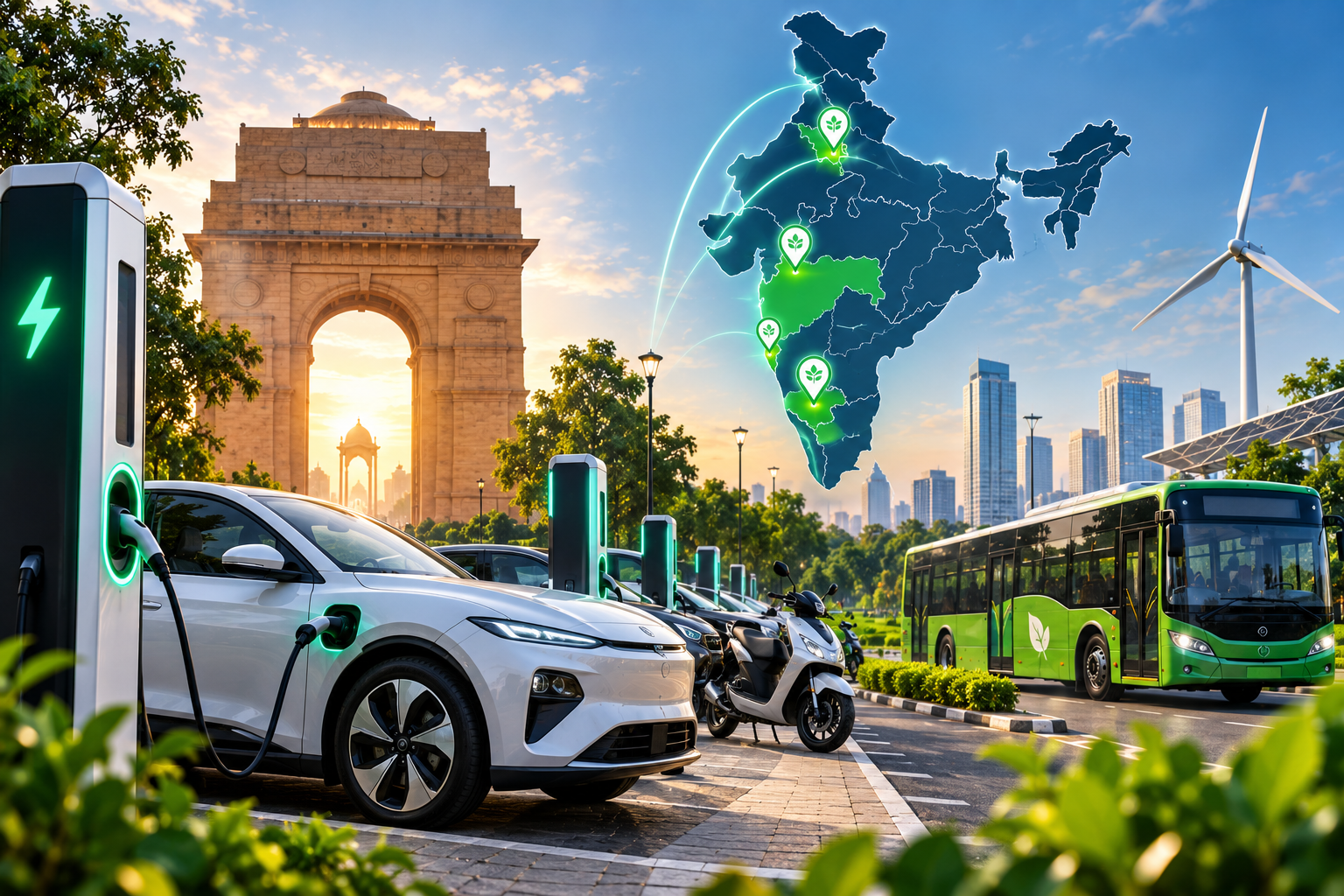
Delhi leads the India Electric Mobility Index with 84 points, while Maharashtra, Karnataka, Chandigarh and Goa occupy the next four positions as states step up efforts to expand EV adoption, charging infrastructure and clean-mobility innovation
Delhi Leads National Electric Mobility Rankings
Delhi has topped the India Electric Mobility Index 2025 released by NITI Aayog, scoring 84 points. Maharashtra ranked second with 78 points, followed by Karnataka with 73 points, Chandigarh with 71 points and Goa with 65 points.
The index evaluates the progress of states and Union Territories across key areas of electric mobility, including transport electrification, electric vehicle charging infrastructure, and research and innovation.
The findings highlight the differing stages of India’s electric mobility transition. While some states have made significant progress in EV adoption and public transport electrification, others have developed charging infrastructure faster than the growth in electric vehicle usage.
Overall Performance Improves
The 2025 edition of the index showed a broad improvement in electric mobility performance across India.
The median score of states and Union Territories increased to 40 in 2025 from 36 in 2024. During the same period, the highest score rose from 77 to 84.
Delhi, Maharashtra, Karnataka and Chandigarh retained their leading positions compared with the previous edition. However, the rankings of several other jurisdictions changed, reflecting differences in policy implementation, infrastructure development, industrial activity and consumer adoption.
Ladakh recorded the largest decline in ranking. Punjab, Mizoram, Chhattisgarh, Gujarat and Himachal Pradesh also witnessed a fall in their positions.
According to the report, the improvement in the median score indicates that electric mobility is gaining momentum across a wider group of states and Union Territories rather than remaining concentrated in a few leading markets.
Transport Electrification: Delhi Takes the Lead
Delhi emerged as the top performer in transport electrification progress, followed closely by Chandigarh and Maharashtra.
The transport electrification category considers the extent to which electric vehicles are being adopted across the transport system. This includes the growth of electric two-wheelers, three-wheelers, cars, buses and other forms of public and commercial transport.
Delhi’s performance reflects the importance of urban mobility demand, public transport networks and policy support in accelerating the shift towards electric vehicles.
Chandigarh and Maharashtra also recorded strong performance in this category. Maharashtra’s large automobile industry, urban centres and growing electric vehicle ecosystem provide a strong base for further adoption.
Karnataka Leads Charging Infrastructure Readiness
Karnataka topped the charging infrastructure readiness category, followed by Maharashtra and Haryana.
This category assesses the availability of charging facilities in relation to the number of electric vehicles. It also considers supporting factors such as state subsidies and the share of renewable energy used to generate electricity.
Charging infrastructure is an important factor in improving consumer confidence and reducing range anxiety. However, the report indicates that infrastructure development alone may not immediately translate into higher EV adoption.
The availability, location, reliability and affordability of chargers are equally important. Public charging stations need to be accessible in residential areas, commercial centres, highways, workplaces and transport hubs to support wider adoption.
Research and Innovation Remain Important Gaps
Maharashtra, Karnataka and Tamil Nadu were the leading performers in the research and innovation category.
This category examines factors such as the number of electric vehicle startups and intellectual property generation in the clean-mobility sector.
Research and innovation are critical for reducing the cost of electric vehicles, improving battery performance, developing charging technologies and strengthening domestic manufacturing capabilities.
The report noted that research and innovation continue to be a major gap in India’s electric mobility ecosystem. Greater cooperation between universities, startups, automobile manufacturers and government institutions may be required to build a stronger domestic technology base.
Infrastructure Does Not Always Translate Into Adoption
One of the key observations of the IEMI 2025 report was that charging infrastructure and EV adoption are not progressing at the same pace in every state.
Haryana provides an example of this gap. The state scored 91 in charging infrastructure readiness but only 19 in transport electrification progress, the lowest among large states.
The report suggested that the availability of charging facilities in Haryana had not yet translated into equivalent growth in electric vehicle adoption.
Several factors may explain this difference, including vehicle prices, consumer awareness, financing availability, operating costs, charging convenience, the availability of suitable vehicle models and the use of electric vehicles in commercial fleets.
The finding highlights the need for states to evaluate not only the number of charging stations installed but also their utilisation and contribution to actual EV adoption.
Focus Shifts From Policy Announcements to Implementation
The index noted that most states and Union Territories now have a basic electric vehicle policy framework. The next stage, however, will require greater emphasis on implementation and measurable outcomes.
State policies may include purchase incentives, road-tax benefits, registration support, charging subsidies, manufacturing incentives and fleet-electrification targets. The effectiveness of these measures depends on timely execution, clear guidelines and coordination among government departments, utilities, vehicle manufacturers and consumers.
States will also need to track practical indicators such as the number of electric vehicles registered, charger utilisation, public transport electrification, battery recycling and the share of renewable energy used for charging.
Public Transport Electrification Gains Importance
NITI Aayog Vice-Chairman Rajiv Gauba called on states to prioritise public transport electrification, expand charging infrastructure and promote research and innovation.
Public transport is a major area of focus because electric buses and other shared-mobility systems can reduce emissions while serving a large number of passengers.
Electrifying public transport also requires planning for depot charging, electricity supply, route scheduling, battery maintenance and financing. States and urban local bodies may need to coordinate with electricity distribution companies and transport operators to ensure that electric buses can operate reliably.
The transition may also create opportunities for manufacturers of electric buses, charging equipment, batteries, power-management systems and fleet-management software.
Different State Strategies Can Support Wider Progress
Gauba noted that states have experienced different outcomes because their electric mobility strategies are shaped by their industrial base, fiscal capacity and geography.
These differences may provide opportunities for states to learn from one another. Large industrial states may focus on vehicle and component manufacturing, while urban regions may prioritise public transport and charging networks. States with significant renewable-energy potential may focus on integrating clean power with charging infrastructure.
The report suggests that varied approaches need not be a weakness if states share successful practices and develop policies suited to their local requirements.
Implications for the Automobile and Energy Sectors
The improvement in electric mobility scores could have implications for several industries.
Automobile manufacturers may benefit from rising demand for electric two-wheelers, passenger vehicles, buses and commercial vehicles. Battery manufacturers, charging-network operators, power equipment suppliers and software providers may also see opportunities as the ecosystem expands.
The transition could increase demand for lithium-ion cells, battery-management systems, power electronics, charging connectors, renewable-energy integration and recycling services.
At the same time, the industry faces challenges related to battery costs, raw-material supply, charging reliability, vehicle financing, resale values and the development of recycling infrastructure.
Companies participating in the electric mobility value chain will need to demonstrate sustainable demand, cost competitiveness and the ability to scale operations.
Electric Mobility and India’s Broader Economic Goals
Electric mobility is linked to India’s objectives of reducing oil-import dependence, improving urban air quality, developing domestic manufacturing and creating new technology capabilities.
A stronger domestic EV ecosystem could support employment in vehicle assembly, battery manufacturing, software development, engineering, charging infrastructure and maintenance services.
However, the transition will require long-term investment and coordination across several sectors. Vehicle electrification alone will not deliver the intended benefits unless charging networks, electricity generation, grid capacity and recycling systems develop alongside it.
Market Outlook
The India Electric Mobility Index 2025 indicates that electric mobility performance is improving across states and Union Territories, although progress remains uneven across adoption, infrastructure and innovation.
Delhi’s leading position, Maharashtra’s strong overall performance and Karnataka’s charging infrastructure leadership underline the importance of coordinated policy and implementation. The gap between charging readiness and actual vehicle adoption in states such as Haryana also shows that infrastructure expansion must be supported by consumer demand, suitable vehicle availability and effective incentives.
For investors, the electric mobility theme may create long-term opportunities across automobile manufacturing, batteries, charging infrastructure, power equipment, renewable energy and mobility technology. However, company-level performance will depend on execution, capital requirements, competitive intensity, policy continuity and the pace of actual EV adoption.