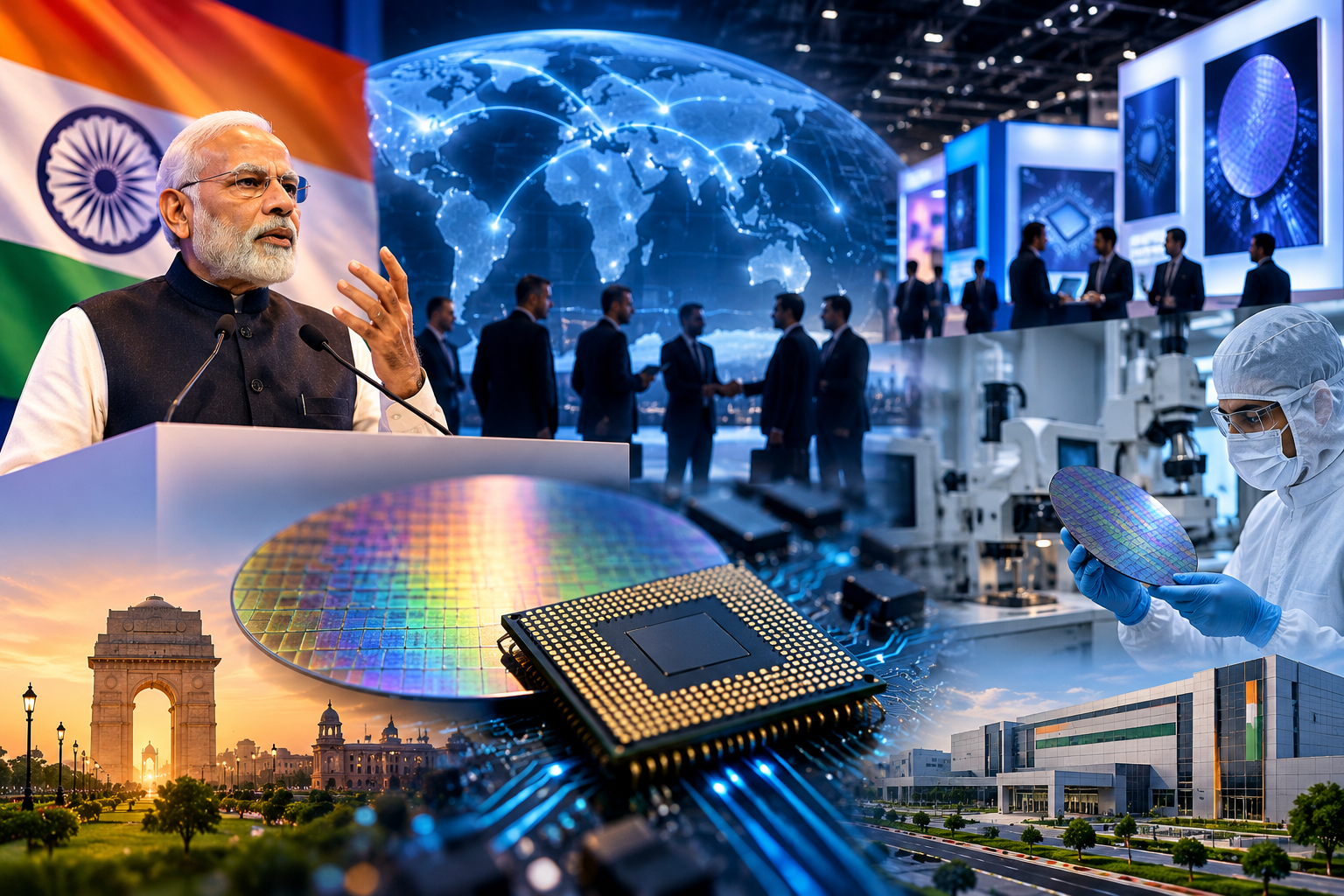
Three-day Semicon India 2026 event brings together more than 300 global companies, 600 exhibitors and 150 speakers as India seeks investment, technology partnerships and a larger role in the global semiconductor supply chain
India’s Semiconductor Ambition Takes Centre Stage
Prime Minister Narendra Modi will inaugurate the three-day Semicon India 2026 conference in New Delhi as the government intensifies efforts to attract global semiconductor manufacturers, equipment suppliers, technology companies and investors.
The event is expected to bring together more than 300 global companies, over 600 exhibitors and 150 speakers across a 15,000-square-metre convention centre. The conference will include startup showcases, technology demonstrations and a student hackathon, highlighting India’s ambition to build a semiconductor ecosystem that extends beyond chip assembly into design, manufacturing, packaging and advanced electronics.
The conference comes at a critical stage for India’s industrial strategy. The government is seeking to expand manufacturing, increase exports and create better-paying employment opportunities by moving workers from traditional sectors into higher-value industries such as electronics, semiconductors and advanced technology.
Government Pushes Investment and Production
India’s semiconductor strategy has received significant financial backing in recent years. The government has committed a further ₹1.9 trillion, or approximately $19.8 billion, in subsidies to support domestic chip and electronics production.
The earlier production-linked incentive programme helped accelerate electronics manufacturing in India and supported Apple’s expansion of iPhone production in the country. India now accounts for a significant share of the company’s global iPhone manufacturing, demonstrating how government incentives can attract large-scale global production.
The semiconductor programme was initially supported by a $10-billion funding initiative designed to encourage chip fabrication, assembly, testing, packaging and semiconductor-related research. The government is now attempting to build on that foundation by supporting companies across the entire value chain.
The policy focus includes financial assistance for semiconductor startups, incentives for manufacturing equipment, support for fabrication plants and assistance for outsourced semiconductor assembly and test facilities.
Tata, Murugappa and Micron Begin Building Capacity
Some of India’s early semiconductor investments are beginning to move from announcements to operational activity.
The Tata Group and Murugappa Group have started work in chip packaging and assembly, while US-based memory chipmaker Micron Technology has commenced production in India. Tata is also developing a semiconductor fabrication plant in Gujarat, which is expected to become operational in early 2028.
These projects are important because semiconductor manufacturing requires substantial capital, specialised infrastructure, reliable power and water supplies, advanced equipment and highly trained personnel. Establishing even one facility can take several years, while developing a complete ecosystem of suppliers and customers can take much longer.
The progress of these projects will be closely watched by global investors as they assess whether India can convert policy support into commercially viable semiconductor production.
AI Investment Drives Global Chip Competition
The semiconductor race has intensified as countries compete for leadership in artificial intelligence, cloud computing, data centres, electric vehicles, healthcare technology and financial services.
Artificial intelligence systems require large amounts of computing power, increasing demand for advanced processors, memory chips, networking equipment and specialised semiconductor components. As computing capacity remains limited in several parts of the world, access to reliable chip supplies has become a strategic economic and national-security priority.
Countries including Taiwan, South Korea, the United States and Malaysia have spent decades developing their semiconductor industries. Their established ecosystems include chip designers, foundries, equipment manufacturers, chemical suppliers, packaging companies and research institutions.
India’s challenge is to develop similar capabilities while competing with countries that already possess deep technical expertise, established supply chains and experienced semiconductor workforces.
From Legacy Chips to Advanced Semiconductors
India’s initial semiconductor push has focused largely on legacy chips used in automobiles, consumer electronics, industrial equipment, power systems and other applications.
These chips remain commercially important and are widely used across the economy. However, India will need to gradually move towards more advanced semiconductors, high-performance processors and sophisticated packaging technologies if it wants to capture a larger share of the global value chain.
Advanced packaging is becoming increasingly important because it allows multiple chips or chip components to be combined into more powerful and efficient systems. It can also help companies improve performance without relying exclusively on the most advanced fabrication processes.
Developing these capabilities will require sustained investment in research and development, semiconductor design education, intellectual property, testing infrastructure and cooperation between universities, startups and large industrial groups.
Opportunities for Indian Electronics and Manufacturing
A successful semiconductor ecosystem could create opportunities for a wide range of Indian industries.
Engineering companies may benefit from demand for specialised machinery, clean-room infrastructure, industrial automation and precision components. Chemical manufacturers could supply materials used in chip fabrication, while logistics providers, power companies and industrial developers may benefit from new manufacturing clusters.
The expansion of semiconductor production could also support domestic electronics manufacturing by reducing dependence on imported components. Over time, this may improve supply-chain resilience and help Indian companies participate more deeply in the production of smartphones, automobiles, renewable-energy systems, telecom equipment and industrial electronics.
However, the benefits will depend on the ability of Indian manufacturers to meet global quality standards, maintain cost competitiveness and secure long-term customers.
Key Challenges Before India
Despite strong policy support, India’s semiconductor ambitions face several structural challenges.
Chip manufacturing is capital-intensive and technically complex. Semiconductor plants require large upfront investments, stable utilities, highly controlled production environments and continuous technology upgrades. Any delay in construction, equipment installation or commercial production can increase costs significantly.
India also needs to expand its skilled workforce. Semiconductor design, fabrication, packaging and testing require specialised knowledge in electrical engineering, materials science, chemistry, physics and industrial operations.
Another challenge is the availability of a complete supplier network. A fabrication plant cannot operate in isolation. It needs access to specialty gases, chemicals, wafers, equipment maintenance, precision engineering, testing facilities and dependable logistics.
Global competition is also intense. Several countries are offering subsidies and tax incentives to attract the same manufacturers and technology partners. India will therefore need to maintain policy consistency and improve ease of doing business to retain investor confidence.
Investment and Policy Implications
The Semicon India 2026 conference is expected to serve as a platform for announcing partnerships, investment commitments and technology collaborations. Discussions are likely to focus on semiconductor fabrication, advanced packaging, chip design, electronics manufacturing, artificial intelligence infrastructure and supply-chain diversification.
For investors, the development of India’s semiconductor ecosystem could create long-term opportunities in capital goods, industrial automation, electronics manufacturing services, engineering, specialty chemicals, power infrastructure and technology.
At the same time, the sector remains exposed to execution risks, high capital expenditure, changing technology cycles and intense international competition. Companies connected to the semiconductor theme may experience strong market interest, but their valuations will depend on actual orders, project timelines, cash flows and commercial production rather than announcements alone.
Market Outlook
India’s semiconductor push is a long-term industrial development story rather than an immediate earnings cycle. The Semicon India 2026 conference may improve visibility around investments, partnerships and government support, but the commercial impact will depend on how quickly announced projects become operational.
In the near term, companies involved in electronics manufacturing, industrial equipment, engineering services, specialty chemicals and infrastructure may remain in focus as investors track new project announcements. Over the medium to long term, the successful development of chip fabrication, packaging and design capabilities could strengthen India’s position in global technology supply chains.
Investors should monitor project execution, government subsidy disbursements, customer agreements, capital expenditure requirements and the progress of advanced semiconductor facilities before drawing conclusions about individual companies or the broader investment theme.