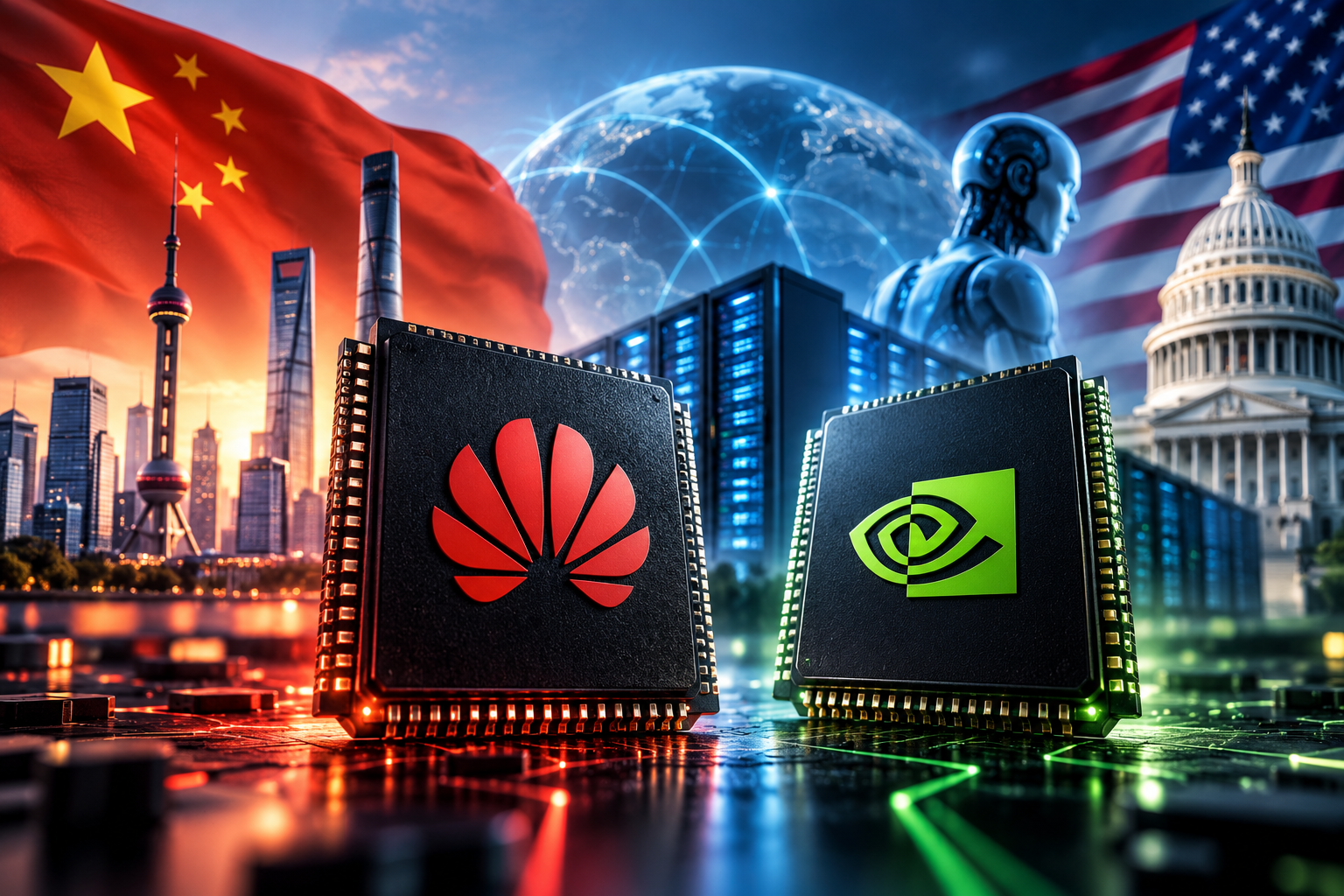
Ascend 960 Chips Expected in 2027 as Chinese Technology Giant Pushes for AI Hardware Self-Sufficiency
Huawei Technologies is set to unveil its next generation of artificial intelligence chips, intensifying its efforts to challenge Nvidia's dominance in China's AI hardware market. The Ascend 960 accelerators are expected to become commercially available in 2027, as the Chinese technology giant seeks to expand its computing capabilities despite years of US export restrictions.
The upcoming chip announcement comes at a time when demand for AI computing power is accelerating across China. Huawei is pursuing advances in chip architecture, networking and software optimisation to narrow the performance gap with Nvidia and establish a more competitive domestic AI technology ecosystem.
Ascend 960 to Lead Huawei's Next AI Chip Generation
Huawei's rotating chairman Wang Tao is scheduled to present the Ascend 960 AI chips at the company's annual summit in Shanghai on Thursday. Analysts will closely examine whether the new processors can deliver sufficient performance for training advanced AI models, a segment where Nvidia continues to maintain a strong position.
The Ascend 960 will succeed Huawei's Ascend 950 family of AI accelerators. The Ascend 950DT, an upgraded version of the current generation, features faster and higher-capacity memory designed for demanding AI inference workloads. Huawei has also announced plans for the Ascend 970, which is expected to arrive in 2028.
The company has outlined a three-year campaign to compete more directly with Nvidia. Huawei has said each successive chip generation will double the computing power of its predecessor, although actual performance will depend on memory bandwidth, software support and the ability to deploy multiple processors together.
Huawei Focuses on Architecture and Software Optimisation
Huawei's chairman of the supervisory board, Guo Ping, has said the company aims to ensure its Ascend chips can operate AI models in China and international markets. The company is seeking to overcome limitations in semiconductor manufacturing and access to advanced components through innovations in chip architecture.
One of its recently announced approaches is LogicFolding, a technique intended to improve chip technology without access to the most advanced manufacturing equipment. Huawei is also developing system-level solutions to combine multiple accelerators, enabling improvements in computing performance and data transmission.
Guo has compared Huawei's strategy with Apple's experience in processor development, highlighting architecture redesign and software optimisation as ways to improve user experience and performance. The broader objective is to reduce dependence on the most advanced Western semiconductor technology.
DeepSeek Plans Large-Scale Deployment of Huawei Chips
Huawei's Ascend processors are already gaining traction among Chinese AI companies. DeepSeek is planning to deploy at least 160,000 Ascend 950DT chips at a data centre in Inner Mongolia to operate its AI models.
The deployment reflects growing demand for domestically produced accelerators as Chinese AI developers seek alternatives to Nvidia's restricted products. However, domestic chips are not yet a complete replacement for Nvidia in all AI workloads. Chinese AI laboratories continue to rely substantially on Nvidia processors for training advanced models, while domestic accelerators are being used for inference and other computing requirements.
This distinction highlights the challenge facing China's semiconductor industry: developing chips that can support not only AI applications but also the training of increasingly complex models.
SuperPod Architecture Targets Nvidia's System-Level Advantage
Huawei is working on a SuperPod structure that will allow as many as 100,000 Ascend chips to be linked in a single cluster. The system uses the company's UnifiedBus networking protocol to improve communication and data transmission between processors.
The strategy is designed to compensate for performance limitations at the individual chip level by improving the efficiency of large-scale computing systems. Huawei believes its networking technology, packaging and software-hardware integration can narrow the gap with Nvidia's advanced AI platforms.
Morgan Stanley analyst Charlie Chan has highlighted the importance of system-level competitiveness, including multi-die design, advanced packaging, rack-scale architecture, optical networking and software-hardware co-optimisation.
US Export Restrictions Continue to Limit Production
Huawei's expansion into AI hardware comes amid restrictions on China's access to advanced semiconductor technology. The US export controls have limited the availability of cutting-edge AI processors and advanced memory products from major international suppliers.
Huawei has made progress in developing its own memory technology, with the Ascend 950 family using memory chips designed in-house. However, production details remain limited, and the company faces challenges in expanding manufacturing capacity to meet demand.
Nvidia's most advanced Blackwell processors are not directly available in China. Nevertheless, reports of restricted Nvidia chips entering the Chinese market through unofficial channels indicate the continuing demand for high-performance AI hardware.
AI Computing Market Could Reach $96 Billion by 2030
The expansion of China's AI chip industry is supported by expectations of strong growth in computing demand. Morgan Stanley estimates that the Chinese AI computing market could reach 646 billion yuan, or approximately $96 billion, by 2030.
Huawei has already raised the price of its Ascend 950DT chip by 60 per cent, citing tight component supply in communications with customers. The price increase reflects the pressure on domestic chipmakers to balance demand, manufacturing capacity and the availability of critical components.
For Huawei, increasing production capacity will be as important as improving chip performance. The company's ability to supply processors at scale could determine how quickly it can expand its market share among Chinese AI developers and data centres.
Huawei Explores Overseas AI Hardware Markets
Huawei is also exploring international markets, including Malaysia and Egypt, as it seeks to expand its AI hardware footprint beyond China. The company's overseas ambitions form part of a broader effort to promote Chinese technology platforms in global markets.
However, international expansion faces challenges, including competition from Nvidia, software compatibility, supply-chain constraints and the regulatory environment governing advanced computing technology. Huawei's success will depend on whether its AI ecosystem can offer competitive performance, availability and long-term support.
Market Outlook
Huawei's planned Ascend 960 launch marks another development in the global competition for AI computing infrastructure. The company is investing in chip architecture, networking and software optimisation to address limitations in individual processor performance and expand the use of domestic AI hardware.
For semiconductor and technology investors, the key developments to monitor will be the commercial availability of the Ascend 960, Huawei's manufacturing capacity, adoption by Chinese AI companies and the evolution of US export restrictions. Nvidia's position in China and the ability of domestic chipmakers to reduce dependence on Western technology will remain important factors shaping the global AI semiconductor industry.