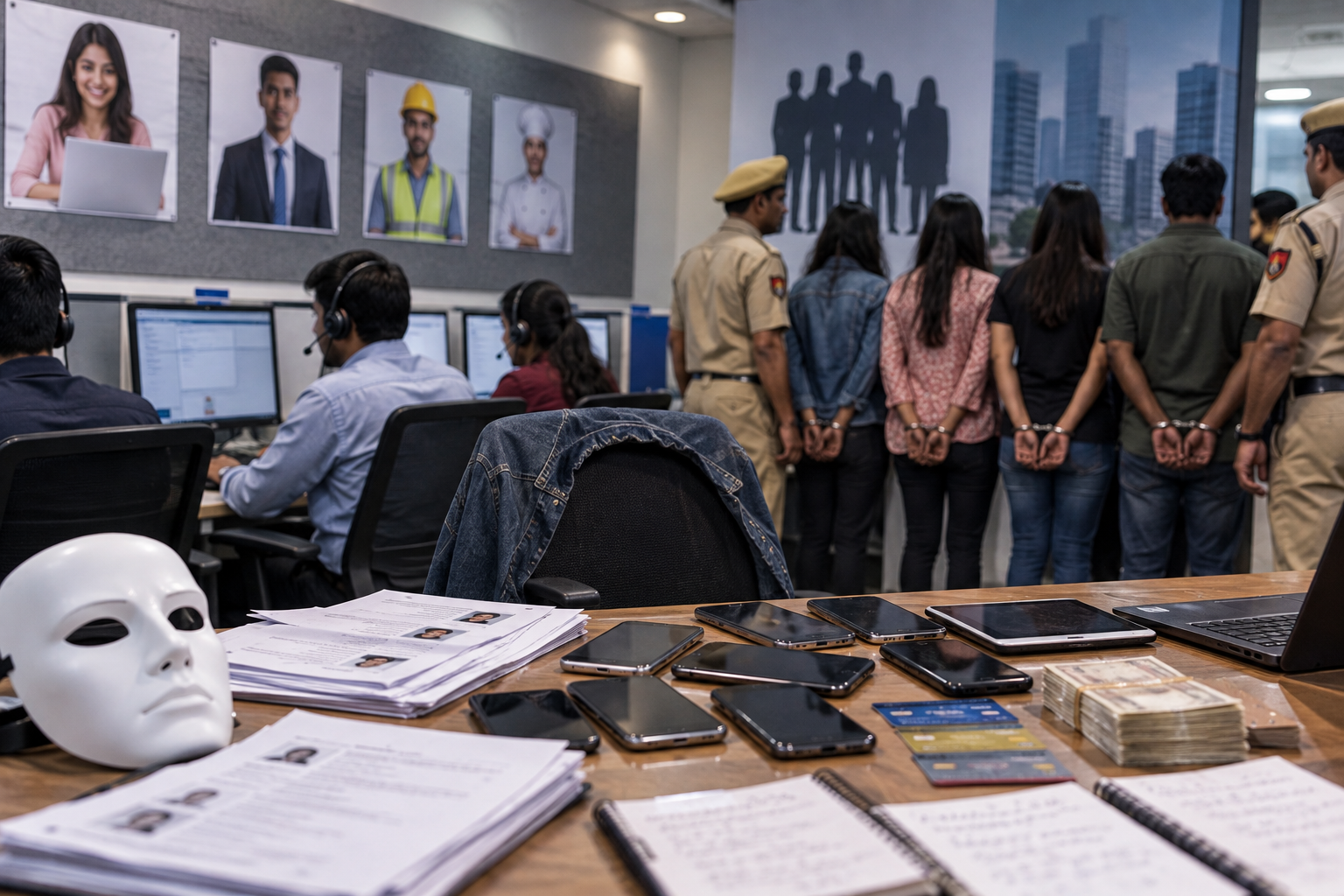
Accused Allegedly Used Fake Job Offers and Fabricated Charges to Collect Money from Candidates
The Delhi Police have arrested five people for allegedly running a fake recruitment racket that targeted job seekers with fraudulent employment offers at automobile and other related companies.
According to a report by news agency PTI, the accused allegedly obtained the details of job seekers through a recruitment platform and contacted them with offers for positions such as data entry operator, data analyst, web designer and accountant.
The candidates were allegedly asked to make successive payments under different recruitment-related charges. The total amount demanded from a candidate could reach ₹25,999.
The case highlights the growing threat of employment fraud, particularly for job seekers who are asked to pay money before receiving a confirmed appointment.
Fraudulent Call Centre Identified in Sangam Vihar
The alleged racket came to light on September 1, when Delhi Police received information about a suspected fraudulent call centre operating in the Sangam Vihar-Jharoda Majra area.
Following the information, police conducted a raid at the location and found three accused allegedly operating the setup and making calls to prospective job seekers.
Two other suspects were subsequently traced and arrested during the investigation.
The arrested individuals have been identified as:
-
Satish Chander Maurya, 30
-
Bindia alias Mahi, 20
-
Preeti alias Supriya, 22
-
Prachi alias Sweety, 19
-
Radhika alias Bhumi, 19
Police are investigating the alleged role of each accused and their possible connections with other people involved in the operation.
Candidates Were Offered Jobs at Different Companies
The accused allegedly contacted candidates whose information had been procured through a job-recruitment platform.
They reportedly offered employment opportunities at different companies, including positions related to data entry, data analysis, web designing and accounting.
The use of specific job profiles and company-related references may have helped the accused make the offers appear genuine. Candidates who had already applied for employment may have been more likely to trust calls that referred to their professional background or recruitment applications.
However, police allege that the recruitment process was only a pretext to collect money from the victims.
Multiple Charges Used to Extract Money
According to the police, the accused allegedly demanded money in stages by presenting different charges as mandatory requirements for completing the recruitment process.
The alleged payment demands included:
| Recruitment-related charge | Amount demanded |
|---|---|
| Courier charges | ₹499 |
| Uniform charges | ₹1,500 |
| Laptop security | ₹3,500 |
| Account opening | ₹5,500 |
| Medical security | ₹6,500 |
| Affidavit charges | ₹8,500 |
| Total | ₹25,999 |
The staged-payment method allegedly allowed the accused to collect smaller amounts initially before demanding larger sums at later stages.
Police said the accused allegedly blocked candidates who refused to make further payments.
Fake Joining Letters and QR Codes Recovered
During the raid and subsequent investigation, police recovered several items allegedly used to conduct the fraud.
The seized material included:
-
12 mobile phones
-
One tablet
-
Seven ATM and debit cards
-
Two bank passbooks
-
Three notepads containing mobile numbers
-
₹6,730 in cash
-
Fake joining letters
-
QR codes linked to different bank accounts
The police said the accused allegedly used QR codes connected to different bank accounts to receive payments from job seekers.
The recovery of fake joining letters and other recruitment-related material suggests that the accused allegedly created documents intended to make the fraudulent offers appear legitimate.
Police Investigate the Money Trail
The Delhi Police have launched further investigation to trace the money trail and identify other individuals who may have been associated with the alleged racket.
Investigators are expected to examine the bank accounts linked to the QR codes, transaction records, mobile phones and other digital evidence recovered from the premises.
The police are also working to ascertain the number of victims and the total amount allegedly collected from them.
The investigation may reveal whether the accused were operating only in Delhi or had links with similar recruitment fraud networks in other parts of the country.
Online Recruitment Platforms Become a Target for Fraudsters
Online recruitment platforms have made it easier for job seekers to search and apply for employment opportunities. However, the availability of personal details on such platforms can also be misused by fraudsters.
Criminals may use information such as a candidate’s name, qualification, previous employment and preferred job location to make unsolicited calls appear authentic.
Fraudsters often use the names of reputed companies, fake offer letters, fabricated interview schedules and official-looking communication to gain the trust of candidates.
Once contact is established, victims may be asked to pay for registration, document verification, training, equipment, medical tests or other invented requirements.
Upfront Payment Is a Major Warning Sign
A genuine employer generally does not require candidates to make repeated payments to secure a job.
Requests for money through personal bank accounts, QR codes, digital wallets or informal payment channels should be treated as a major warning sign.
Job seekers should independently verify the vacancy through the company’s official website and contact the organisation using verified contact details. They should not rely only on phone numbers or email addresses provided by an unknown recruiter.
Precautions for Job Seekers
Candidates can take the following precautions to protect themselves from recruitment fraud:
-
Verify job vacancies through the employer’s official website.
-
Confirm the recruiter’s email address and company details.
-
Avoid paying money for registration, interview scheduling or appointment confirmation.
-
Be cautious of offers that promise employment without a proper interview.
-
Check the authenticity of joining letters and employment documents.
-
Do not share OTPs, passwords, banking details or sensitive identity documents with unknown persons.
-
Preserve call records, messages, emails and payment receipts if a suspicious offer is received.
-
Report fraudulent payment requests to the police and cybercrime authorities.
Candidates who have already transferred money should immediately contact their bank or payment service provider and report the transaction to the appropriate cybercrime authorities.
Investigation Underway to Identify More Victims
The police are continuing their investigation into the alleged recruitment racket.
Authorities are examining the seized devices and financial documents to identify additional victims, trace the money collected and determine whether more people were involved.
The investigation will also focus on how the accused obtained the job seekers’ information and whether the data was sourced through any other individuals or platforms.
Market Outlook
The alleged Delhi recruitment racket highlights the increasing risks associated with online employment fraud and the misuse of job-seeker information.
The recovery of fake joining letters, mobile phones, bank documents and QR codes could help investigators establish the scale of the operation and trace the flow of funds. The number of victims and the total amount allegedly collected will become clearer as the investigation progresses.
For job seekers, the key lesson is to remain cautious about employment offers that require upfront or repeated payments. A genuine recruitment process should be independently verified, and any demand for money before appointment should be treated as a potential fraud warning.