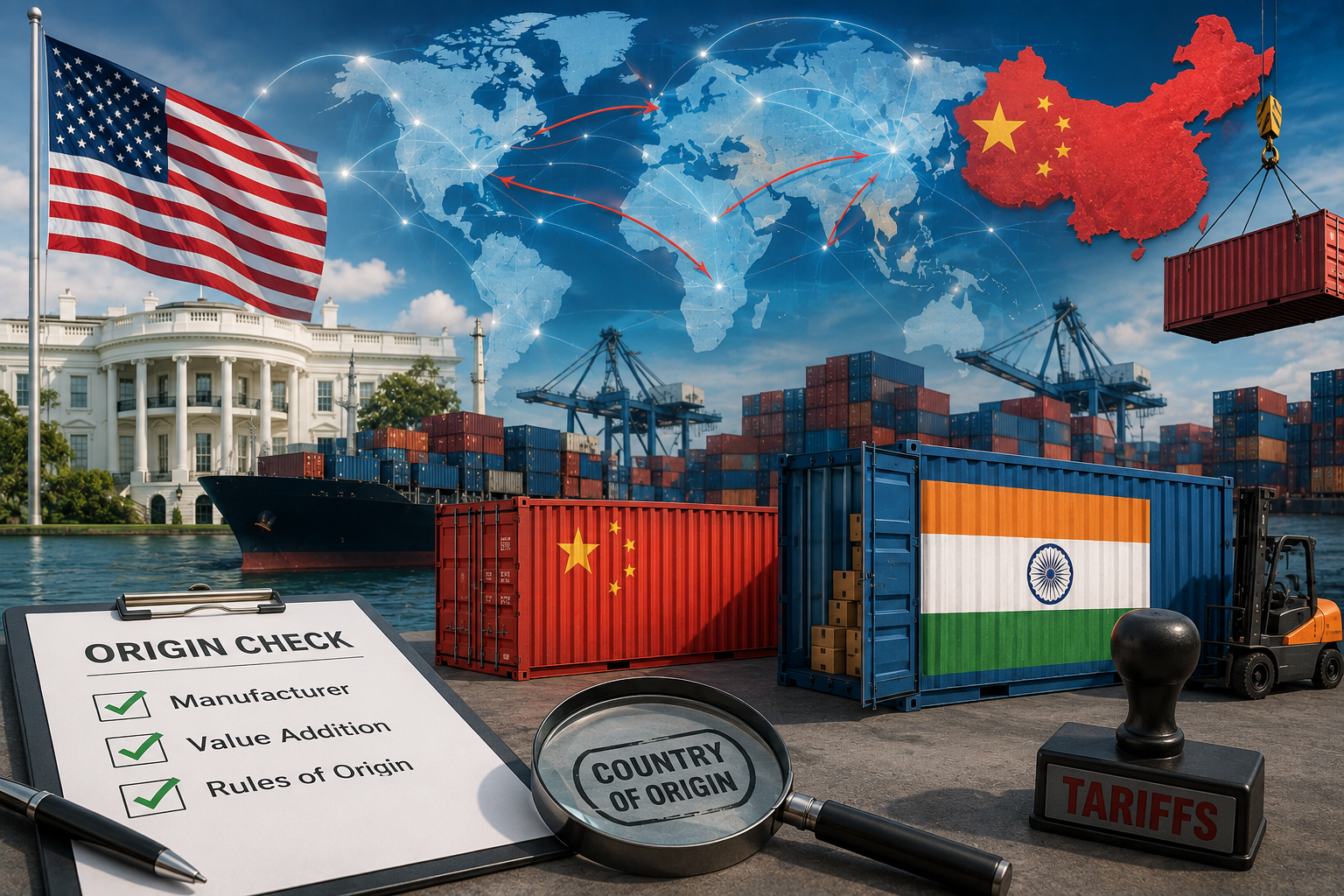
US Report Flags India Among 40-Plus Economies at Risk of Chinese Goods Being Rerouted to Avoid Tariffs; Tighter Origin Checks Could Raise Compliance Burden for Exporters
India has been placed in Tier 1 of a new White House classification of economies considered vulnerable to China-linked transshipment, a move that could result in greater scrutiny of Indian shipments entering the US market.
The development comes at a sensitive time for India-US trade relations, with the two countries working towards an interim reciprocal trade agreement. While the classification does not impose a new India-specific tariff or accuse the Indian government or Indian exporters as a whole of tariff evasion, it could lead to stricter customs checks and greater documentation requirements.
The White House report, titled “The Great Transshipment Scam”, identifies more than 40 economies that Washington considers part of a broader network through which Chinese goods may be rerouted to avoid higher US tariffs.
For Indian exporters, the focus is likely to shift increasingly towards rules of origin, domestic value addition and supply-chain transparency.
India Classified as a Tier 1 "Diversified Scale Leader"
India has been placed in the Tier 1 “Diversified Scale Leader” category alongside Canada, the European Union, Israel, Japan, Mexico, South Korea and Taiwan.
According to the report, Tier 1 economies have large and diversified manufacturing and trading bases. This makes it more difficult for US authorities to distinguish between legitimate supply-chain diversification and potential tariff evasion.
Importantly, the classification itself does not establish that India is engaged in systematic tariff evasion.
The report does not identify the Indian government or any specific Indian company as having carried out tariff evasion.
What Is China-Linked Transshipment?
Transshipment generally refers to goods moving through an intermediate country before reaching their final destination.
The practice is not inherently illegal.
The issue arises when Chinese goods are sent to another country, undergo insufficient processing and are subsequently declared as originating from that country when they do not meet the applicable rules of origin.
For example, Chinese components could be imported into India, subjected to limited assembly or processing and then exported to the US as Indian-origin products.
If the transformation does not satisfy US origin requirements, customs authorities could potentially consider the declaration inaccurate.
Why Has the US Increased Its Focus?
The White House report argues that transshipment risks became more prominent after the US imposed Section 301 tariffs on Chinese products in 2018.
The higher tariffs created an incentive for some manufacturers and traders to explore alternative supply chains.
Washington is now attempting to distinguish between two very different developments:
Genuine supply-chain diversification: Production is actually shifted from China to another country.
Tariff-driven rerouting: Chinese goods continue to be substantially produced in China but pass through another country primarily to obtain a different country-of-origin designation.
The distinction could become increasingly important for Indian manufacturers.
India, Mexico and Vietnam Identified as Major Hubs
The report identifies India, Mexico and Vietnam among the leading hubs for China-origin goods across the countries examined in 2025.
It estimates that around $67 billion of goods were transshipped through these three countries.
However, the report itself acknowledges that changes in bilateral trade patterns do not automatically prove tariff evasion.
For instance, a fall in China's direct exports to the US alongside rising exports from India could reflect genuine investment, production relocation or changes in sourcing.
This distinction will be important as US authorities increase scrutiny.
Pune-Gujarat-Chennai Manufacturing Belt Highlighted
The report identifies the Pune-Gujarat-Chennai production corridor as a representative area of potential transshipment exposure.
The reference relates to pumps and compressors under HS codes 8413-8414.
The three regions have significant industrial and manufacturing ecosystems, making them important parts of India's broader supply-chain network.
However, inclusion in the report does not imply that companies operating in these regions are involved in illegal activity.
Instead, it indicates that US authorities intend to pay closer attention to supply chains associated with these manufacturing corridors.
"Screwdriver Factories" Come Under US Lens
The report uses the term “screwdriver factories” to describe facilities where imported components undergo minimal assembly before being exported.
The US concern is that such operations may be established primarily to change the declared country of origin rather than represent meaningful manufacturing.
For Indian exporters, this could increase the importance of proving that manufacturing in India involves substantial transformation and genuine value addition.
Companies with significant domestic manufacturing, engineering, labour, sourcing and production capabilities should potentially be better positioned to demonstrate their Indian origin.
White House Estimates Billions in Potential Tariff Losses
The White House report estimates the annual value of potentially illegal transshipment at between $40 billion and $303 billion, depending on the methodology used.
Its central estimate places the figure at approximately $75 billion.
The report estimates associated tariff revenue losses at around $19 billion-$34 billion.
It separately estimates $19 billion-$26 billion in foregone federal revenue arising from the broader economic effects.
These are estimates rather than confirmed measurements of illegal activity.
The White House also acknowledges that trade shifts alone cannot establish that tariff evasion has occurred.
AI-Based Customs Screening Could Change the Game
One of the most significant developments is the US plan to make greater use of artificial intelligence in customs enforcement.
US Customs and Border Protection is developing an AI-based system known as “Detective Border”, which is expected to identify inconsistencies in shipment declarations.
The system could compare:
- Declared country of origin
- Shipping routes
- Component content
- Manufacturing capacity
- Container markings
- X-ray images
- Other customs and trade data
This could make it substantially harder for companies to rely on incomplete or inconsistent origin documentation.
Customs Scrutiny Could Become More Data-Driven
Traditionally, customs enforcement has relied heavily on documentation, inspections and risk-based screening.
AI-powered systems could allow US authorities to cross-reference much larger amounts of data.
For example, customs officials could potentially compare the volume of goods a factory claims to produce with its reported production capacity, imported components and export volumes.
This could help identify unusual patterns.
For legitimate exporters, however, the development also means that accurate and consistent data across the entire supply chain will become increasingly important.
Retrospective Tariff Risk Is a Concern
Another potential risk for exporters is the possibility of retrospective action.
US trade adviser Peter Navarro has warned that importers found to have falsely declared the origin of goods could face tariffs retrospectively, potentially covering shipments from roughly the previous year.
Such a development could create significant financial exposure.
An exporter that believes its product qualifies as Indian-origin but later faces a customs challenge could potentially encounter additional duties, penalties or disputes.
This makes origin verification an increasingly important part of export risk management.
India-US Trade Talks Could Become More Complicated
The White House report arrives as India and the US continue negotiations on an interim reciprocal trade agreement.
A framework announced earlier included commitments to establish rules of origin to ensure that trade benefits primarily accrue to India and the US.
The latest US assessment could result in greater emphasis on those provisions.
Indian exporters using Chinese components may be required to provide stronger evidence regarding the extent of manufacturing and value addition undertaken in India.
Rules of Origin Could Become a Major Issue
Rules of origin determine the country that qualifies as the source of a product for trade purposes.
Modern supply chains often involve multiple countries.
A product could contain Chinese components, undergo manufacturing in India and then be exported to the US.
The key question becomes whether the processing in India constitutes sufficient transformation under US rules.
If the rules become stricter, exporters may need to demonstrate:
- Domestic manufacturing content
- Labour and processing involved
- Local sourcing
- Transformation of imported components
- Production costs
- Factory capacity
- Supply-chain records
No New India-Specific Tariff for Now
For Indian investors and exporters, one distinction is particularly important.
The Tier 1 classification does not itself impose a new India-specific tariff.
The development primarily signals increased scrutiny and potential enforcement action.
Therefore, investors should not interpret the report as an immediate increase in tariffs on all Indian goods entering the US.
The impact will depend on how US customs authorities implement the new screening framework and how future India-US trade negotiations address rules of origin.
Which Indian Industries Could Be Affected?
The impact is likely to vary substantially by sector.
Industries with complicated international supply chains could face greater scrutiny, including:
Electronics
Products often contain components sourced from multiple Asian countries.
Engineering Goods
Machinery and industrial equipment can involve globally sourced components.
Auto Components
Manufacturers may rely on imported electronic and mechanical parts.
Electrical Equipment
Transformers, motors, pumps and related equipment can have complex supply chains.
Renewable-Energy Equipment
Solar and electrical components remain particularly exposed to global sourcing issues.
Consumer Goods
Products involving imported components and final assembly could attract additional origin scrutiny.
Exporters With Genuine Manufacturing Could Benefit
The development is not necessarily negative for all Indian companies.
In fact, it could strengthen the competitive position of businesses with genuine manufacturing operations in India.
If US companies increasingly seek to reduce dependence on China, they could shift more production towards Indian manufacturers that can demonstrate:
- Significant domestic value addition
- Large-scale manufacturing
- Strong quality standards
- Reliable supply chains
- Transparent origin documentation
- Long-term production capacity
This could create opportunities for Indian companies positioned to benefit from the China-plus-one strategy.
India Could Attract More Manufacturing Investment
The US crackdown could potentially accelerate supply-chain diversification.
Global companies are already looking to reduce concentration in China.
If US customs authorities increasingly examine the origin of components rather than only the final shipping country, multinational companies may have greater incentives to build genuine manufacturing ecosystems outside China.
India could benefit if it can provide competitive costs, skilled labour, infrastructure and reliable trade access.
However, simply shifting final assembly to India may no longer be enough.
Higher Value Addition Could Become Necessary
The new environment could encourage Indian manufacturers to move further up the value chain.
Instead of importing most components and performing limited assembly, companies may increasingly need to manufacture more components domestically.
This could encourage investment in:
- Component manufacturing
- Electronics ecosystems
- Industrial machinery
- Engineering
- Tooling
- Chemicals
- Auto components
- Research and development
In the long term, this could strengthen India's manufacturing capabilities.
Exporters Could Face Higher Compliance Costs
Even companies engaged in legitimate trade may face additional expenses.
They may need to strengthen:
- Customs compliance
- Supply-chain documentation
- Supplier audits
- Origin verification
- Trade advisory systems
- Digital traceability
- Internal controls
Large companies may be able to absorb these costs more easily.
Smaller exporters could face greater pressure on margins.
Small and Medium Exporters Need to Be Particularly Careful
For smaller Indian exporters, documentation gaps could become a significant risk.
A company may legally import Chinese components and manufacture products in India, but it must still demonstrate that its final product satisfies the relevant rules of origin.
Incomplete invoices, inconsistent supplier information or unclear production records could potentially trigger additional questions from customs authorities.
This means trade compliance could become an increasingly important business function even for mid-sized exporters.
Could India's Export Competitiveness Be Affected?
In the short term, tighter scrutiny could increase shipment delays and administrative costs.
This may be particularly challenging for businesses operating on thin margins or with time-sensitive delivery commitments.
However, if Indian companies successfully adapt to stricter origin requirements, the longer-term impact could be manageable.
Companies with transparent supply chains may even gain an advantage over competitors that rely heavily on complex or opaque sourcing arrangements.
Impact on Indian Listed Companies
The market impact is likely to be stock-specific rather than broad-based.
Investors should pay particular attention to companies with:
- High US revenue exposure
- Significant China-sourced inputs
- Low domestic value addition
- Assembly-heavy business models
- Complex international supply chains
- High dependence on US customers
On the other hand, companies with significant Indian manufacturing and diversified export markets could be relatively better positioned.
What Investors Should Monitor
The following developments could become important market triggers:
- Final India-US trade agreement.
- Rules-of-origin provisions.
- US customs enforcement measures.
- Implementation of AI-based customs screening.
- Any India-specific tariff changes.
- Changes in US imports from India.
- Export growth in key manufacturing sectors.
- China-linked input exposure.
- New manufacturing investments in India.
- Company disclosures regarding supply-chain diversification.
Potential Winners From the Shift
If US companies accelerate their China-plus-one strategies, Indian companies with strong domestic manufacturing capabilities could potentially benefit.
Potential beneficiaries could include businesses in:
- Electronics manufacturing
- Auto components
- Industrial engineering
- Specialty chemicals
- Machinery
- Electrical equipment
- Consumer durables
- Contract manufacturing
However, the impact will depend on the company's individual customer base, product category and rules of origin.
Potential Risks for Export-Oriented Companies
Companies heavily dependent on the US market could face greater uncertainty.
Potential risks include:
Higher compliance costs: More documentation and verification.
Customs delays: Additional inspections could increase transit times.
Retrospective duties: Incorrect origin declarations could create financial liabilities.
Margin pressure: Compliance and tariff-related costs may affect profitability.
Customer renegotiations: US buyers could demand greater transparency or shift sourcing.
China-Plus-One Strategy Gets a New Test
The latest development reinforces an important structural theme for Indian manufacturing.
The China-plus-one strategy is not simply about moving a factory from China to India.
Increasingly, global buyers may demand evidence of genuine production, local value addition and supply-chain independence.
This could favour Indian companies that have invested in domestic manufacturing ecosystems rather than those relying mainly on imported Chinese components.
Why the Development Matters for India's Manufacturing Ambition
India has been trying to increase its share of global manufacturing and merchandise exports.
The country has attracted investment in electronics, automobiles, chemicals, renewable energy and industrial manufacturing.
US scrutiny of transshipment could initially create challenges, but it could also encourage Indian companies to deepen domestic supply chains.
If manufacturers respond by increasing local sourcing and component production, the policy could indirectly support India's longer-term industrial ambitions.
Market Outlook
The White House's decision to place India in Tier 1 of its China-linked transshipment risk framework is a significant development for Indian exporters, but it should not be interpreted as an immediate tariff hike against India.
The immediate impact is more likely to be greater customs scrutiny, stricter origin verification and higher compliance requirements. Companies with significant Chinese inputs and limited processing in India could face greater risks, particularly if US customs authorities begin using AI-driven systems to cross-check declared origins against shipping, production and component data.
At the same time, the development could create a structural opportunity for Indian manufacturing. Companies with genuine domestic production, high value addition and transparent supply chains could benefit as US businesses look for alternatives to China.
For the Indian equity market, the impact is likely to remain sector- and company-specific. Exporters with high US exposure and China-dependent supply chains warrant close monitoring, while companies positioned to capture genuine China-plus-one manufacturing opportunities could emerge as potential beneficiaries.
The biggest near-term trigger will be the India-US trade agreement and its final rules of origin. Clear and commercially workable rules could limit disruption, while stringent value-addition requirements could increase compliance costs and pressure margins for some exporters.
Overall, the latest US move highlights a major change in global trade enforcement: the destination from which a product is shipped may no longer be enough; the US is increasingly interested in where the components originated and how much genuine manufacturing occurred before export.
For Indian industry, that makes domestic value addition, supply-chain transparency and manufacturing depth increasingly important — and could ultimately separate the companies that benefit from the China-plus-one opportunity from those that face the greatest compliance risk.